Homeless in Hollywood

“People who are homeless are not social inadequates.
They are people without homes.”
Sheila McKechnie

Homeless in Hollywood

The homeless makeshift homes lining Hollywood Boulevard underpass.

The other day I visited the Hollyhock House. The Hollyhock House is the first house designed by Frank Lloyd Wright in Los Angeles in the 1920s.

The house sits high above Hollywood Boulevard on over 26 acres, with views of the iconic Hollywood sign and Griffith Park Observatory.

I’ve been looking forward to this visit for quite some time. The tour was a disappointment. Mostly because you’re not allowed to take photos of the interior and because they only allow access to less than 1,000 square feet out of 5,000 square feet of the house.

But, the most disappointing part of the day was the sight of all the homelessness in and around Hollywood Boulevard. I haven’t been to Hollywood in almost three years and I was saddened and shocked to see the increase in the number of homeless people.

On any given day, at least 800,000 people are homeless in the United States, including about 200,000 children in homeless families. At least 2.3 million people experienced homelessness at some time during an average year. Because more families with children than unpartnered people enter and leave homelessness during a year, families represent a relatively large share of the annual population. As a result, during a typical year, between 900,000 and 1.4 million children are homeless with their families.

What will end homelessness? I don’t have the answer. I know there are organizations in every community to help the homeless. But, until this country decides to take steps to help the homeless, because most cannot help themselves, there will always be the homeless.

Thomas Jefferson had an interesting take on the homeless over two hundred years ago:

“I believe that banking institutions are more dangerous to our liberties than standing armies. If the American people ever allow private banks to control the issue of their currency, first by inflation, then by deflation, the banks and corporations that will grow up around [the banks] will deprive the people of all property until their children wake-up homeless on the continent their fathers conquered. The issuing power should be taken from the banks and restored to the people, to whom it properly belongs.”

Shine On
Must See TV

“Either write something worth reading or
do something worth writing.”
Benjamin Franklin

Well Read    BTL

I’ve been doing an excellent job this year of watching less television. What shows I do watch, I find taping them is the most productive way to enjoy television. Most of what is on TV I can live without. However, there are two shows that I have to watch every week:

One is Well Read, an author interview show on PBS. The hosts are, Terry Tazioli and Mary Ann Gwinn. Tazioli has interviewed authors such as Jodi Picoult, Jane Smiley, James McBride, Marlon James, David Mitchell, Louise Penny, Anne Lamott, William Gibson and many others. Most of the books on my “to read list” are because of an interview I saw on Well Read.

The other show I watch every week is, Between the Lines hosted by Barry Kibrick. Again, this show interviews award-winning authors.

If you’re serious about reading and writing, both these shows are must see TV.

Shine On

Prominent Pachyderm Painter

“The question is, are we happy to suppose
that our grandchildren may never be able to see
an elephant except in a picture book?”
David Attenborough

Artistic Elephant

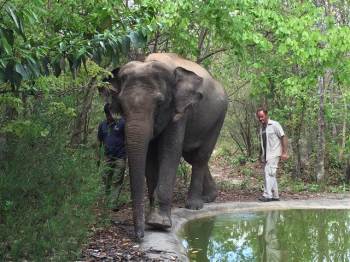
Lucky with Nick Marx, her savior.

She was found abandoned at 6 months old after her mother was killed by poachers. Now, at 15 years old, she is one of the most popular animals out of 1,200 other rescued animals at Phnom Tamao Wildlife Rescue Center in Cambodia.

Her name is Lucky. She is an Asian elephant who has been battling a series of illnesses, which started with a fatal elephant virus.

Earlier this year, Lucky stopped eating and had to be fed and medicated through an intravenous drip into veins in her ear. Nick Marx, wildlife rescue director and his team battled for weeks to keep the plucky pachyderm alive. The $40,000 cost of her treatment quickly drained the resources of the rescue center as well as Marx’s savings.

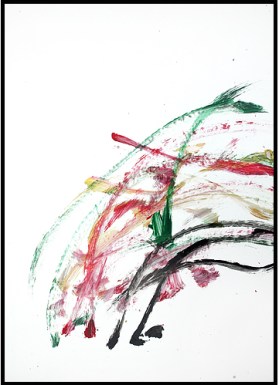
To raise money for Lucky’s treatment, she was taught to paint on canvases as well as T-shirts. Using a rewards-based system by doling out her favorite fruit treats as a means of reinforcement, she quickly caught on. The paintings and T-shirts were auctioned off at the Rescue Center.

Lucky's Painting

Lucky’s Auctioned Artwork

Word quickly spread about Lucky’s paintings. The New York based Wildlife Alliance, which supports the center, raised more than $1,100 by auctioning just two of her paintings. As far as anybody knows, this is a record for original works by an elephant.

It was just this past month that Lucky showed the first signs of recovery: Flapping her ears, showering herself and feasting on the grass.

Thanks to Lucky’s handlers clever auction idea and the funds raised from sales, Lucky is on her way to a full recovery.

As for Lucky’s paintings, she is fast becoming a prominent pachyderm painter.

Shine On