Live Your Dream

“By three methods we may learn wisdom:
First, by reflection, which is noblest;
Second, by imitation, which is easiest; and
Third by experience, which is the bitterest.”
Confucius

Lessons of LifeThis is your life.

Do what you love,
and do it often.
If you don’t like something,
change it.

Stop over analyzing,
life is simple.
All emotions are beautiful.

When you eat, appreciate every last bite.

If you don’t have enough time, stop watching TV.
If you are looking for the love of your life, stop;
they will be waiting for you when you start doing things you love.

Open your mind, arms, and heart to new things and people, we are united in our differences.

Ask the next person you see what their passion is, and share
your inspiring dream with them.

Travel often; Getting lost will help you find yourself.

Some opportunities only come once, seize them.
Life is about the people you meet, and the things you create with them,
so go out and start creating.

Life is short. Wear your passion and live your dream.

Shine On

In Harmony with Animals

“I think of my life’s work as a celebration of all of nature,
an orchestra that plays not the sounds of one musician,
the music of one species, but rather
an expression of all of nature’s songs”.
Gregory Colbert

Gregory-Colbert

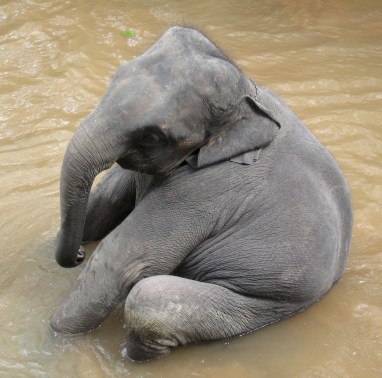
Elephant with woman by photographer Gregory Colbert.

The other day I read, Larger Than Life, by Jodi Picoult. It’s a wonderfully written novella about a young woman researcher studying the memory in elephants. It’s the first time reading one of her books, but the story made such an impact on me, I will surely read other books by Ms Picoult.

I’ve always been intrigued and in awe by elephants. It saddens me to hear in the news about poaching in Botswana and other African countries. The thought of elephants becoming extinct frightens me. Hopefully, with the help of numerous writers, celebrities as well as photographers raising awareness of the terrible threat to these noble prehistoric pachyderms extinction will not happen.

There is one man, a not so famous celebrity by the name of Gregory Colbert who is making a difference in saving the elephant. He is a Canadian photographer/film maker who created Ashes and Snow, an ongoing traveling exhibition of photographs and films focusing on the exquisite interaction of humans and animals. Better known as the nomadic museum, these images and films are displayed in purposely built temporary structures that travel the world.

Mr. Colbert started this exhibit in 1992 in hopes of exploring the relationship between man and animals from the inside out. Ashes and Snow has been viewed by more than ten million visitors to date, making it the most attended exhibition by any living artist in history.

He is fast become my favorite photographer. Not only for his heart warming images, but for his beliefs. He has discovered the shared language and poetic sensibilities of all animals, and is working towards restoring the common ground that once existed when people lived in harmony with animals.

Shine On

Our Men of Honor

“A nation reveals itself not only by the men it produces,
but also by the men it honors, the men it remembers.”
John F. Kennedy

Lincoln Memorial

The Lincoln Memorial, Washington D.C. This nineteen-foot tall statue of Abraham Lincoln emerged from the design of Massachusetts sculptor Daniel Chester French whose attention to detail, accuracy, and composition created a masterpiece.

Today, March 3, 1865 marks the 150th anniversary of the day President Abraham Lincoln signed a law to establish a national soldiers and sailors asylum. It was signed a month before the Civil War ended and the day before his second inauguration. Its roots can be traced back to 1636, when the Pilgrims of Plymouth Colony were at war with the Pequot Indians.

The Pilgrims passed a law that stated that disabled soldiers would be supported by the colony. Later, the Continental Congress of 1776 encouraged enlistments during the Revolutionary War, providing pensions to disabled soldiers. In the early days of the Republic, individual states and communities provided direct medical and hospital care to Veterans. Then, in 1811, the federal government authorized the first domiciliary and medical facility for Veterans. Also in the 19th century, the nation’s Veterans assistance program was expanded to include benefits and pensions not only for Veterans, but for their widows and dependents.

Home for Disabled Veterans

An illustration of the Milwaukee location of the National Home for Disabled Volunteer Soldiers, from the 1885 edition of the Wisconsin Blue Book.

It wasn’t until 1873 that the National Home for Disabled Volunteer Soldiers was established. It was the first-ever government institution created specifically for honorably discharged volunteer soldiers. The first national home opened November 1, 1866, near Augusta, Maine. These national homes were often called “soldiers’ homes” or “military homes,” and only soldiers who fought for the Union Army—including U.S. Colored Troops—were eligible for admittance.

The sprawling campuses became the template for future generations of federal Veterans’ hospitals. Because of President Lincoln, today the United States has the most comprehensive system of assistance for Veterans of any nation in the world.

Thank you President Lincoln for being the first in our government to have the compassion and the forethought to look after all of our past, present and future war veterans. Our men of honor.

Shine On

Children Smashing Puddles

“I’m singing in the rain,
just singing in the rain;
What a wonderful feeling,
I’m happy again.”
Arthur Freed

Children Smashing Puddles

Rain is rare in California
The sky is rarely cloudy
Why is rain so rare in California?
Because of Climate Warming

Before the rain begins to pour
The cumulus clouds appear
Like floating pieces of cotton
Or like rounded white towers of fear

The day after rain is a beautiful sight
The mountains and hills
Are filled with tall green grass
And scattered with small orange poppies

But, the most spectacular sight
I love to see after all the rain
Are all the little children
Smashing little puddles from the rain

By: J R

P.S. Today is Dr. Seuss’s birthday. He would have been 111 years old. I dedicate this poem to my hero, Dr. Seuss.

For the last eighteen years, Dr. Seuss’s birthday has been celebrated with the annual “Read Across America Day”, an event sponsored by the National Education Association in partnership with Dr. Seuss Enterprises. Millions of students participate in one of the nation’s largest reading observance.

Thanks to Dr Seuss, millions of children around the world learned to read and love to write. You can count me as one of his faithful followers even to this day.

Shine On

Whale Spouting

“To have a huge, friendly whale willingly approach your boat
and look you straight in the eye is without doubt one of the
most extraordinary experiences on the planet.”
Mark Carwardine

Wally the Gray Whale

Wally the famous gray whale spouting in Redondo Beach.

For the past few weeks, my husband and I have been enjoying the gray whales outside our living room window. We spot them when the whales spout a large heart-shaped spray of water. Curious creature that I am, I wanted to learn more about whales spouting.

Contrary to what you may have seen in such movies as Pixar’s otherwise extremely entertaining Finding Nemo, whales don’t  spray water out of their blowholes.

Whales’ noses/blowholes, are on the top of their heads, so that they can just barely break the surface to breathe without rising too far out of the water. When inhaling, they flex a muscle which opens the blowhole and take in a big gulp of air. Then, they relax the muscle to close the blowhole, leaving them free to dive down beneath the surface of the water once more without drowning themselves.

It’s exhaling that’s the interesting part. When the whale resurfaces, they have to release the used up air back into the atmosphere just like all other mammals do. This results in a spout, but it isn’t water, at least not at first. The air inside the whale is typically quite warm from the whale’s body heat. When it’s exhaled, it meets the much cooler temperature of the air outside and immediately condenses, making it look like a spout of water. This is also often mixed with mucus —it is a nose, after all.

Every species of whale has a differently shaped blowhole. Some even have two, which results in differently shaped spouts. You can tell what species of whale by seeing their spouts. For instance, a humpback whale’s spout looks like a column; orcas’ spouts are somewhat more bushy; and gray whales’ two blowholes are positioned in such a way that their exhalation results in something of a heart-shaped spout.

Now when I go whale watching next Saturday with my son, just like an experienced whale watcher, we’ll be able to tell which whales are which by their whale spouting.

Shine On