The American Overachiever

“Tell me and I forget.
Teach me and I remember.
Involve me and I learn.”
Benjamin Franklin
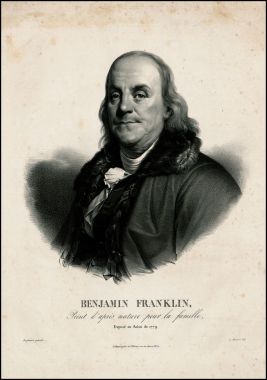
American Overachiever

He’s one of the father’s of our country and he coined a number of terms and proverbs that are used today, including battery, conductor and electrician.

It was on this day in 1752, Benjamin Franklin flies a kite during a thunderstorm and collects a charge in a Leyden jar when the kite is struck by lightning, enabling him to demonstrate the electrical nature of lightning.

Franklin became interested in electricity in the mid-1740s, a time when much was still unknown on the topic, and spent almost a decade conducting electrical experiments.

Franklin also wrote and published Poor Richard’s Almanack, a collection of proverbs advocating hard work and honesty in order to get ahead. The almanac, which Franklin first published in 1733 under the pen name Richard Saunders, included such wisdom as: “Early to bed, early to rise, makes a man healthy, wealthy and wise.”

Whether or not Franklin followed this advice in his own life is unknown, but he came to represent the American overachiever.

Shine On

The Beginning of the End

“Every major player is working on this
technology of artificial intelligence.
As of now, it’s benign… but I would say
that the day is not far off when
artificial intelligence as applied to
cyber warfare becomes
a threat to everybody.”
Ted Bell

The Beginning of the End

Today it was announced that scientist at UC Berkeley have successfully programmed a robot to learn simple tasks through trial and error just like humans learn. This robot BRETT, (Berkeley Robot for the Elimination of Tedious Tasks) can use visual and sensory information about itself, its environment and the objects before it.

To the average person this may not seem like a big deal, but this is a major breakthrough in the area of artificial intelligence (AI). In the summer of 1956 the field of AI was just getting started. The founders of AI became the leaders in the research for decades. Many of these men predicted that a machine as intelligent as a human being would some day exist by the 1970s. Eventually it became obvious that they had grossly underestimated the difficulty of the project.

Here we are almost sixty years later and the technology these men worked on has arrived. The technology itself is fascinating but what is more interesting to me is how humans will use this information. Will AI be used for the betterment of man, or will it be the beginning of the end?

Shine On