Colored With Success

“If you want an interesting party sometime,
combine cocktails and
a fresh box of crayons for everyone.”
Robert Fulghum

Color This Success

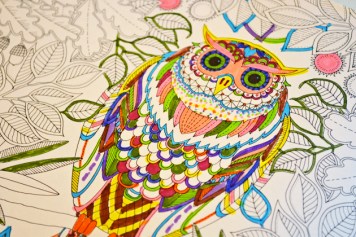
It’s good old-fashioned child’s play. Filling in the spaces with color. The newest and best relaxation method, and stress-reducer that is soaring in popularity. It’s something that most people haven’t done since elementary school — coloring.

The draw, so to speak, is in the calming effect of picking up a crayon, marker or colored pencil and filling in the white spaces.

Lately, coloring is so popular in France, coloring books are out selling cookbooks. Amazon lists over 2,200 coloring books for sale. In fact, producers of coloring books for adults can’t seem to print them fast enough. One of the top ten best sellers on Amazon listed is Johanna Basford’s “Secret Garden” series.

What a great way to relax, be creative and engage in activity that allows you to free your mind from the stresses of the day. Call this new fad anything you want, but I’d say this new stress buster is colored with success.

Shine On

Aquaponic Farm

“I believe someday great chefs will be known not only by the
recipes and methods they cook their food with, but by the
recipes and methods they grow their food with.”
Adam Navidi

Aquaponic Farming

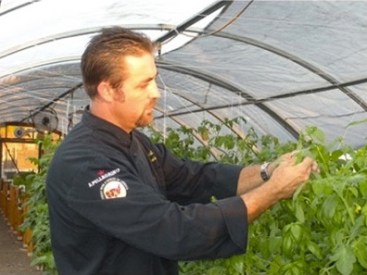
Chef Adam Navidi, at his Future Foods Farm

Unless you live under a rock, you undoubtedly have heard about the drought situation in California. All of us in California are working to curb our water use. But, there’s one man in Southern California doing his part to save water.

Adam Navidi’s daily ritual involves harvesting fresh greens and other vegetables from his future farm. But it’s how he grows them that’s far from routine.

Adam has figured out a way to produce organic fruits and vegetables in the middle of a severe drought. He owns and operates Future Foods Farms in Brea, California. His farm is an aquaponic farm, which means the tomatoes, kale, microgreens and even edible flowers don’t grow in soil. Instead, the roots sit in water, and the plants are held up by a raft made of recycled Styrofoam shipping containers.

Inside each of the 10 greenhouses on the farm are small pools containing tilapia. The fish produce nutrients that feed the plants organically. The plants absorb those nutrients and also filter the water that goes back into the fish tanks.

There are huge benefits to aquaponic farming. Aquaponic plants grow two to three times faster as they do in soil and use a reduced amount of water. In fact, he produces one head of lettuce with one gallon of water versus conventional farming, or growing in the soil, which takes 10 to 15 gallons of water to produce a head of lettuce. Aquaponic farming also takes up less space and there is less evaporation. He has lettuce growing vertically in one greenhouse.

His water bill for the nursery that used to sit where his farm is now averaged about $1,200 to $1,600 a month. His current water bill ranges from $140 to $160 per month.

Mr. Navidi not only sells to local restaurants through local farmer’s markets, he also serves fresh greens daily at his own restaurant called Oceans and Earth in Yorba Linda.

Future Food Farms has opened the farm up to local colleges for research. He also hosts tours and tastings for people interested in learning how to start their own home aquaponic farm.

Shine On

The Hubble Telescope

“I’m such a long-term investor,
I’ve never really let go and celebrated
what I did with the Hubble telescope.”
Story Musgrave

Hubble Image

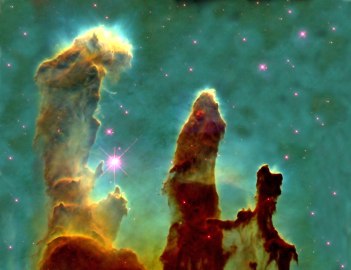
Hubble image of the Pillars of Creation.

The Hubble Space Telescope turns 25 today. When it was launched in 1990, the department I worked with at the Jet Propulsion Laboratory, was responsible for the designing and overseeing the building of the camera for Hubble: The camera was the Wide Field and Planetary Camera (WF/PC).

Unfortunately, within weeks after the launch of the telescope, the returned images indicated a serious problem with the optical system. The cause of the problem was that the primary mirror had been ground to the wrong shape. Although my department was not responsible for this miscalculation, we were all devastated by this error.

My boss was chosen to be part of the task force, The Allen Commission, to locate and correct the problem with Hubble. After several meetings, my boss and I had been discussing over lunch some of the details from the commission meetings. He often would run things by me, because I’m the “think outside the box” type of person. I kiddingly suggested that Hubble needed contact lenses to correct the problem. When I mentioned this to him, his eyes lit up and I could literally see the lightbulb go off above his head. He told me I was a genius, but I didn’t quite understand what I had said.

A few years later, after sharp beautiful images of the solar system were published, my boss sent me some of the images to thank me for helping him solve the Hubble problem.

The Hubble Telescope and its images have helped change our understanding of the age of the universe, the evolution of galaxies and the expansion of space itself. I’m pretty sure, if I had never mentioned to my boss about how to fix Hubble, that someone else would have eventually come up with the same idea. However, I like to think that because of my, Forrest Gump moment, I may have played a small part in the repair of the Hubble telescope.

Shine On

Whale Spouting

“To have a huge, friendly whale willingly approach your boat
and look you straight in the eye is without doubt one of the
most extraordinary experiences on the planet.”
Mark Carwardine

Wally the Gray Whale

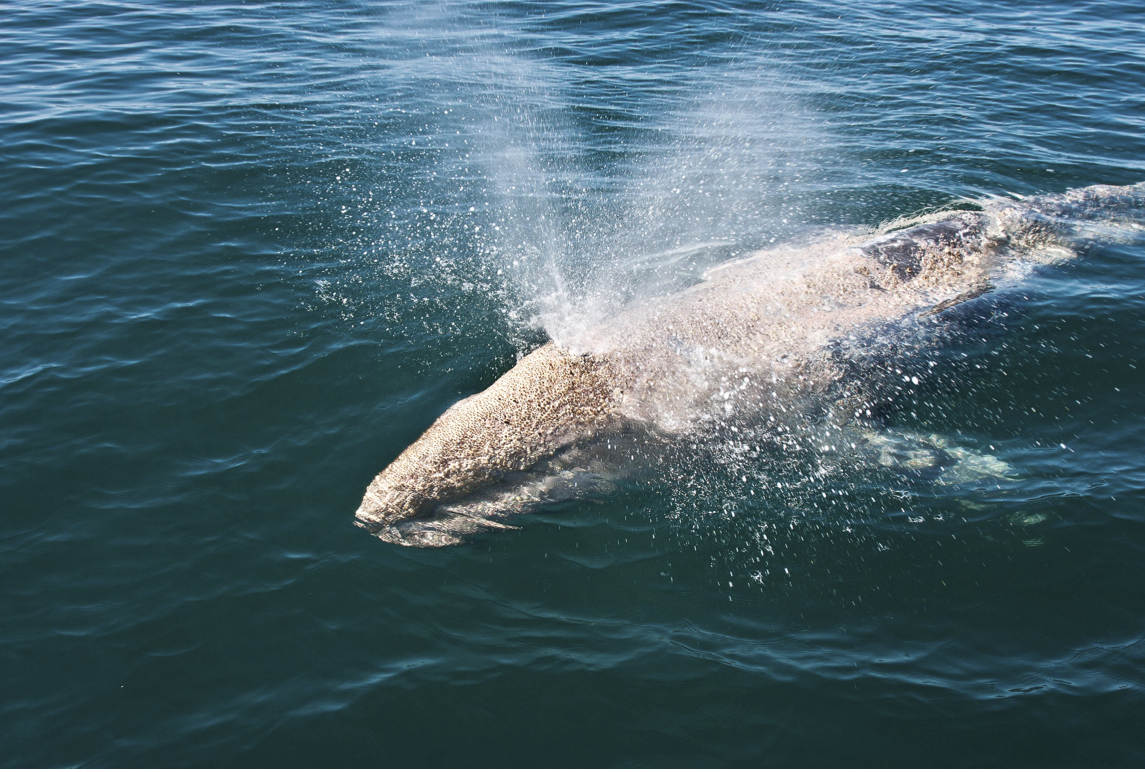
Wally the famous gray whale spouting in Redondo Beach.

For the past few weeks, my husband and I have been enjoying the gray whales outside our living room window. We spot them when the whales spout a large heart-shaped spray of water. Curious creature that I am, I wanted to learn more about whales spouting.

Contrary to what you may have seen in such movies as Pixar’s otherwise extremely entertaining Finding Nemo, whales don’t  spray water out of their blowholes.

Whales’ noses/blowholes, are on the top of their heads, so that they can just barely break the surface to breathe without rising too far out of the water. When inhaling, they flex a muscle which opens the blowhole and take in a big gulp of air. Then, they relax the muscle to close the blowhole, leaving them free to dive down beneath the surface of the water once more without drowning themselves.

It’s exhaling that’s the interesting part. When the whale resurfaces, they have to release the used up air back into the atmosphere just like all other mammals do. This results in a spout, but it isn’t water, at least not at first. The air inside the whale is typically quite warm from the whale’s body heat. When it’s exhaled, it meets the much cooler temperature of the air outside and immediately condenses, making it look like a spout of water. This is also often mixed with mucus —it is a nose, after all.

Every species of whale has a differently shaped blowhole. Some even have two, which results in differently shaped spouts. You can tell what species of whale by seeing their spouts. For instance, a humpback whale’s spout looks like a column; orcas’ spouts are somewhat more bushy; and gray whales’ two blowholes are positioned in such a way that their exhalation results in something of a heart-shaped spout.

Now when I go whale watching next Saturday with my son, just like an experienced whale watcher, we’ll be able to tell which whales are which by their whale spouting.

Shine On

The Great Desmond Morris

“We may prefer to think of ourselves as fallen angels,
but in reality we are rising apes.”
Desmond Morris
The Naked ApeToday I just started reading The Naked Ape by Desmond Morris. As usual, I wanted to know more about Desmond Morris, so I Googled Mr. Morris and found out he is still alive at age 87. Amazingly, he wrote his first book, The Naked Ape in four short weeks in November 1966.

He was born Desmond John Morris on January 24, 1928 in Purton, Wilshire, England. His father, Harry Morris was a children’s fiction author. When Desmond was 14, his father was killed while serving in the armed forces. Ever since then, as noted from a 2008 interview, “It was the beginning of a life-long hatred of the establishment. The church, the government and the military were all on my hate list and have remained there ever since.”  He said in another interview, that “my reasoning behind drifting towards the surrealist subculture is rather profound. In a time living as a child in the Second World War and then losing my father to the repercussions of that violence, an inner urge for rebellion against authority struck me.”

Desmond grew up around all species of animals. In his twenties he developed a passion in both natural history and writing and his interest continued throughout his adult life. He was not only a zoologist, ethologist and a writer but he was also an established artist. He had major art exhibits throughout the world up until 1999.

As a result of his research study into the drawing abilities of apes, in 1957 he organized a chimpanzee paintings and drawings exhibition at the Institute of Contemporary Arts, London. In the spring of 1967 he resigned from his post of Curator held at London Zoo, and became executive director of the London Institute of Contemporary Arts for only a year, until 1968 with the release of The Naked Ape, sending Morris on an absence from the arts world of over twenty years, while his sociobiology career took the front seat.

In the 1950s up until the 1990s Desmond Morris wrote and directed television shows and movies. He’s still writing and publishing books and has published 84 books. Recently, in 2014 he published two books. One called Leopard and the second called Headworks, which is a volume of his collected poems from 1945 to 2014.

Desmond Morris’ art and writing continues to push the limits of mans curiosity about himself and other species on this planet. In his 2013 book The Artistic Ape; Three Million Years of Art, he sets out to answer why it is that the human species has been so intensely creative for thousands of years. This is another Desmond Morris book I plan to add to my 2015 reading list.

Here’s a recent comment from an interview with Desmond Morris about his book The Artistic Ape; Three Million Years of Art:

“Art is something that all humans feel compelled to pursue in one form or another. A culture without art is a dying culture. But art is everywhere and we have had too narrow a definition of it in the past. When I was writing a book about football, many years ago, I noticed that even the scruffiest of football hooligans would talk excitedly about “a beautiful goal”. They didn’t say ‘an efficient goal’, they were judging the goal aesthetically – although they would have laughed at me if I had told them they were making an aesthetic judgement – but that is precisely what they were doing. Every time a man buys a necktie he makes an aesthetic judgement. Every time he chooses a new car, he does the same. Our whole world is governed by aesthetic judgements, only we don’t see it that way – we say art is in a gallery or a museum, but the truth is that it influences us in many ways every day of our lives.”

To learn more about Desmond Morris and find information about his recent books, go to his website at:

The Great Desmond Morris.

Shine On