Garnerin’s Grand Parachute

“A person often meets his destiny on the road he took to avoid it.”
Jean de La Fontaine
Garnerin's Grand Parachute

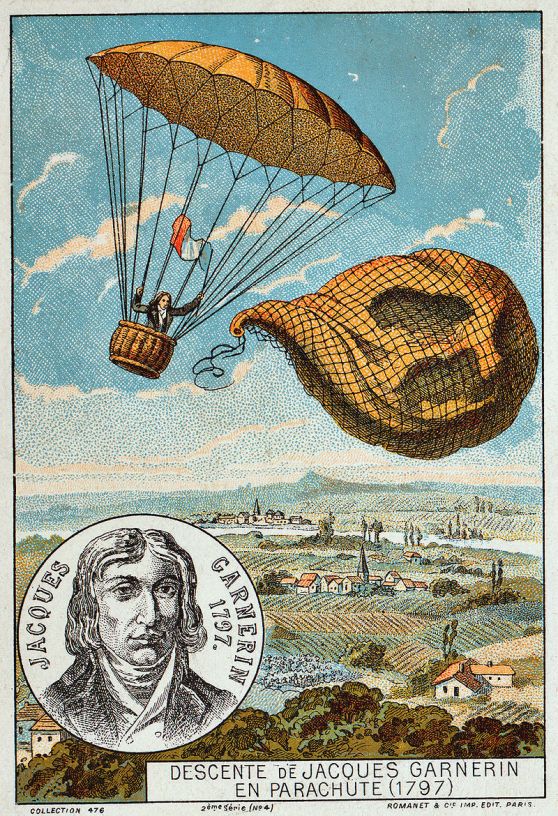
Today marks the day in 1797, when 28 year old french balloonist Andre-Jacques Garnerin made the first parachute descent, landing safely from a height of about 3,000 feet over Paris.

Garnerin’s parachute resembled a closed umbrella before he ascended, with a pole running down its center and a rope running through a tube in the pole, which connected it to his balloon. As he rode in a basket attached to the bottom of the parachute, he severed the rope that connected his parachute to the balloon. Then the balloon continued skyward while Garnerin with his basket and parachute fell. It was reported that the basket swung violently during descent, then bumped and scraped when it landed, but Garnerin was uninjured.

Garnerin regularly staged tests and demonstrations in Paris, but these became a controversial issue when he announced that his next flight would include a woman as a passenger. Although the public and press were in favor, he was forced to appear in front of officials of the Central Bureau of Police to justify his project. Officials were concerned about the effect that reduced air pressure might have on the organs of the delicate female body and loss of consciousness, plus the moral implications of flying in such close proximity.

Unsatisfied with Garnerin’s responses, the police issued an injunction against him, forbidding the ascent on the grounds that the young woman was committing herself to the venture without any idea of the possible outcome.

Garnerin had the injunction overturned after consultation with both the Minister of the Interior and the Minister of the Police. Officials agreed that there was no more scandal in seeing two people of different sexes ascend in a balloon than it is to see them jump into a carriage.

Unfortunately, Garnerin died in a construction accident when he was hit by a wooden beam while making a balloon in Paris on August 18,1823.

It may not sound like much today, but 217 years ago parachuting was quite a feat. A large number of spectators would come from all over Europe to watch Garnerin parachute from his balloon. It even prompted the English to write this famous popular ballad:

Bold Garnerin went up
Which increased his Repute
And came safe to earth
In Garnerin’s Grand Parachute

Shine On
Back To The Present

“Now, if my calculations are correct,
when this baby hits 88 miles an hour,
you’re going to see some serious shit!”
Dr. Emmett Brown

Back to The Future Day

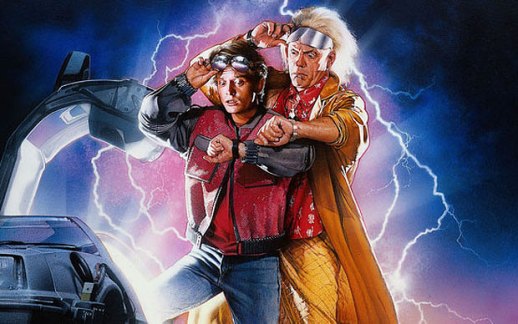
One of the best movie series of all time is Back To The Future. My two favorites are the first and third of the series. Some of you diehard BTTF fans may recall in the second of the series Marty and Doc travel to October 21, 2015.

Today, almost thirty years after the second movie was made, we are wondering, how much of the future did Robert Zemeckis get right?

In some cases, Zemeckis’ 2015 isn’t too far from reality. For example, we don’t have hoverboads yet, but Japanese car company Lexus recently unveiled a prototype for a real, rideable hoverboard. A company called Arx Pax in California is also working on its own version. Unfortunately they both rely on magnets, so are unlikely to be able to fly over water like Marty’s.

How about wearable technology? Marty’s future kids wear headsets at the dinner table to make and receive calls and watch TV. With the introduction of Google Glass in 2013, and gaming headsets like Oculus Rift in the works, virtual reality is not far off, and Microsoft’s recently announced Hololens more than a passing resemblance to Junior’s goggles.

How about video calls?  Marty’s video call with his co-worker Needles seemed like a futuristic dream, but with FaceTime and Skype now staples, the video call has evolved from a business medium to an essential of everyday life.

What about hands-free gaming? While we don’t see it in the film, kids at Cafe 80s mock Marty for having to use his hands to play an arcade game, implying that Xbox Kinect-style gaming is the norm in their 2015. And guess what, it is.

How about the iPad or tablet computers?  When Doc meets Marty by the clock tower, he is brandishing what looks like an iPad-style tablet computer. Today, tablets are commonplace with 233 million units expected to be sold in 2015.

What about fingerprint recognition? Most of us don’t use it to get into our house, but fingerprint recognition is now a major part of many people’s lives, being used on several smartphones to unlock them or pay for items.

Then there was the famous self-tying shoes. Marty’s self-tying trainers were one of the weirder inventions features in Back to the Future II. Nike designer Tinker Hatfield has confirmed he and his team are working on a consumer version of the shoes, complete with self-tying laces, and hopes to have them ready for sale by the end of 2015.

Sure, there were a few things that Zemeckis got wrong. Such as flying cars and power clothing but I must admit, Zemeckis not only made a great film but showed us what the future had in store for us. Bringing us back to the present.

Shine On

Ruff Competition

“I’ve always said money may buy you a fine dog,
but only love can make it wag its tail.”
Kinky Friedman

Ruff Competition

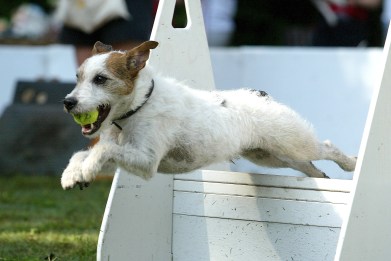
Every year hundreds of canines and their human companions travel to Indianapolis, Indiana to compete in the North American Flyball Championship.

What is flyball you ask? It’s the canine equivalent to the horse steeplechase event. The North American Flyball Association, Inc. (NAFA) was established in 1984, when 12 flyball clubs in Michigan and Ontario banded together to guide the development of flyball in North America.

Flyball got its start in the late 1960s and early 1970s, when a group of dog trainers in Southern California created scent discrimination hurdle racing, then put a guy at the end to throw tennis balls to the dogs when they finished the jump line. It didn’t take long for the group to decide to build some sort of tennis ball-launching apparatus, and the first flyball box was born.

Herbert Wagner is credited with developing the first flyball box, and apparently he did a flyball demo on the Tonight Show with Johnny Carson that got a lot of people’s attention. Subsequently, the new dog sport for dog enthusiasts was introduced in the Toronto-Detroit area by several dog training clubs. After a few small tournaments were held in conjunction with dog shows, the first ever flyball tournament was held in 1983.

Today, there are over 400 active clubs and 6,500 competing dogs, NAFA, a nonprofit organization is recognized as the world’s leading authority on flyball and the sport’s top sanctioning organization.

If you want to see the dogs in action, here’s a short documentary about the sport and the ruff competition.

Shine On