“Science is more than a body of knowledge
It’s a way of thinking and a way
Of skeptically interrogating the Universe.”
Carl Sagan
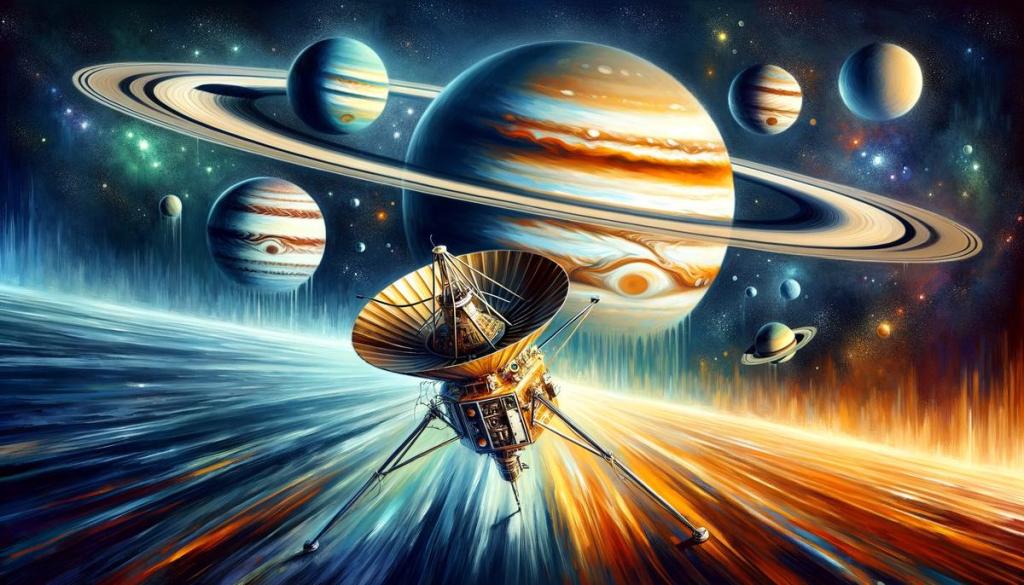
The Voyager 1 spacecraft, traveling for almost 50 years, crossed a mile marker reached by no other human made object. It’s now one light-day away from Earth. That’s the distance a particle of light can travel in 24 hours, equaling about 16 billion miles, a point that Voyager 1 reached on Wednesday, November 18, 2026,
Voyagers 1 and 2, launched by NASA in August and September 1977, have logged billions of miles, executing flybys of the giant planets Jupiter, Saturn, Uranus and Neptune. The two unmanned craft have relayed a staggering amount of data on each of the planetary systems, in the process discovering such phenomena as new moons, rings and the first active volcano in space.
The Voyager mission is managed by JPL in Pasadena, California for NASA. The spacecraft was originally conceived because of rare alignment of the planets that only occurs approximately every 170 years. The alignment would allow a single spacecraft to visit each of the four giant gaseous planets, using the gravity of each in slingshot-like effect to propel the spacecraft on to the next planet.
The Voyagers’ initially were scheduled only to fly by Jupiter and Saturn, but the mission’s success prompted NASA to extend it with flybys of Uranus and Neptune.
Voyager 2 was launched August 20, 1977, followed by Voyager 1 on September 5 of that year. Because of its trajectory, Voyager 1 overtook its twin and arrived first at Jupiter on March 5, 1979. Voyager 1 flew by Saturn on November 12, 1980; its flight path at that planet then took it up and away from the ecliptic, the plane in which most of the planets orbit the Sun.
Voyager 2 encountered Jupiter on July 9, 1979, followed by a Saturn flyby August 25, 1981. Voyager 2 then continued on to flyby Uranus on January 24, 1986 and then encountered Neptune on August 24, 1986.
Highlights of the mission at Jupiter include discovery of active volcanoes on Jupiter’s moon Io; detailed photos of Jupiter’s atmosphere, including the Great Red Spot, and the surfaces of the planet’s four major moons; discovery of three new, smaller moons; detection of lightning bolts in Jupiter’s upper atmosphere; and discovery of faint, narrow ring system encircling the planet.
At Saturn, the Voyagers revealed high-resolution details of the planet’s celebrated rings, including ring spokes and braiding features; discovered six new moons; and relayed photos of Saturn’s larger moons.
I worked at JPL during all four planetary encounters. I was fortunate to befriend and work with the most innovative and brilliant people at JPL. Our department, The Observational Systems Division (OSD) focused on designing, assembling, testing, and operating observational flight instruments and remote sensing systems for Earth and space exploration. OSD also supported optical sciences and instrument hardware development, including work on the Wide Field and Planetary Camera 2 (WFPC2) for the Hubble Space Telescope. If that wasn’t exciting enough, OSD received all the digital images from Voyager and then released print copies to the World,
JPL during the 1970’s to the 1990’s was an exhilarating place to work. During the week of the planetary encounters, there were reporters from all over the World using our departments conference room to write up their news stories. We had lots of famous visitors from movie and tv celebrities, to World leaders and royalty. Visitors such as famous science fiction writer Ray Bradbury showed up at JPL during every encounter.
One celebrity that had his own department at JPL was Carl Sagan. He became a household name thanks to his PBS Cosmos: Personal Voyage weekly series and appearances on the Tonight Show.
Sagan had served on the Voyager imaging team since its inception, and had been lobbying for a family portrait of the solar system for years. However, turning the cameras back toward the inner solar system posed significant technical and operational risks. Pointing sensitive optical equipment anywhere near the blazing glare of the Sun threatened to fry the vidicon camera tubes, permanently blinding the spacecraft. Furthermore, mission planners argued that photographing tiny, distant planets yielded no new scientific data about planetary geology or atmospheric dynamics. To them, it was an emotional vanity project. A waste of dwindling spacecraft lifespan and telemetry bandwidth.
Yet Sagan persisted, backed by colleagues who understood that science is not merely about accumulating data, but about transforming human consciousness. When NASA in 1990 ultimately relented and commanded Voyager 1 to swivel its camera backward across billions of miles, they unlocked an entirely new dimension of space exploration. They proved that space missions are not just technological feats of engineering, but philosophical milestones that redefine humanity’s place in the universe.
I have lots of fond memories as well as beautiful original prints from Voyagers planetary encounters. My decades of working at JPL was a wonderful experience not just because it was an exciting place to work but because we also were making history.
Shine On

