Free Speech

“I can feel in myself, and see
In others around me, a powerful
Nostalgia for the time
When history existed.”
Francis Fukuyama

Bust of President Zachary Taylor covered in plastic after blood was smeared on it when a Trump mob broke into the Capitol Building on January 6, 2021


We’ve created a world where everybody can talk, but only a select few people are actually heard. Anybody can start a newsletter or get on social media, but only a few people are ever actually seen and heard.

Francis Fukuyama writes about in his new book, In the Realm of the Last Man: A Memoir, that while free speech is certainly important, the issue facing us today is about amplification.

More than a conventional memoir, In the Realm of the Last Man is a personal history as well as a political history. Returning to and developing the concepts that have been central to his work, recognition, thymos, trust, identity, human nature, institutions, and he illuminates the crises of the twenty-first century. In the Realm is the story of a life that illuminates the troubled fate of democracy and liberalism over the last fifty years.

In our current fragile democracy, who gets to be heard? How is the President of the United States allowed to use taxpayer dollars for his political propaganda? How is the President of the United States allowed to stymie freedom of speech?

Another important terrifying tell is, why did Elon Musk buy Twitter? Because it bought him a megaphone. Musk was already the richest man in the world, and yet he had to sit by the phone and wait for the BBC or CNN to call him. Billions of dollars couldn’t get him an audience, but his own social media could. And so, he bought social media.

As long as humans have been alive, some people have been heard more than others. At first, this meant the loudest or the most charismatic voices were heard. But then came the gatekeepers. First, publishers decided who could write a book or get in a newspaper. Then came radio, then TV, and now the internet.

Today, Meta and Google control the vast amount of what anybody hears or sees. Everybody can speak. But who gets heard is decided by a few companies changing algorithms and rules.

And so, we hear from the influencers and celebrities who know how to make a viral reel. We hear only about those topics that get shared or liked, or don’t violate a company’s terms of service.

Here and now, our conversations get narrowed, and the speakers are muted or amplified, depending on what a few gatekeepers actually want us to see and hear, while calling it free speech.

Shine On

Eternal Flow of Modes


“Minds are won through love and nobility rather than force
Happiness is virtue itself rather than its reward
Hope and fear are intertwined, and
Excellent things are both rare and difficult”
Baruch Espinosa


Reading has been part of my daily life as far back as I can remember. Tracking what I read began in 2015 when I discovered Good Reads. This online database website that allows you to track what you’ve read, what you’d like to read and also review the books you’ve read.

Each year I set a goal to read a number of books. It’s a lofty goal but surprisingly because of Good Reads, I’m able to reach my goal.

I read a diverse subject matter of books because of my wide variety of interests and unbridled curiosity. I’m always nosing into something new I find exciting. Recently, because of all the terrible and horrific news on tv, I’m reading more than watching tv. I tape all my news shows and movies so I can watch them commercial free at my leisure. This has allowed me to spend more time reading and also writing my current work of fiction.

One area I have not read a lot about is Philosophy. One man in particular has caught my attention, Baruch Espinosa. He was born in 1632 and died in 1677 and was of Portuguese-Jewish origin and lived in the Dutch Republic. Espinosa’s philosophy addressed a multitude of areas such as philosophical discourse, metaphysics, epistemology, political philosophy, ethics, philosophy of mind, and philosophy of science.

In one of his writings he wrote about: “What if death is not the end? It might not be the end that you want, but what if death is not the end of your story?” According to Espinosa’s monism, there might be more to your postmortem existence than you might think.

Espinosa argued that the entire universe is just one substance. He wrote how what if your body and all of your thoughts are part of this substance. How everything is part of an eternal, infinite substance. But everything that we interact with, all of the objects and all of the people that we meet are simply modes. Modes are temporary configurations of the underlying reality.

What if, you are just a particular configuration at this moment in time? Eventually, you will move on to a different mode, because we are just waves in an ocean, briefly visible above the whole. And one day, our waves will fade back again into the sea.

Likewise, you are just a fleeting moment of the infinite. You are a temporary manifestation of the one substance. Eventually, your mind and your body will disintegrate and you will rejoin the great ocean. But your substance will not vanish; it will just transform.

Espinosa invites us to see the world from the perspective of eternity, and from this view, the distinctions we make between others and ourselves, between life and death, are just illusions born of our limited perspective. And so you are not just a human. You are the universe momentarily expressed as you.

Mind blowing thoughts from a man’s theory that one day, you will rejoin the infinite substance — not as a loss, but as part of a vast ocean of the eternal flow of modes.

Shine On

More Mudită


“Happiness is letting go of what you think
your life is supposed to look like and
celebrating it for everything that it is.”
Mandy Hall


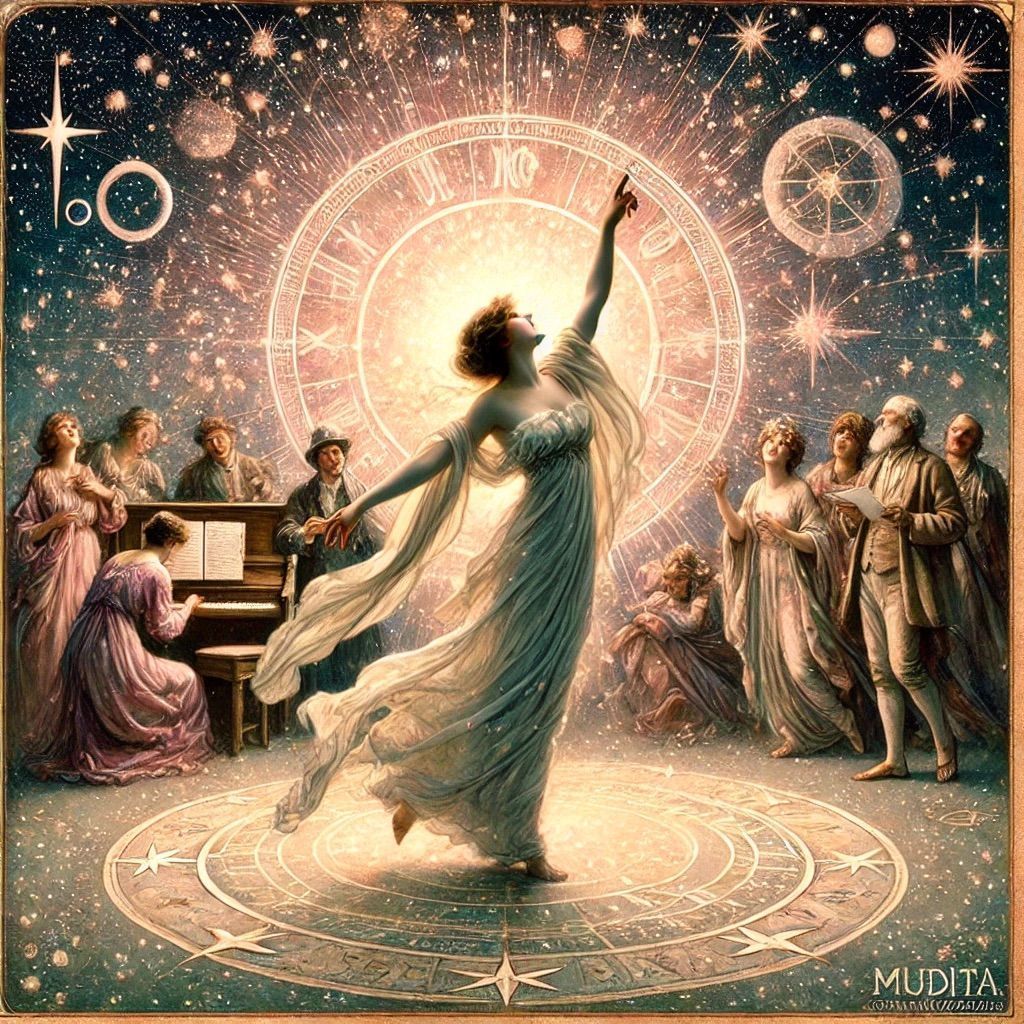
In Buddhist philosophy, there are four key states of mind that anybody needs to occupy to be happy and to reach enlightenment, and of these four mudită is generally considered to be the hardest, but also the most important.

To show joy is to celebrate happiness and achievement in others even when we are facing tragedy ourselves. Mudită is when you bask in the reflected joy of somebody else’s happiness. It’s the parent who smiles when they hear their children laughing in the next room. It’s when you jump with joy at a friends promotion. It’s when you smile and are grateful when your friend tells you that they are cancer free.

Mudită is a kind of joyous empathy that delights in the vicarious happiness of another person.

Buddhism says that we should bring more mudită to our interactions with all other people — in fact, all living things more broadly. And the philosopher Buddhaghosa laid out a method to do so.

Buddhaghosa says that we shouldn’t start with somebody that we love, because that is too easy. Nor should we start with somebody that we resent, because that is too hard. Instead, find somebody who is cheerful. Find the person who is a half full, optimistic kind of sort, and be around them a lot more. Let their cheerfulness wash over you, because it is contagious. Let their easy laugh and happy gratitude in, and so too will you become that way. From here, you should find a neutral person, and then the person you resent, until finally you are finding happiness in the joy of somebody you don’t even like.

Mudită is a blessing, because it allows us to experience more joy than ever before. We can experience the joy in our own individual lives, but we can also experience everywhere and in everyone’s lives more Mudită.

Shine On