“We cling to our own point of view, as though everything depended on it. Yet our opinions have no permanence. Like autumn and winter, They gradually pass away.” Chuang Tzu
Welcome fall, my favorite season of the year. Although I’m a fan of evergreen trees, deciduous trees with their spectacular burst of color is always a welcome site.
The autumnal equinox, also called the September equinox or the fall equinox will arrive on Tuesday, September 22, 2026. Not only do temperatures drop, but plant life slows down, and so do we. The autumnalequinox is an astronomical event that marks the start of autumn or fall. In the Northern Hemisphere, the autumnal equinox occurs every September whereas in the Southern Hemisphere, it occurs every March.
During an equinox, the Suncrosses what we call the “celestial equator”, an imaginary extension of Earth’s equator line into space. The equinox occurs precisely when the Sun’s center passes through this line.
Surrounding the autumnal equinox is the relationship with the full Moon. Curiously, the full Moon that occurs nearest to the autumnal equinox is always called the HarvestMoon. Why is that?
Well, surprise, surprise the name has to do with farming. Around the fall equinox, the full Moon rises around sunset for several nights in a row, traditionally providing farmers with just enough light to finish their harvests during the arrival of the Harvest Moon.
“Every time I see an adult on a bicycle, I no longer despair for the future of the human race.” H. G. Wells
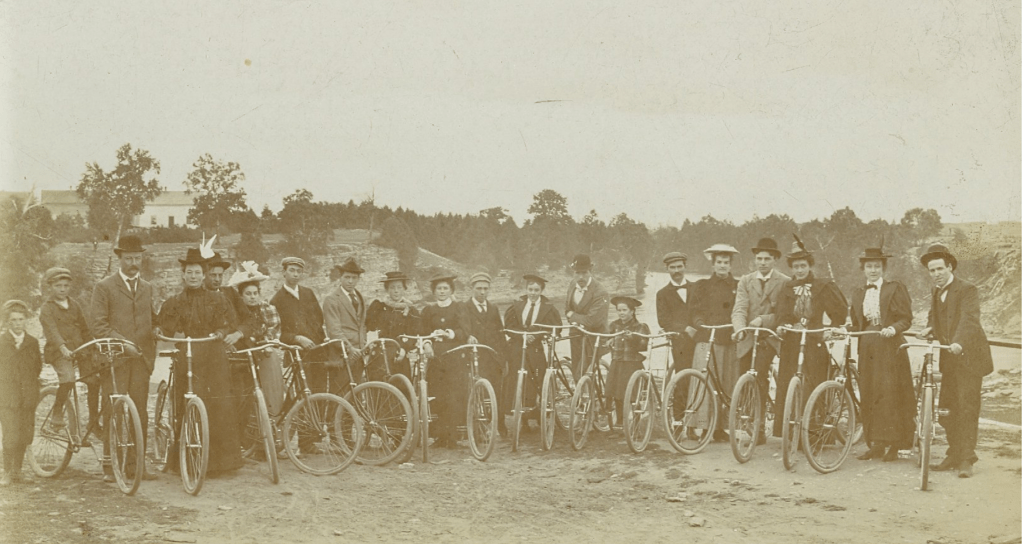
It was the early-18th century in Western Europe when man first began experimenting with human-powered vehicles. In the beginning, these vehicles consisted of four or more wheels and could accommodate up to seven passengers. Much different from carts or carriages, they had handles or ropes for men on foot to push or pull. They were attempts at replacing horses with humans.
Even back in the 1800’s, the purchase of a horse was expensive for the working man. No fit and wealthy gentleman would be without a horse for pleasure riding. They usually had horses for drawing carriages, but most affluent European men owned horses for leisure riding.
That all changed in 1815 when the world was thrown into turmoil. A turmoil not from a war or an economic crises, but because of a small island over six thousand miles from Europe in the South Pacific.
On April 10, 1815, halfway between Asia and Australia, Mount Tambora erupted in Indonesia. It was to become the largest volcanic explosion in recorded history as well as claiming the most fatalities. Mount Tambora’s eruption killed well over 71,000 of its people. This once silent volcano erupted with the power equivalent to 1,000 atomic explosions, blasting about 38 cubic miles of ash, pumice and other matter into the atmosphere.
Ashes reflected the sun’s light and cooled the earth’s surface. Temperatures dropped below freezing in July from Mexico to Vienna. Unexpected snowstorms and rainstorms brought travel to a stop. Farms and grain stores were washed away. Crops failed. Livestock died by the tens of thousands. The world was gripped by the worst famine in a century, and infectious diseases such as typhus was rampant. The year 1816 would become known as “the year without a summer”.
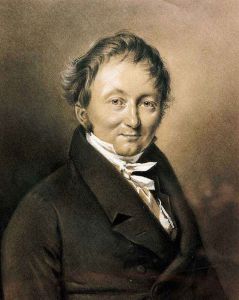
Karl Wilhelm Friedrich Christian Ludwig Drais
With all the soot and ash engulfing Europe, there was one ray of hope to this gloomy disaster. He was a 31 year-old aristocrat, an expert in forestry, an enthusiastic and passionate horseman as well as an avid inventor from Baden, Germany. His name was Karl Wilhelm Friedrich Christian Ludwig Drais, otherwise known as Baron Drais von Sauerbronn. Baron Drais’ beloved horses died from environmental causes from the volcano eruption, and set the Baron on a journey to invent the bicycle.
It’s not known what the impetus was for the Baron to think about the problems confronting the horses, and how those factors affected gentlemen who rode for pleasure. But somehow, this led him to thinking about the basic form of the horse and its accommodations for a rider in a wooden and wrought iron frame with a pair of carriage wheels in tandem. The result would be recognized by anyone today as the ancestor of all bicycles.
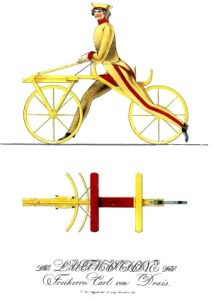
Baron Drais on his original Laufmaschine, the earliest two-wheeler, Circa 1819
Early in 1817 the Baron built out of cherry tree wood and softwood a “running machine”, which he called a Draisine or a Laufmaschine. The machine was more pony-sized than horse-sized so that the riders feet reached the ground for propulsion.
This early bicycle consisted of a saddle seat, handlebars and a steerable front wheel. Testing and improving it throughout the next few years, the Baron finished his invention and patented the running machine in January of 1818.
Almost overnight the Baron’s Laufmaschine became a sensation. News of the running machine spread westward across Europe. Enthusiasm grew among a small circle of young aristocratic men known as “dandies”. Demonstrating one’s manly abilities was key for “dandies”, and the Laufmaschine was a novelty too challenging and exciting for any dandy to pass up.
The Baron’s Laufmaschine displayed at the Kurpfälzisches Museum in Heidelberg, Germany
The Laufmaschine name was a bit foreign to British, so they renamed it the “dandy horse”. Before long, every young gentleman who aspired to the dandy ideal owned a dandy horse. A basic dandy horse in 1818 cost the equivalent of about $900 in today’s money, which made it a rather expensive plaything. The best of these were constructed by carriage builders; the more crude ones were cobbled together by blacksmiths.
Original Draisine Circa 1817 Made to Order
As quickly as it appeared, the dandy horse disappeared. By 1820, the price of oats was back down to pre-1815 levels, and horses were readily available to those who could afford them. It wouldn’t be until the mid-1860s that someone had the idea to put pedals on the front wheel of a dandy horse, giving it an improved means of locomotion, as well as a scrub brake for the rear wheel; an improvement for stopping over crashing it into a hedge.
So what happened to the Baron Drais? He had the misfortune to belong to the losing political party when the Prussians took over Baden, and he had his title and property stripped; he died penniless and forgotten two years later. But without the Baron and the aristocratic plaything he invented, life might have been very different, and certainly less colorful as the bicycles beginning.
“It is in knowledge that man has found his greatness and his happiness.” James Smithson
The Smithsonian Institution is the world’s largest museum, education, and research complex, encompassing 21 museums, 21 libraries, and the National Zoological Park. Founded on August 10, 1846, through a bequest by British scientist James Smithson, it operates as a federal trust instrumentality dedicated to the “increase and diffusion of knowledge”.
Congress authorized acceptance of the Smithson bequest on July 1, 1836, but it took another ten years of debate before the Smithsonian was founded. Once established, the Smithsonian became part of the process of developing an American national identity; an identity rooted in exploration, innovation, and a unique American style.
James Smithson, the illegitimate child of a wealthy Englishman, had traveled much during his life, but had never once set foot on American soil. Yet, he decided to give the entirety of his sizable estate, which totaled half a million dollars, or 1/66 of the United States’ entire federal budget at the time, to a country that was foreign to him.
Some speculate it was because he was denied his father’s legacy. Others argue that he was inspired by the United States’ experiment with democracy. Some attribute his philanthropy to ideals inspired by such organizations as the Royal Institution, which was dedicated to using scientific knowledge to improve human conditions. Smithson never wrote about or discussed his bequest with friends or colleagues, so we are left to speculate on the ideals and motivations of a gift that has had such significant impact on the arts, humanities, and sciences in the United States.
Smithson died in 1829, and six years later, President Andrew Jackson announced the bequest to Congress. On July 1, 1836, Congress accepted the legacy bequeathed to the nation and pledged the faith of the United States to the charitable trust. In September 1838, Smithson’s legacy, which amounted to more than 100,000 gold sovereigns, was delivered to the mint at Philadelphia. Recoined in U.S. currency, the gift amounted to more than $500,000.
Now, in the 21st century, thanks to the work of Smithson and his vision for the world 180 years later, the Smithsonian is still a beacon to shine a light on knowledge.
“If you ever plan to motor west Travel my way take the highway That is best get your kicks on Route Sixty-Six” Bobby Troup
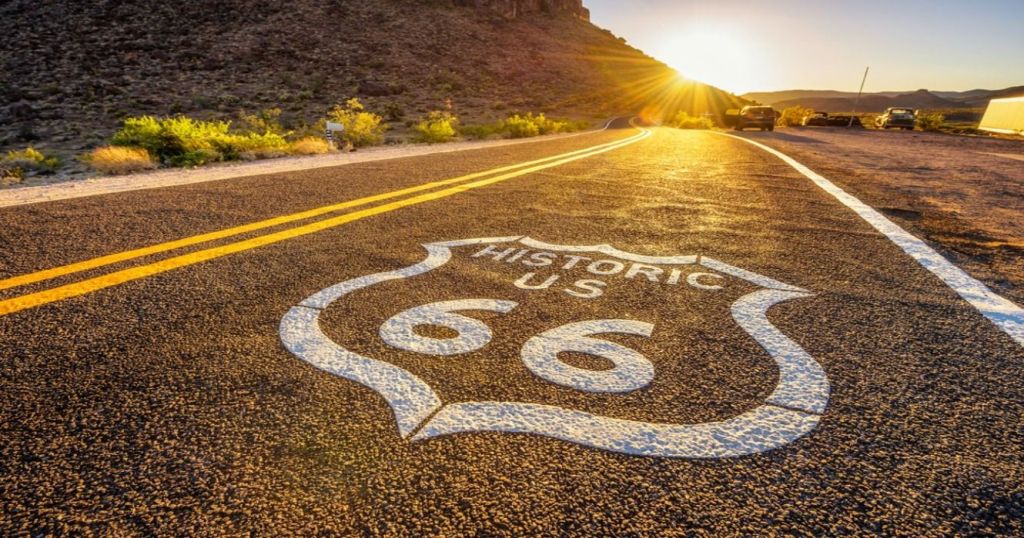
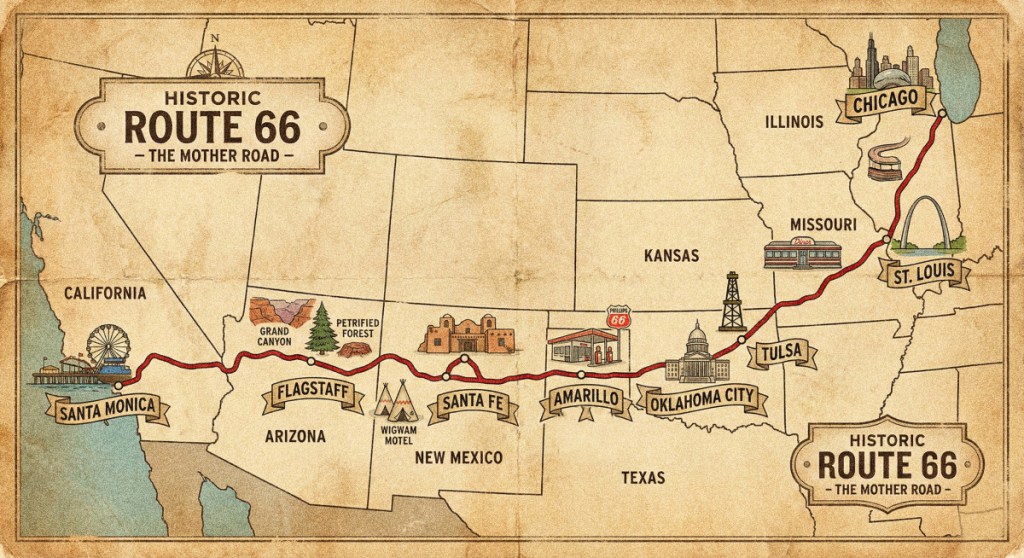
This year is the 100th Anniversary of America’s most iconic roads, Route 66. It was one of the original highways in the United States Numbered Highway System. Established on November 11, 1926, with signage erected the following year, the highway ran from Chicago, Illinois, through Missouri, Kansas, Oklahoma, Texas, New Mexico, and Arizona before terminating in Santa Monica, California, covering 2,448 miles.
US 66 became a major route for westward migration, particularly during the Dust Bowl of the 1930s, and contributed to the economic development of communities along its path. It later faced decline as traffic was diverted to the Interstate Highway System in the mid-20th century. The highway was officially removed from the United States Highway System in 1985 after being largely replaced by Interstate highways. Many segments of the former route have since been preserved as Historic Route 66, a National Scenic Byway, and incorporated into state and local road systems.
Route 66 has its roots when in 1857, Lt. Edward Fitzgerald Beale of the U.S. Army Corps of Topographical Engineers was directed by the United States Department of War to construct a wagon road along the 35th parallel. The route, later known as Beale’s Wagon Road, was intended to improve transportation across the southwestern United States and included experiments with the use of camels as pack animals. Portions of this route were later incorporated into alignments of US 66.
Before the creation of a nationwide system of numbered highways, long-distance travel in the United States relied on a network of privately marked auto trails. The route that later became US 66 incorporated segments of several of these trails, including the National Old Trails Road, parts of the Ozark Trails system, and, in the Midwest and South, portions of routes such as the Lone Star Route. These routes were often indirect and inconsistently marked, leading to calls for a standardized national highway system.
Preservation efforts in the late 20th century expanded at the national level. In 1999, President Bill Clinton signed the National Route 66 Preservation Act, which provided federal support for preserving and restoring historic features along the route. The National Park Service developed the Route 66 Corridor Preservation Program and a Discover Our Shared Heritage travel itinerary documenting historically significant locations along the route. Then in 2008, the World Monuments Fund included Route 66 on its World Monuments Watch, citing threats to historic roadside architecture from development and neglect.
The fervor for Route 66 has been widely represented in American popular culture, reflecting its historical role in travel, migration, and the development of automobile culture. The highway was popularized in music by Bobby Troup’s 1946 song “Get Your Kicks on Route 66”, first recorded by Nat King Cole, which became a standard later performed by numerous artists across many genres. The route also lent its name to the television series Route 66, which followed two young men traveling across the United States. In literature, John Steinbeck’s novel The Grapes of Wrath portrays westward migration along US 66 during the Dust Bowl, referring to it as the “Mother Road”, a phrase that became closely associated with the highway. It’s also been depicted in film, including the animated feature Cars, which portrays a fictional town bypassed by an Interstate Highway, reflecting the decline experienced by communities along the route.
Now, in the 21st century, Route 66 has continued to be recognized in popular media and public commemorations, a revival as a heritage tourism destination, attracting both domestic and international travelers. Preservation groups have worked to restore historic motels, gas stations, and neon signage associated with mid-20th-century automobile travel on the route.
I know my “Bucket List” includes a trip in my Blue Fox down the highway that is best to get my kicks on Route 66.
“Happiness is letting go of what you think your life is supposed to look like and celebrating it for everything that it is.” Mandy Hall
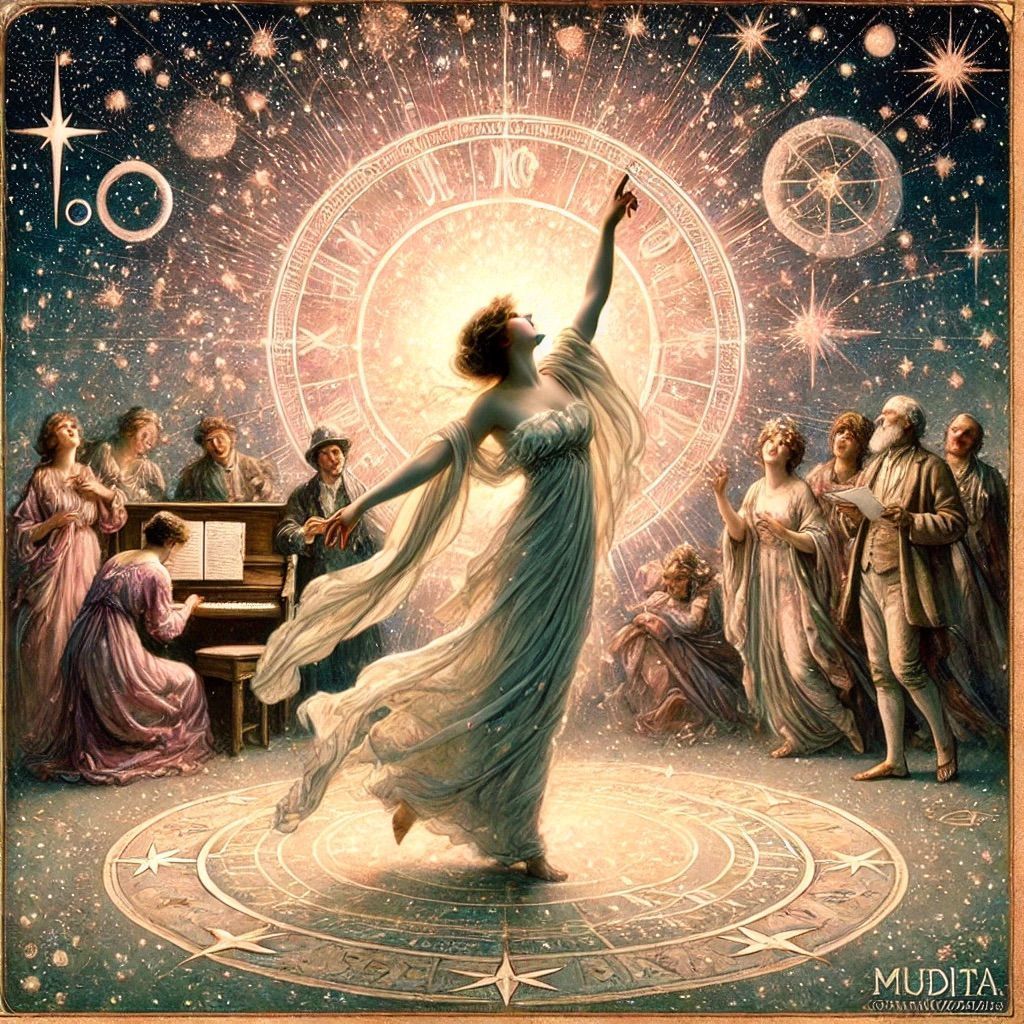
In Buddhist philosophy, there are four key states of mind that anybody needs to occupy to be happy and to reach enlightenment, and of these four mudită is generally considered to be the hardest, but also the most important.
To show joy is to celebrate happiness and achievement in others even when we are facing tragedy ourselves. Mudită is when you bask in the reflected joy of somebody else’s happiness. It’s the parent who smiles when they hear their children laughing in the next room. It’s when you jump with joy at a friends promotion. It’s when you smile and are grateful when your friend tells you that they are cancer free.
Mudită is a kind of joyous empathy that delights in the vicarious happiness of another person.
Buddhism says that we should bring more mudită to our interactions with all other people — in fact, all living things more broadly. And the philosopher Buddhaghosa laid out a method to do so.
Buddhaghosa says that we shouldn’t start with somebody that we love, because that is too easy. Nor should we start with somebody that we resent, because that is too hard. Instead, find somebody who is cheerful. Find the person who is a half full, optimistic kind of sort, and be around them a lot more. Let their cheerfulness wash over you, because it is contagious. Let their easy laugh and happy gratitude in, and so too will you become that way. From here, you should find a neutral person, and then the person you resent, until finally you are finding happiness in the joy of somebody you don’t even like.
Mudită is a blessing, because it allows us to experience more joy than ever before. We can experience the joy in our own individual lives, but we can also experience everywhere and in everyone’s lives more Mudită.