“”The truth will set you free But first it will piss you off.” Gloria Steinem
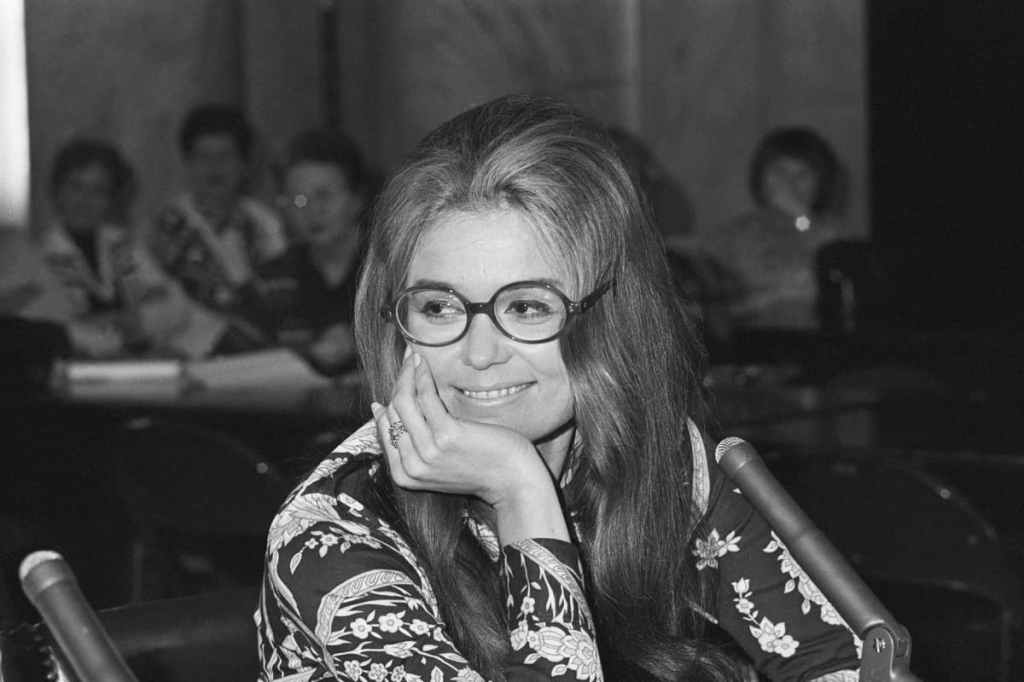
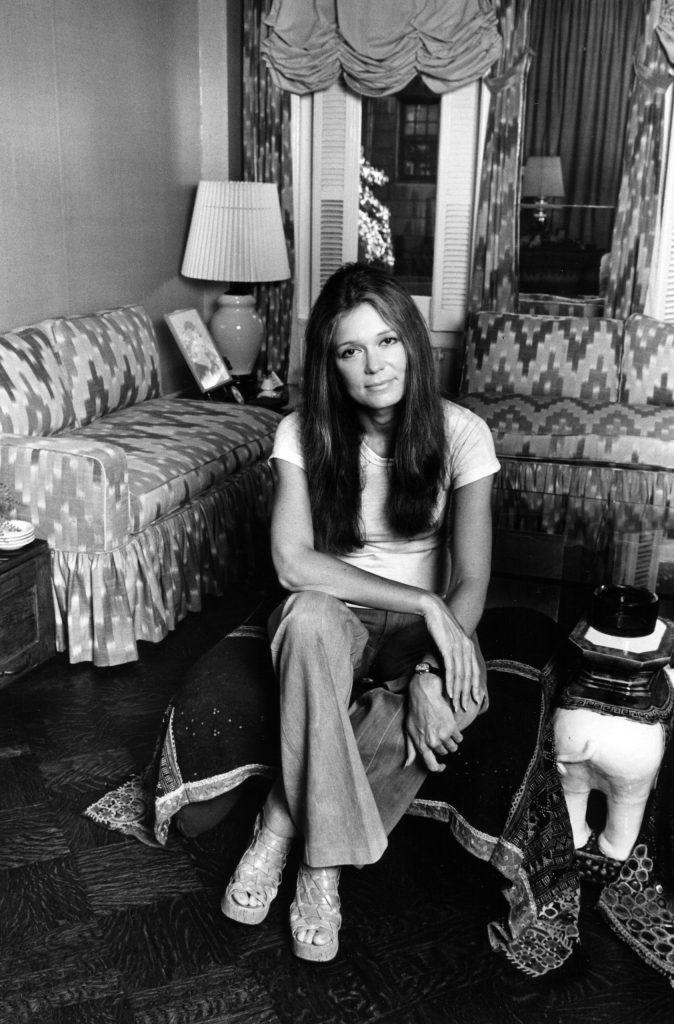
Last Wednesday, September 2, 2026 the World lost another passionate talented and intelligent woman. Gloria Steinem, the American journalist and political activist who became the face for feminism in the late 1960s and early 1970s, died at age 92.
Born on March 25, 1934, in Toledo, Ohio, Gloria Marie Steinem inherited an activist tradition. Her grandmother served as chair of the educational committee of the National Women Suffrage Association and also helped rescue members of her family, who were Jewish, from Germany during the mid-1930s.
Steinem graduated from Smith College and moved to New York in 1960, where she was often sexualized and dismissed while searching for reporting jobs in a male-dominated journalism industry. “We need a reporter, not a pretty girl,” she says she was told by an editor at Life Magazine.
By 1962, one of her first articles was published in Esquire Magazine, an exploration of birth control and shifting sexual beliefs among college students. Themes that would continue to appear in her later work.
Gloria’s near century on earth were years well lived, and she continued working for equality until the very end. Steinem was a feminist icon who spent the better part of a century advocating for women’s rights in the workplace, especially equal pay for women as well as the right to abortion and sex education.
Her name and face became synonymous with the fight for women’s rights. She continued to be a vocal proponent of feminism and other liberal causes; like anti-war activism well into her 90s. She devoted her life to the pursuit of equality and political change. She worked tirelessly for over 70 years to ensure each generation built upon the work of the previous one.
I will be forever grateful for her many accomplishments helping woman. She fought so I could choose whatever I wanted to do with my life rather than be confined by traditional gender roles. Something she said that I have lived by is: “Do what you love so much that you forget what time it is when you’re doing it.”
She changed women’s lives by opening up possibilities we never imagined. “Far too many people are looking for the right person, instead of trying to be the right person.” As she also stated: “Women are not a special interest group; they are half the population.”
She lit a torch many years ago. It is now our responsibility to keep that torch lifted and lit into the future.
Rest in peace Gloria. You will be missed as a champion for woman.
“Songwriting is my way of channeling My feelings and my thoughts. Not just mine, but the things I see But also the people I care about. My head would explode if I didn’t get some of that stuff out.” Dolly Parton
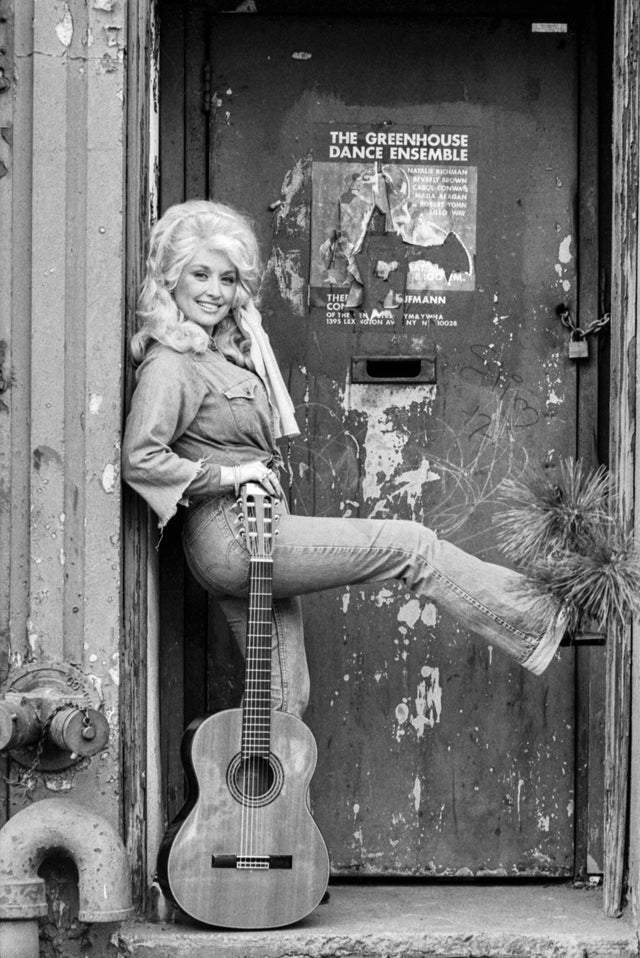
Today is just not as sparkly. It’s a sad day for the entire World. We lost a woman who gave us joy and happiness beyond belief. Dolly Parton died at age 80 and in those 80 years, she gave so much of herself to the World.
She gave us beautiful music. Music is the only art form that has the capacity to touch everyone and Dolly truly touched everyone with her lyrics and songs. Parton composed over 3,000 songs, including one of my all time favorites, “I Will Always Love You”, a two-time U.S. country chart-topper and an international hit. She made over $10M in royalties from the 1992 Whitney Houston hit. She generously used that money to invest in a Nashville strip mall in a historic Black community, affectionately referring to the property as, “the house that Whitney built”.
She gave us wonderful movies to remember her by. She gave us literature for young readers who didn’t have the means to buy books, donating over 300 million books to children. She contributed millions of dollars to charity including the development of the COVID vaccine during the pandemic.
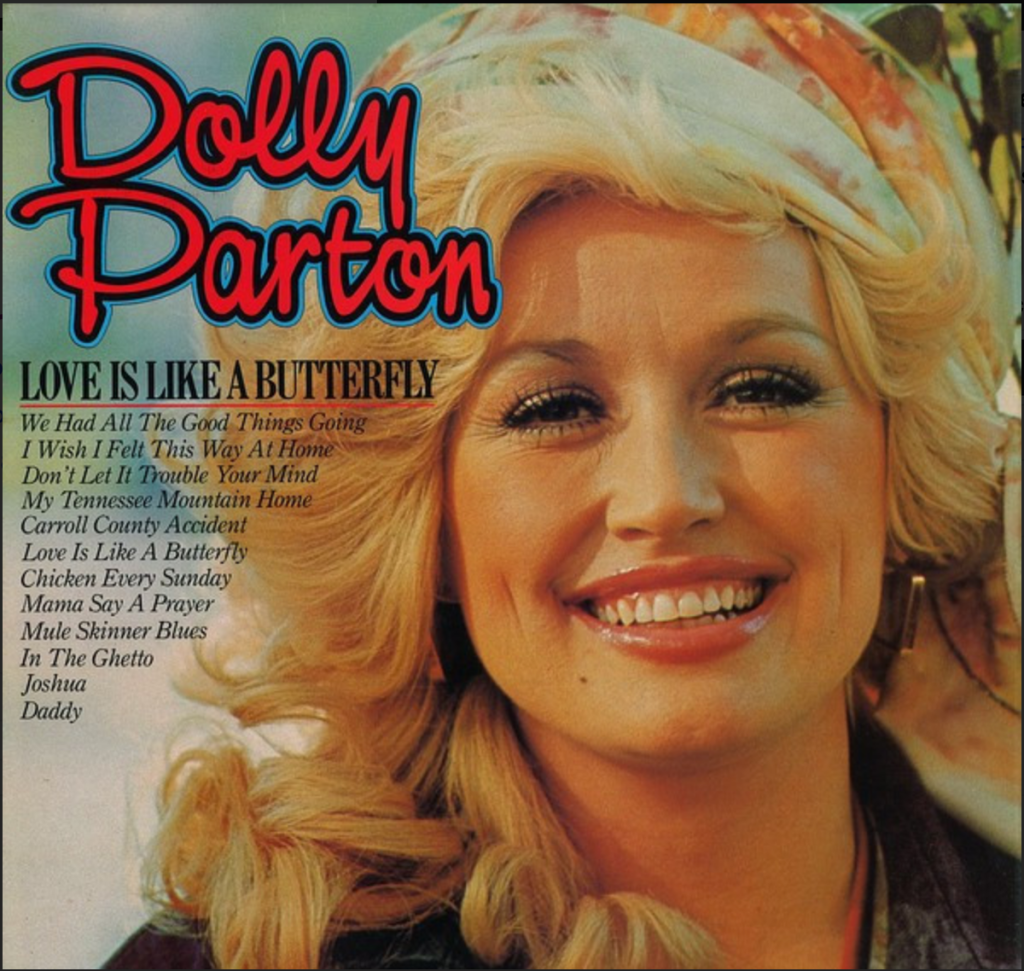
In August 1974, I was just a teenager when I heard on the radio, Dolly Parton’s song, Love Is Like a Butterfly. The song was written and recorded by Dolly and was the first single and title track from her album, “Love Is Like a Butterfly”. It was her fourth number one hit on the country charts as a solo artist.
Her Butterfly song stayed with me all these years because of my love of butterflies. Point of fact, it touched me so much that on March 14, 2026, I created a video for my Instagram account highlighting this song. National Learn About Butterflies Day is celebrated every March 14th encouraging us to look for a blur of color as butterflies begin migrating across the country.
Her music and movies I have loved and enjoyed all my life. My poetry and music I’ve created is highly influenced by her own music and style of singing.
She always wrote from the heart. I admired her most for her strength, honesty, humor, free spirit, humbleness, dedication to her husband for over 60 years, her beauty, and her classiness. Not to mention, she was tenacious when it came to her beliefs and dreams.
Too often we don’t realize what we have until it’s gone. Today around the world, millions of people will no doubt be grieving from the loss of a true iconic treasure, Dolly Parton. We’ll always love you.
Shine On
Here’s my favorite Dolly YouTube video from September 19, 1979 Tonight Show.
“If you ever plan to motor west Travel my way take the highway That is best get your kicks on Route Sixty-Six” Bobby Troup
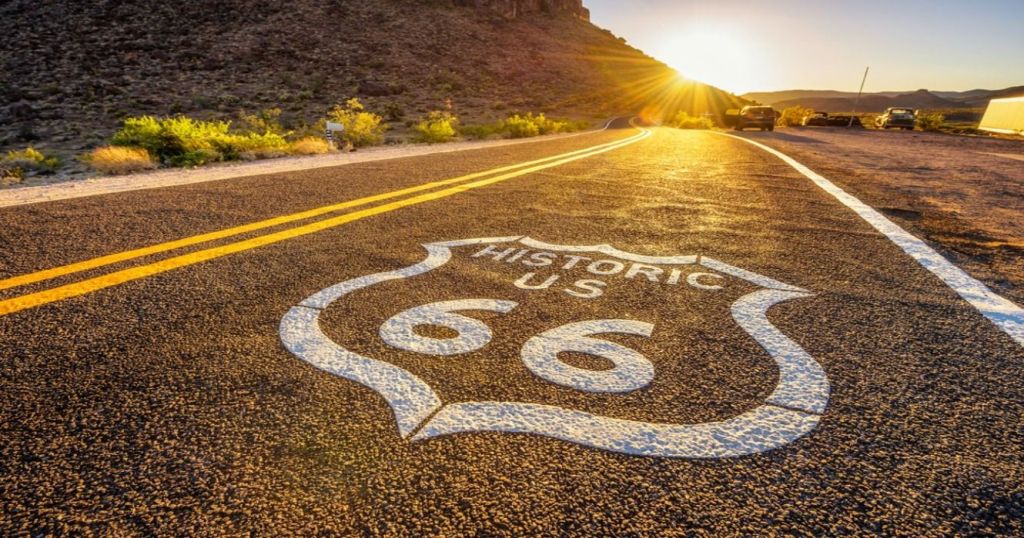
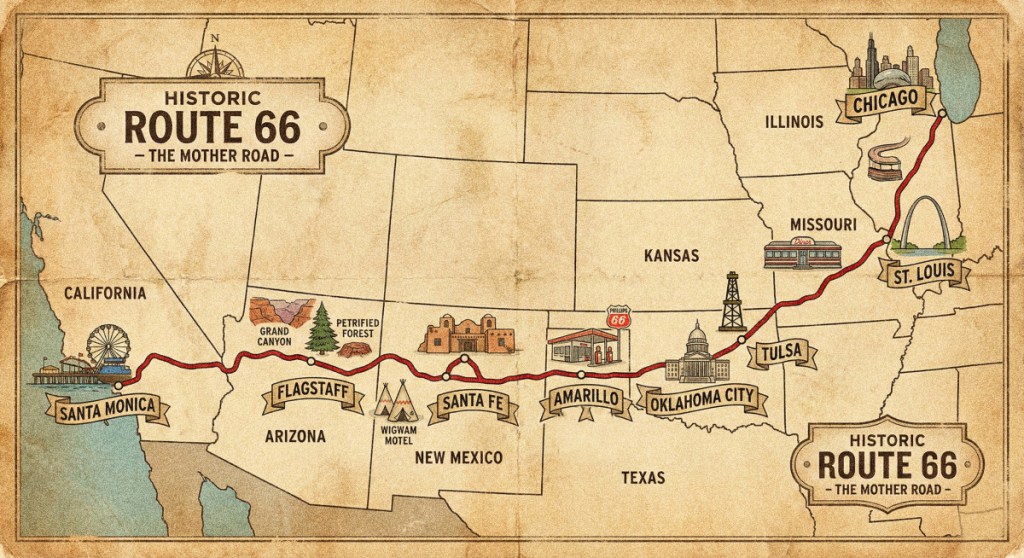
This year is the 100th Anniversary of America’s most iconic roads, Route 66. It was one of the original highways in the United States Numbered Highway System. Established on November 11, 1926, with signage erected the following year, the highway ran from Chicago, Illinois, through Missouri, Kansas, Oklahoma, Texas, New Mexico, and Arizona before terminating in Santa Monica, California, covering 2,448 miles.
US 66 became a major route for westward migration, particularly during the Dust Bowl of the 1930s, and contributed to the economic development of communities along its path. It later faced decline as traffic was diverted to the Interstate Highway System in the mid-20th century. The highway was officially removed from the United States Highway System in 1985 after being largely replaced by Interstate highways. Many segments of the former route have since been preserved as Historic Route 66, a National Scenic Byway, and incorporated into state and local road systems.
Route 66 has its roots when in 1857, Lt. Edward Fitzgerald Beale of the U.S. Army Corps of Topographical Engineers was directed by the United States Department of War to construct a wagon road along the 35th parallel. The route, later known as Beale’s Wagon Road, was intended to improve transportation across the southwestern United States and included experiments with the use of camels as pack animals. Portions of this route were later incorporated into alignments of US 66.
Before the creation of a nationwide system of numbered highways, long-distance travel in the United States relied on a network of privately marked auto trails. The route that later became US 66 incorporated segments of several of these trails, including the National Old Trails Road, parts of the Ozark Trails system, and, in the Midwest and South, portions of routes such as the Lone Star Route. These routes were often indirect and inconsistently marked, leading to calls for a standardized national highway system.
Preservation efforts in the late 20th century expanded at the national level. In 1999, President Bill Clinton signed the National Route 66 Preservation Act, which provided federal support for preserving and restoring historic features along the route. The National Park Service developed the Route 66 Corridor Preservation Program and a Discover Our Shared Heritage travel itinerary documenting historically significant locations along the route. Then in 2008, the World Monuments Fund included Route 66 on its World Monuments Watch, citing threats to historic roadside architecture from development and neglect.
The fervor for Route 66 has been widely represented in American popular culture, reflecting its historical role in travel, migration, and the development of automobile culture. The highway was popularized in music by Bobby Troup’s 1946 song “Get Your Kicks on Route 66”, first recorded by Nat King Cole, which became a standard later performed by numerous artists across many genres. The route also lent its name to the television series Route 66, which followed two young men traveling across the United States. In literature, John Steinbeck’s novel The Grapes of Wrath portrays westward migration along US 66 during the Dust Bowl, referring to it as the “Mother Road”, a phrase that became closely associated with the highway. It’s also been depicted in film, including the animated feature Cars, which portrays a fictional town bypassed by an Interstate Highway, reflecting the decline experienced by communities along the route.
Now, in the 21st century, Route 66 has continued to be recognized in popular media and public commemorations, a revival as a heritage tourism destination, attracting both domestic and international travelers. Preservation groups have worked to restore historic motels, gas stations, and neon signage associated with mid-20th-century automobile travel on the route.
I know my “Bucket List” includes a trip in my Blue Fox down the highway that is best to get my kicks on Route 66.
“Happiness is letting go of what you think your life is supposed to look like and celebrating it for everything that it is.” Mandy Hall
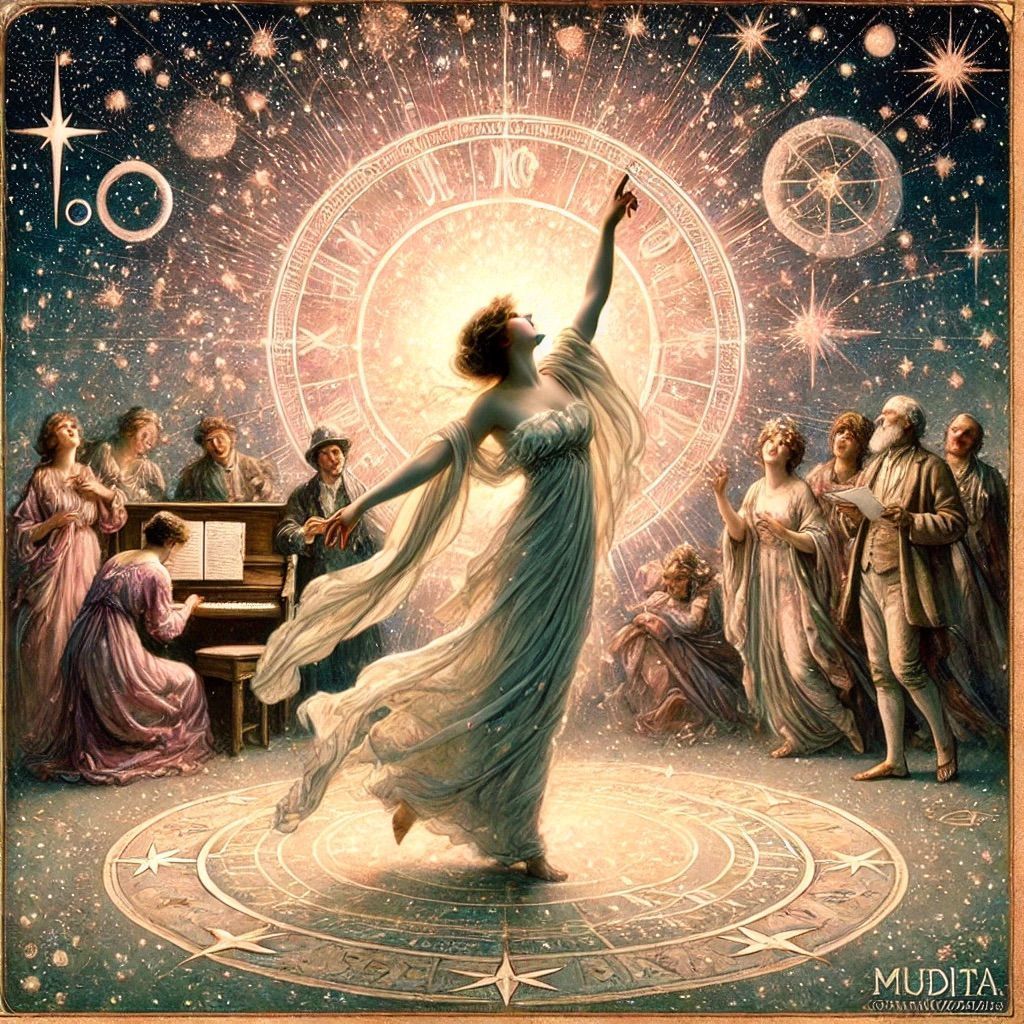
In Buddhist philosophy, there are four key states of mind that anybody needs to occupy to be happy and to reach enlightenment, and of these four mudită is generally considered to be the hardest, but also the most important.
To show joy is to celebrate happiness and achievement in others even when we are facing tragedy ourselves. Mudită is when you bask in the reflected joy of somebody else’s happiness. It’s the parent who smiles when they hear their children laughing in the next room. It’s when you jump with joy at a friends promotion. It’s when you smile and are grateful when your friend tells you that they are cancer free.
Mudită is a kind of joyous empathy that delights in the vicarious happiness of another person.
Buddhism says that we should bring more mudită to our interactions with all other people — in fact, all living things more broadly. And the philosopher Buddhaghosa laid out a method to do so.
Buddhaghosa says that we shouldn’t start with somebody that we love, because that is too easy. Nor should we start with somebody that we resent, because that is too hard. Instead, find somebody who is cheerful. Find the person who is a half full, optimistic kind of sort, and be around them a lot more. Let their cheerfulness wash over you, because it is contagious. Let their easy laugh and happy gratitude in, and so too will you become that way. From here, you should find a neutral person, and then the person you resent, until finally you are finding happiness in the joy of somebody you don’t even like.
Mudită is a blessing, because it allows us to experience more joy than ever before. We can experience the joy in our own individual lives, but we can also experience everywhere and in everyone’s lives more Mudită.