“If you ever plan to motor west
Travel my way take the highway
That is best get your kicks on
Route Sixty-Six”
Bobby Troup
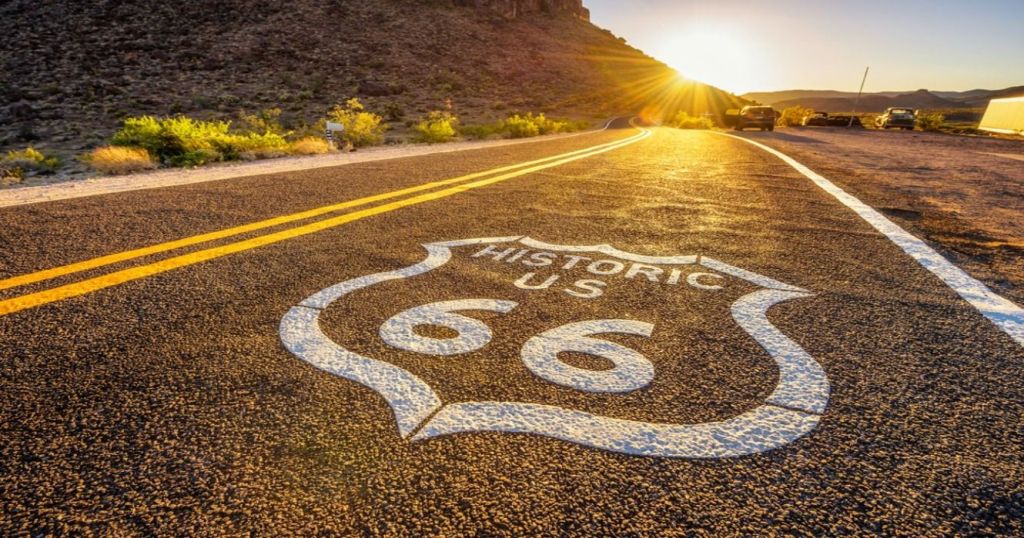
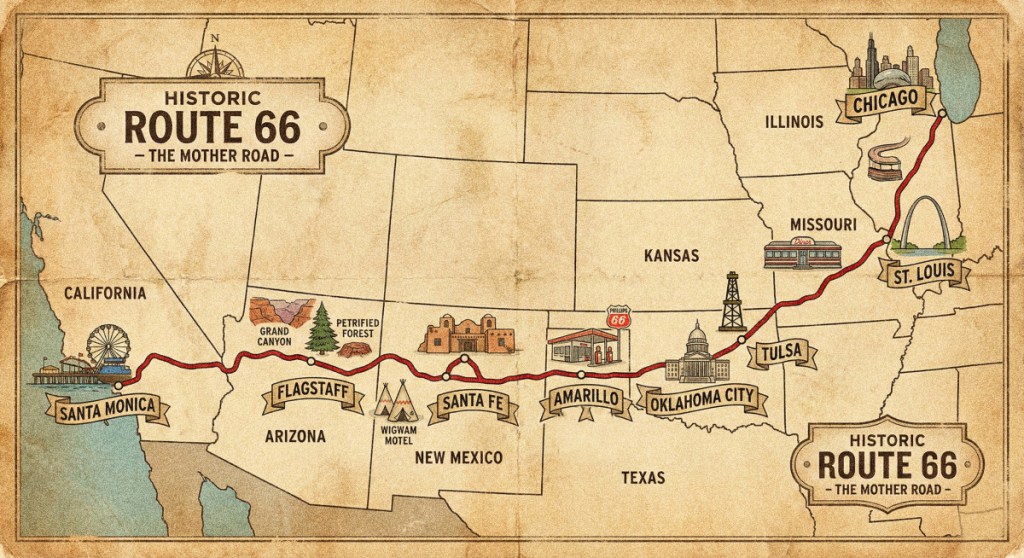
This year is the 100th Anniversary of America’s most iconic roads, Route 66. It was one of the original highways in the United States Numbered Highway System. Established on November 11, 1926, with signage erected the following year, the highway ran from Chicago, Illinois, through Missouri, Kansas, Oklahoma, Texas, New Mexico, and Arizona before terminating in Santa Monica, California, covering 2,448 miles.
US 66 became a major route for westward migration, particularly during the Dust Bowl of the 1930s, and contributed to the economic development of communities along its path. It later faced decline as traffic was diverted to the Interstate Highway System in the mid-20th century. The highway was officially removed from the United States Highway System in 1985 after being largely replaced by Interstate highways. Many segments of the former route have since been preserved as Historic Route 66, a National Scenic Byway, and incorporated into state and local road systems.
Route 66 has its roots when in 1857, Lt. Edward Fitzgerald Beale of the U.S. Army Corps of Topographical Engineers was directed by the United States Department of War to construct a wagon road along the 35th parallel. The route, later known as Beale’s Wagon Road, was intended to improve transportation across the southwestern United States and included experiments with the use of camels as pack animals. Portions of this route were later incorporated into alignments of US 66.
Before the creation of a nationwide system of numbered highways, long-distance travel in the United States relied on a network of privately marked auto trails. The route that later became US 66 incorporated segments of several of these trails, including the National Old Trails Road, parts of the Ozark Trails system, and, in the Midwest and South, portions of routes such as the Lone Star Route. These routes were often indirect and inconsistently marked, leading to calls for a standardized national highway system.
Preservation efforts in the late 20th century expanded at the national level. In 1999, President Bill Clinton signed the National Route 66 Preservation Act, which provided federal support for preserving and restoring historic features along the route. The National Park Service developed the Route 66 Corridor Preservation Program and a Discover Our Shared Heritage travel itinerary documenting historically significant locations along the route. Then in 2008, the World Monuments Fund included Route 66 on its World Monuments Watch, citing threats to historic roadside architecture from development and neglect.
The fervor for Route 66 has been widely represented in American popular culture, reflecting its historical role in travel, migration, and the development of automobile culture. The highway was popularized in music by Bobby Troup’s 1946 song “Get Your Kicks on Route 66”, first recorded by Nat King Cole, which became a standard later performed by numerous artists across many genres. The route also lent its name to the television series Route 66, which followed two young men traveling across the United States. In literature, John Steinbeck’s novel The Grapes of Wrath portrays westward migration along US 66 during the Dust Bowl, referring to it as the “Mother Road”, a phrase that became closely associated with the highway. It’s also been depicted in film, including the animated feature Cars, which portrays a fictional town bypassed by an Interstate Highway, reflecting the decline experienced by communities along the route.
Now, in the 21st century, Route 66 has continued to be recognized in popular media and public commemorations, a revival as a heritage tourism destination, attracting both domestic and international travelers. Preservation groups have worked to restore historic motels, gas stations, and neon signage associated with mid-20th-century automobile travel on the route.
I know my “Bucket List” includes a trip in my Blue Fox down the highway that is best to get my kicks on Route 66.
Shine On