Bicycles Beginning

“Every time I see an adult on a bicycle,
I no longer despair for the future of the human race.”
H. G. Wells

It was the early-18th century in Western Europe when man first began experimenting with human-powered vehicles. In the beginning, these vehicles consisted of four or more wheels and could accommodate up to seven passengers. Much different from carts or carriages, they had handles or ropes for men on foot to push or pull. They were attempts at replacing horses with humans.

Even back in the 1800’s, the purchase of a horse was expensive for the working man. No fit and wealthy gentleman would be without a horse for pleasure riding. They usually had horses for drawing carriages, but most affluent European men owned horses for leisure riding.

That all changed in 1815 when the world was thrown into turmoil. A turmoil not from a war or an economic crises, but because of a small island over six thousand miles from Europe in the South Pacific.

On April 10, 1815, halfway between Asia and Australia, Mount Tambora erupted in Indonesia. It was to become the largest volcanic explosion in recorded history as well as claiming the most fatalities. Mount Tambora’s eruption killed well over 71,000 of its people. This once silent volcano erupted with the power equivalent to 1,000 atomic explosions, blasting about 38 cubic miles of ash, pumice and other matter into the atmosphere.

Ashes reflected the sun’s light and cooled the earth’s surface. Temperatures dropped below freezing in July from Mexico to Vienna. Unexpected snowstorms and rainstorms brought travel to a stop. Farms and grain stores were washed away. Crops failed. Livestock died by the tens of thousands. The world was gripped by the worst famine in a century, and infectious diseases such as typhus was rampant. The year 1816 would become known as “the year without a summer”.
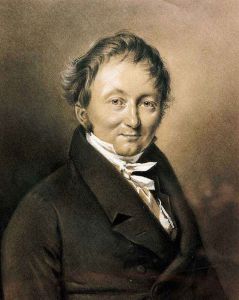
karl-wilhelm-friedrich-christian-ludwig-drais
Karl Wilhelm Friedrich Christian Ludwig Drais

With all the soot and ash engulfing Europe, there was one ray of hope to this gloomy disaster. He was a 31 year-old aristocrat, an expert in forestry, an enthusiastic and passionate horseman as well as an avid inventor from Baden, Germany. His name was Karl Wilhelm Friedrich Christian Ludwig Drais, otherwise known as Baron Drais von Sauerbronn. Baron Drais’ beloved horses died from environmental causes from the volcano eruption, and set the Baron on a journey to invent the bicycle.

It’s not known what the impetus was for the Baron to think about the problems confronting the horses, and how those factors affected gentlemen who rode for pleasure. But somehow, this led him to thinking about the basic form of the horse and its accommodations for a rider in a wooden and wrought iron frame with a pair of carriage wheels in tandem. The result would be recognized by anyone today as the ancestor of all bicycles.

Baron Bike
Baron Drais on his original Laufmaschine, the earliest two-wheeler, Circa 1819

Early in 1817 the Baron built out of cherry tree wood and softwood a “running machine”, which he called a Draisine or a Laufmaschine. The machine was more pony-sized than horse-sized so that the riders feet reached the ground for propulsion.

This early bicycle consisted of a saddle seat, handlebars and a steerable front wheel. Testing and improving it throughout the next few years, the Baron finished his invention and patented the running machine in January of 1818.

Almost overnight the Baron’s Laufmaschine became a sensation. News of the running machine spread westward across Europe. Enthusiasm grew among a small circle of young aristocratic men known as “dandies”. Demonstrating one’s manly abilities was key for “dandies”, and the Laufmaschine was a novelty too challenging and exciting for any dandy to pass up.

First Bike
The Baron’s Laufmaschine displayed at the Kurpfälzisches Museum in Heidelberg, Germany

The Laufmaschine name was a bit foreign to British, so they renamed it the “dandy horse”. Before long, every young gentleman who aspired to the dandy ideal owned a dandy horse. A basic dandy horse in 1818 cost the equivalent of about $900 in today’s money, which made it a rather expensive plaything. The best of these were constructed by carriage builders; the more crude ones were cobbled together by blacksmiths.
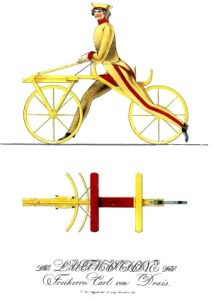
image28
Original Draisine Circa 1817 Made to Order

As quickly as it appeared, the dandy horse disappeared. By 1820, the price of oats was back down to pre-1815 levels, and horses were readily available to those who could afford them. It wouldn’t be until the mid-1860s that someone had the idea to put pedals on the front wheel of a dandy horse, giving it an improved means of locomotion, as well as a scrub brake for the rear wheel; an improvement for stopping over crashing it into a hedge.

So what happened to the Baron Drais? He had the misfortune to belong to the losing political party when the Prussians took over Baden, and he had his title and property stripped; he died penniless and forgotten two years later. But without the Baron and the aristocratic plaything he invented, life might have been very different, and certainly less colorful as the bicycles beginning.

Shine On
Bicycling’s Golden Age

“When the spirits are low,
when the day appears dark,
when work becomes monotonous,
when hope hardly seems worth having,
just mount a bicycle and go out
for a spin down the road,
without thought on anything
but the ride you are taking.”
Arthur Conan Doyle

Bike Poster 1890s

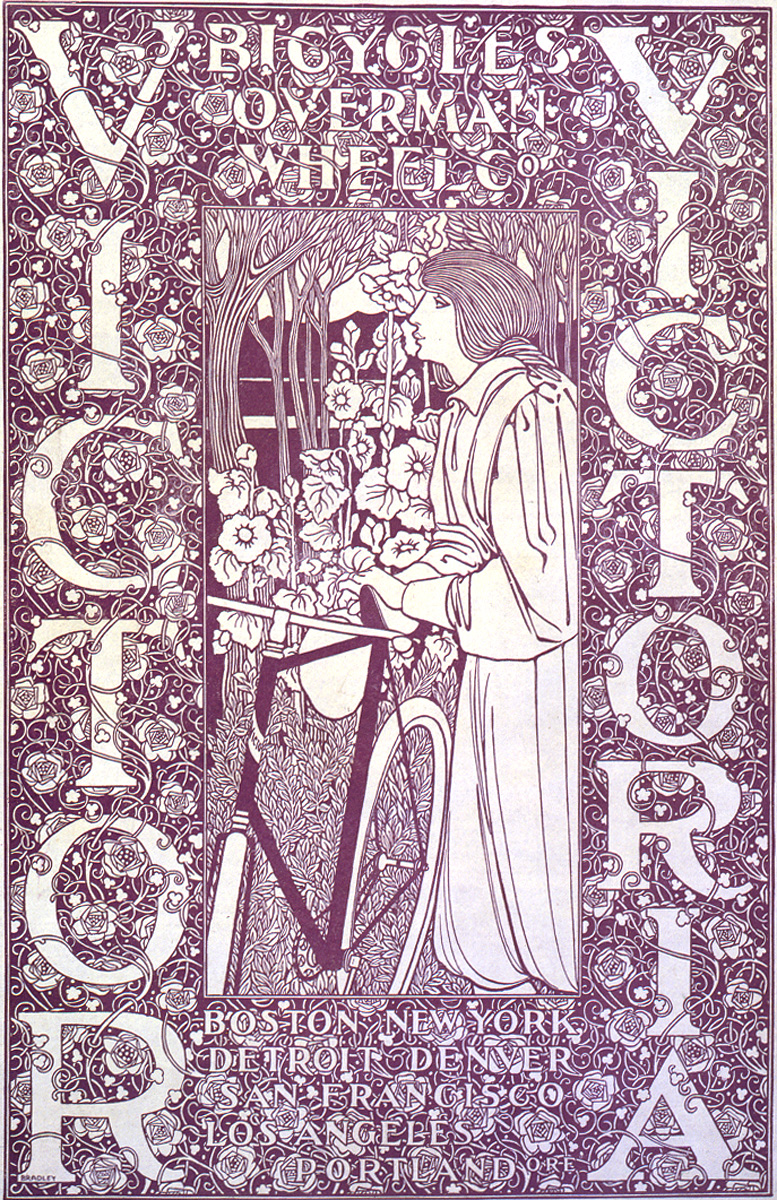
Victor, Victoria bicycles Overman Wheel Co., 1896. Artist: Will Bradley

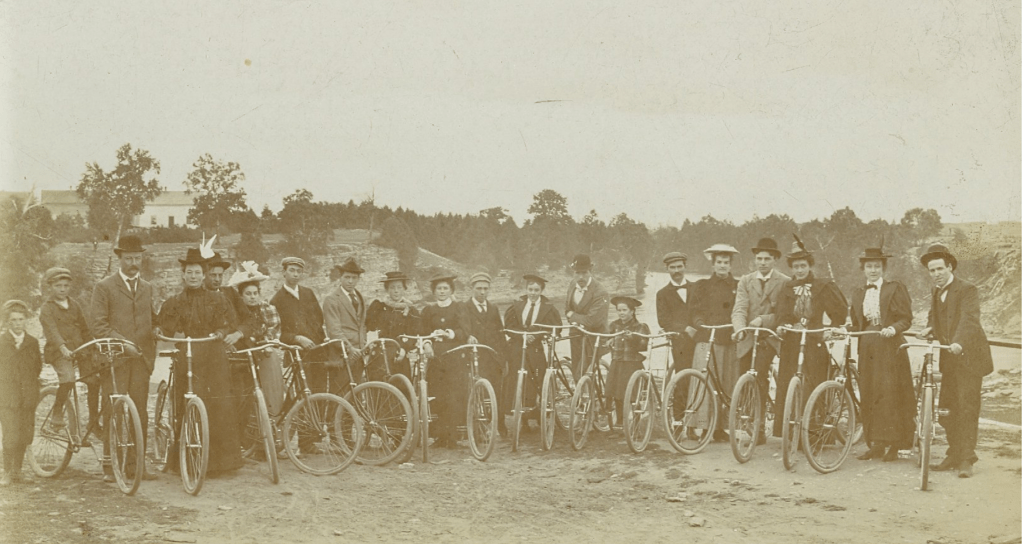
During the turn of the century, the modern bicycle sparked a nation-wide bicycle craze. Zeal for this new two-wheeled vehicle became especially popular in Southern California. With California’s ideal year-round weather conditions, this new healthy outdoor activity attracted both young and old as well as men and women.

Enthusiasts organized group rides across the Southland, formed local bicycle clubs, and lobbied for the construction of bicycle roads.

bicycles-come-to-california

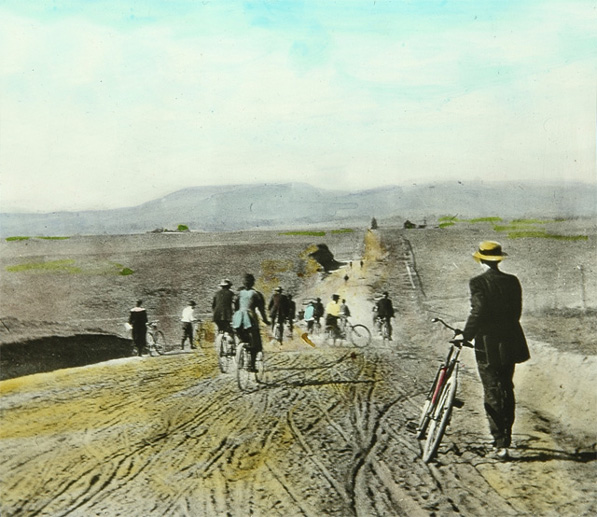
LA Times Bicycle Club members ride north on Western Avenue toward Hollywood. Circa 1894

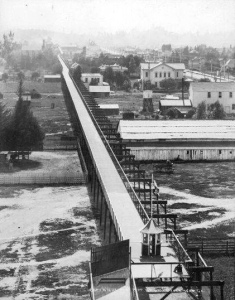
The most famous bicycle route was the California Cycleway, an elevated bikeway extending from the historic Los Angeles Plaza to Pasadena’s Hotel Green. Made of Oregon pine, the cycleway had easy grades, sparing cyclists from the hilly terrain between the two cities.

california-cyclewayA one-and-a-quarter-mile stretch of the privately financed cycleway, pictured here, opened in 1897 between the Hotel Green and South Pasadena’s Raymond Hotel.
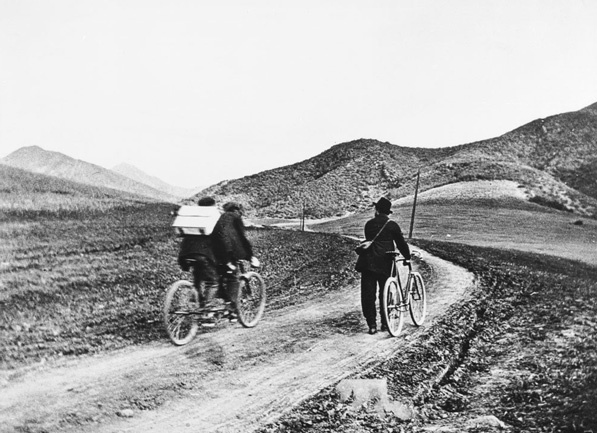
Unfortunately, by 1910 the cycleway had fallen into disuse. Its full route to Los Angeles was never completed. Today, the Arroyo Seco Parkway uses much of the California Cycleway’s original right-of-way.

Another popular cycling corridor lay between Los Angeles and the town of Hollywood. The Los Angeles Times Bicycle Club organized runs along the route, whose unpaved roads eventually became our modern-day, traffic-choked boulevards.

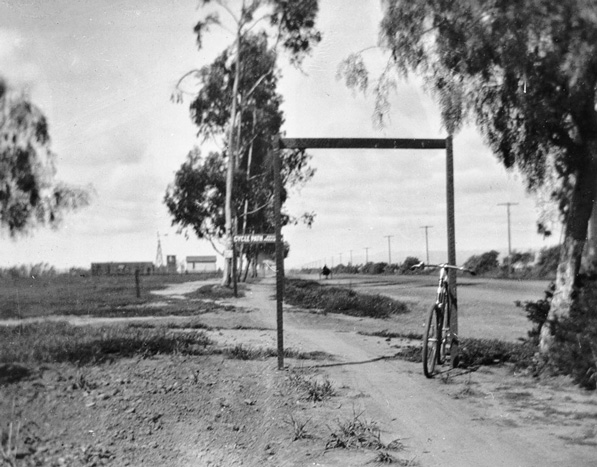
With cycling becoming more and more popular, the beach community of Santa Monica with the help of The Southern Pacific Railroad, built the “Santa Monica Cycle Path”. The 1896 photograph below, shows the beginning of the bike path which later extended to Downtown Los Angeles.

sm-bike-path

Santa Monica to Los Angeles cycle path @ 1896

Meanwhile in the Northern California town of Davis, the high-wheel bicycle was making a surge. Because the agricultural land around the City of Davis is flat and the climate is relatively mild year-round, riding a bicycle became the mode of transportation and an easy way to get around town.

University of California students have been coming to Davis since 1908 and bicycling has always been an important part of their campus experience. After the city incorporated in 1917, the increasing number of paved roads encouraged local citizens to take up cycling.

Due to rapid growth of the university and the city, traffic conflicts between bikes and vehicles were increasing throughout the 20th century. After acknowledging that the well-educated and well-traveled citizenry would be receptive to European-style bikeways, the Davis City Council decided in 1967 to create a few short blocks of bicycle lanes. As a result, Davis became the first city in the United States to install official city bicycle lanes.

1900 bike pathThe combined system of bicycle lanes and dedicated bike paths today reaches well over 100 miles in a small town that is only about 11 square miles. Davis has become a model for hundreds of U.S. cities because of its safe, integrated bicycle transportation network. The UC Davis campus has developed its own extensive bicycle path system and support programs.

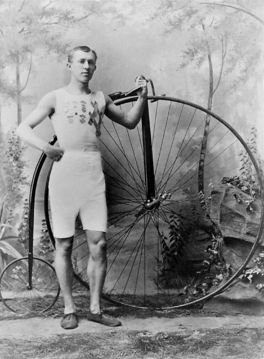
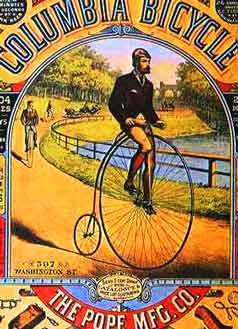
Many remaining high-wheelers were collected during scrap metal drives during the Great War of 1914–18, making the few remaining machines valuable and highly desired collectibles today, as well as nostalgic reminders of bicycling’s Golden Age.

Shine On


To learn more about the history of bicycles, visit the Bicycle Hall of Fame in Davis, California. Follow the link below:

US Bicycling Hall of Fame


Bicycles in America

“Life is like riding a bicycle.
To keep your balance
you must keep moving.”
Albert Einstein


WK Clarkson

W. K. Clarkson, Jr.


Almost simultaneously across the Atlantic in the United States, while the Baron built his cherry tree wood and softwood Draisine, W. K. Clarkson, Jr. of New York, was granted a patent for a velocipede on June 26, 1819. Unfortunately, the records for the patent were destroyed in a fire at the Patent Office in 1836 and we no longer know what this patent covered.

There is no evidence that bicycling gained much popularity in the U.S. at the time. However, around 1863 in Paris, Pierre Michaux played an important part in velocipede development when in his workshop Pierre added pedals to the front axle. To this day it’s not certain whether he or his employee Pierre Lallement is entitled to the credit.

Lallement moved to New Haven Connecticut, and in 1866 he was granted a patent for improvements in velocipedes. Then in 1868, the Hanlon brothers of New York, improved Lallement’s vehicle.

Americans began to show an immense enthusiasm for the velocipede in 1868. By early 1869, a number of carriage builders were making cycles. Numerous riding schools were established in many eastern cities, and the sport of riding became suddenly popular, especially among the students of Harvard and Yale Universities. The craze ended as suddenly as it began. By the end of May in 1869 bicycling was a dying sport.

The reasons for the decline was because the cycles were heavy and cumbersome. There was no cushioning and the rider had to steer and pedal the same front wheel. Riding a velocipede took a great deal of strength and coordination. Cities also began to pass ordinances against riding on pedestrian sidewalks. Further use and development in the United States remained nearly at a standstill during the 1870s.

By the late 1870s, bicycles and tricycles using wire-spoked wheels were commonly seen, notably in England. James Starley of Coventry introduced the Ariel in 1871, a high-wheeled bicycle with wire spokes that was copied for two decades. This type of cycle, with modifications, gained popularity and later became known as an “Ordinary”.

columbia-bicycleAmericans again became interested in bicycles, and began importing machines from England. Albert A. Pope became the first American bicycle manufacturer. In 1878 he began manufacturing bicycles under the trade name “Columbia” in Connecticut.
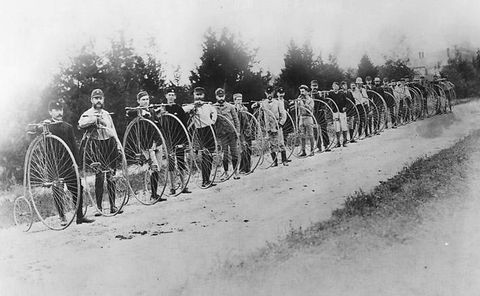
Twenty years after the success of the Columbia, the American Bicycle Company was founded by Albert Augustus Pope. Shortly after, Pope incorporated the American Bicycle Company on May 12, 1899.

In 1898, the U.S. bicycle industry was caught in a downward spiral of market saturation, over-supply and intense price competition. In an attempt to control supply and limit competition, 42 manufacturers (later over 75 companies) formed the American Bicycle Company and soon afterwards announced plans to open a branch plant in Canada called the National Cycle Company.

American Bicycle later bought the Gormully & Jeffery Manufacturing Company which made Rambler brand bicycles. Rambler bicycle was obtained in 1900 after Thomas B. Jeffery sold it to focus on the Rambler automobile.

Bicycles began to evolve more and more. The Ordinary, or high-wheel bicycle as it is currently called, was light weight and fast. But it was also hazardous, since the rider’s center of gravity was only slightly behind the large front wheel and the rider was in danger of taking what came to be called a “header”—flying over the handlebars.

Ordinary BikesBecause of the Ordinary’s inherent danger, efforts were made to design a safer bicycle. Some people tried to modify the Ordinary to make it safer, others put their efforts into redesigning the bicycle. The latter path won out as “Safety” bicycles became more popular. These cycles had two small wheels of equal size, a chain driver, and gears. Soon after the advent of the Safety bicycle, John Boyd Dunlop patented a pneumatic tire (in both England and the United States). Brakes were also improved in the 1890s.
The number of bicycles in use boomed as production rose from an estimated 200,000 bicycles in 1889 to 1,000,000 in 1899 as popularity skyrocketed for bicycles in America.

Shine On

read about, Bicycling’s Golden Age

That First Ride

“Nothing compares
to the simple pleasure of
riding a bike.”
John F. Kennedy


First Bike


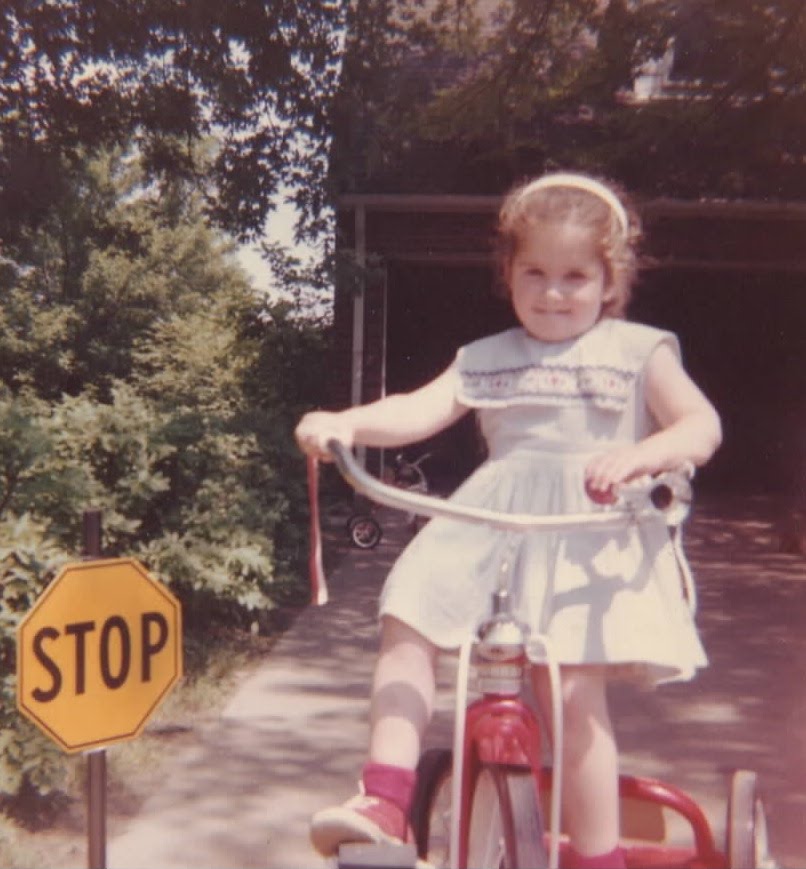
Bicycles have been part of my life since my first tricycle I received on my third birthday. I was so proud of this shiny red tricycle, which came with its very own miniature stop sign. I remember riding my bike around the neighborhood all day until it was dark out and my mom would find me and bring me home.

I guess it was the freedom experienced when riding a bicycle which attracted me the most. As a toddler, you’re at the mercy and control of everyone. Riding my bike gave me the power and freedom to go anywhere my tiny feet and legs could take me.

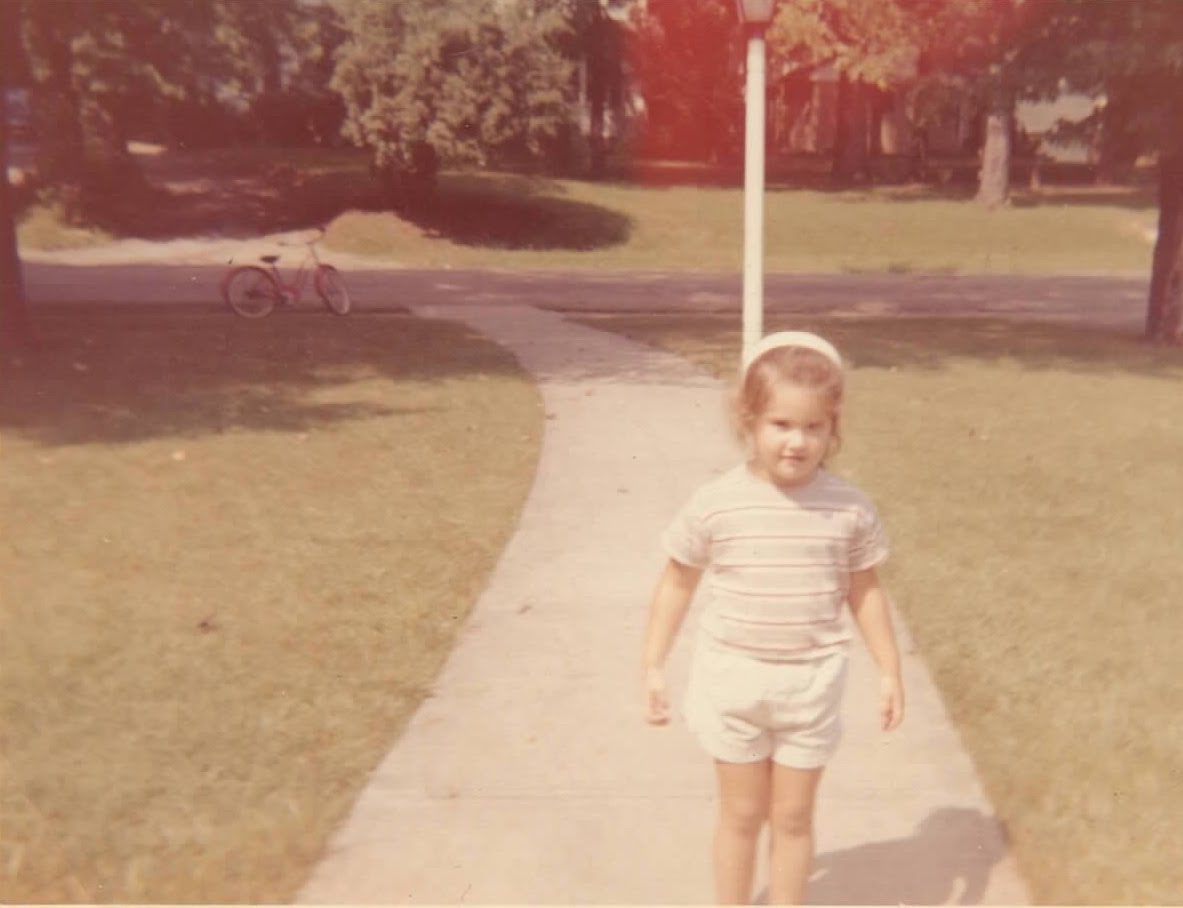
Hand me down SchwinnMy tricycle days were short lived when I discovered two wheelers. My much older sister and brother would fly by me on my short slow tricycle. So, within a year after receiving my beloved trike, I taught myself how to ride my sister’s two-wheeler. At four years old, not tall enough to reach the pedals while sitting on the bike seat, I learned to balance myself on the foot pedals. Stopping the bike was a challenge but I quickly had my technique down pat. My sister’s hand-me-down large red Schwinn bike was where my serious love of biking began.
When we relocated to California, my parents bought me my dream bike to ride to school. This green, Schwinn Sting Ray, My Fair Lady model was my first very own bike.

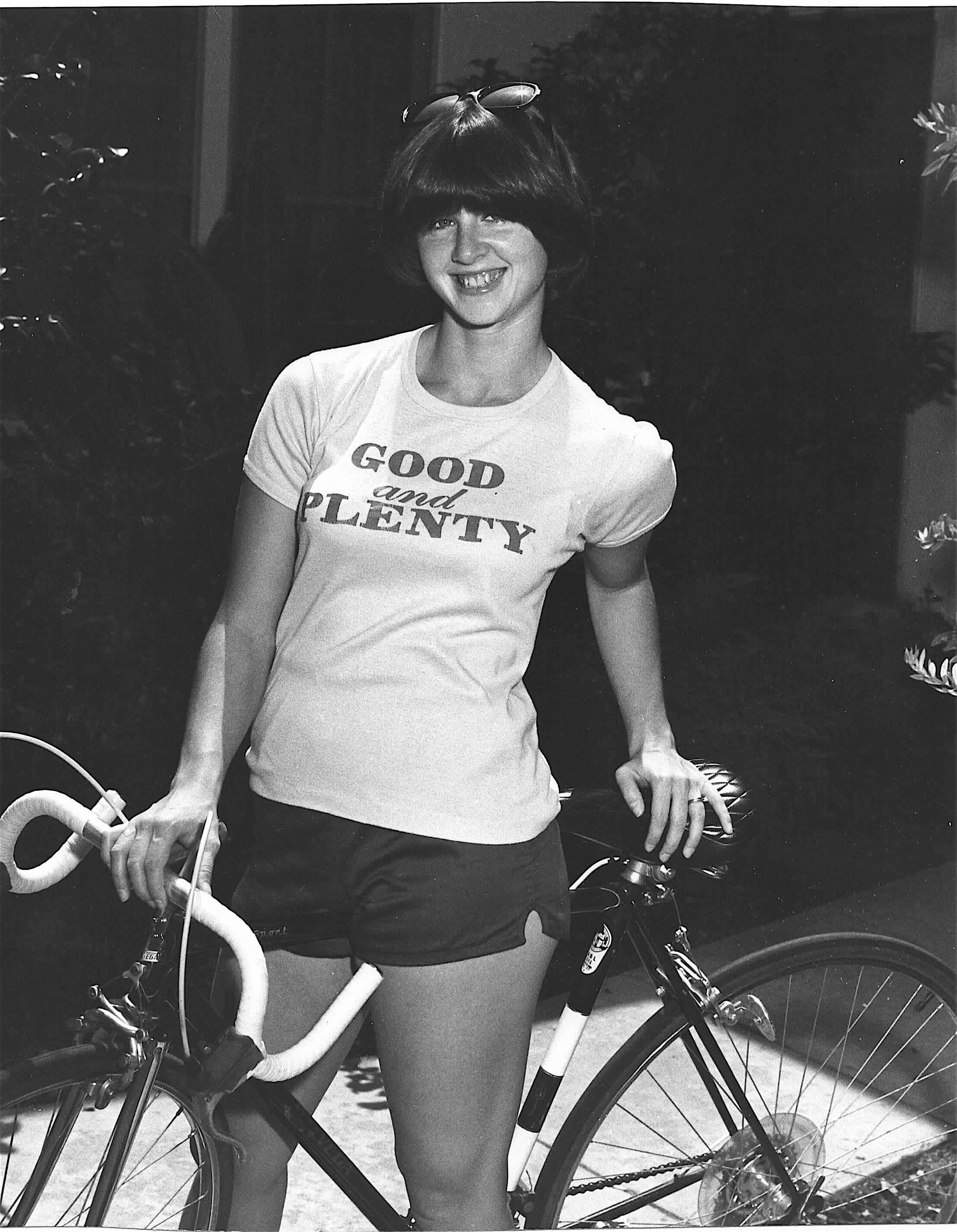
In my teens I discovered speed bikes. I read and researched about these modern fast lightweight bikes which fueled the astonishing “Bike Boom” of the 1970s.  I saved up for one I had my eye on at Montgomery Ward. This Japanese $100, black slick 10-speed became my pride and joy. I learned to fine tune the gears and brakes. Daily after riding, I would spend a good hour cleaning and polishing my bike. I even had bought myself a small pack with tools that attached under the back of the seat.

First Ten Speed


One school morning I went to the garage to get my bike and it was gone. In tears and feeling like someone had kicked me in the gut, I called my mom at work. I was crying hysterically and she kept asking me who died? I was finally able to tell her my bike was gone. She told me to call my older brother, which I immediately did.

Within an hour, my brother showed up with my bike in tow. My brother had drove around the neighborhood and spotted the bike thief. He knew immediately it was my bike from the shiny spokes and tool pack under the seat. When he stopped the grubby looking kid on my bike and asked where he got the nice bike, the kid stammered and couldn’t answer. At that point, my brother jumped out of his car, grabbed the boy and told him to hand over the bike or he’d break every bone in his body. The kid dropped the bike and ran. My brother’s actions are not exactly something someone would do today, unless you want to get shot. But, I’m forever grateful to my heroic big brother for getting my bike back so quickly in one piece.

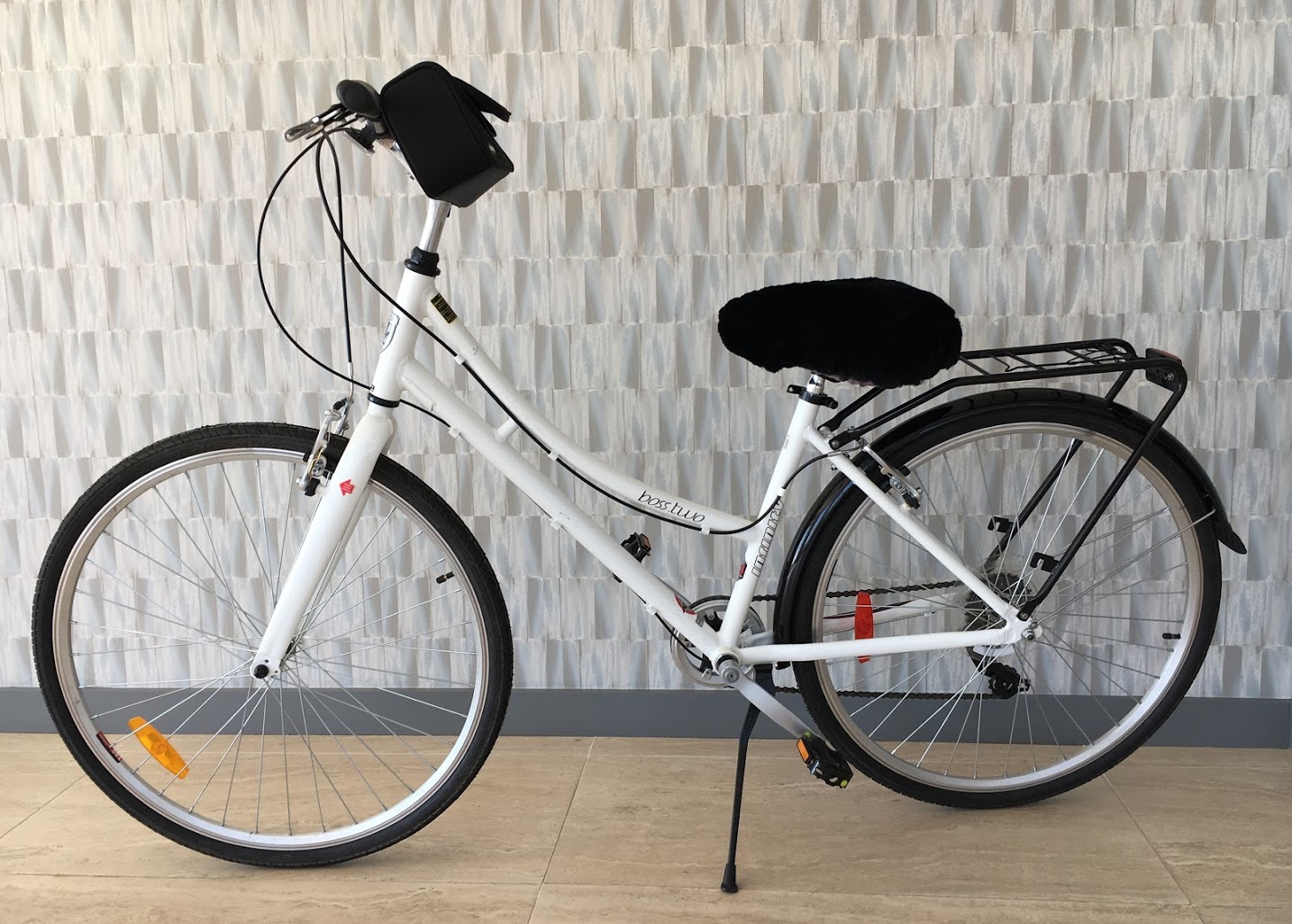
In the new millennium, I moved on from 10-speeds to mountain bikes. My current bike with pearlized white paint finish, is a Boss Two Infinity 7-speed and what they call a hybrid which is part speed bike part mountain bike. It’s extremely smooth riding and comfortable. Of course, I’ve tricked it out with my black sheep skin seat, handlebar pack, black sturdy rear rack, CatEye Padrone bike computer as well as front and rear lights.

Boss Two

I’ve had numerous 10-speeds and mountain bikes through the years but my first bike the Schwinn, My Fair Lady, Sting Ray was like a first love and nothing I ever rode or owned would ever match that feeling of true freedom on that first ride.

Shine On

my cycling saga continues with, Schwinn Lady