Our Furtive Foxy Friend

“A fox is a wolf who sends flowers.”
Ruth Brown


The Fox

The North American Red Fox aka the Vulpes vulpes

Around dusk this past evening, I was on my walk and saw what appeared to be a fox. We have lots of coyotes roaming the city, but a fox? I must have been mistaken.

It piqued my curiosity, so I did a little research about the fox. I found out some interesting facts about foxes on a California website.

The fox, the smallest member of the dog family, is a highly adaptable species that inhabits mostly forest, chaparral, and desert regions, but can be found in nearly all habitats. There are three types of fox common to Southern California, including the Gray Fox, Red Fox, and Island Fox. The Southern California Kit Fox, a subspecies of Kit Fox, died out in Southern California in 1903.

Foxes are more solitary in their habits than are others in the dog family. They are territorial and can be aggressive, especially during the breeding season. Their once-a-year breeding season corresponds with the availability of food.

Despite the fact that urban foxes use human buildings for shelter and human refuse for food, their contact with humans is quite limited. Most people who live in an urban area have never seen a fox in the city. Foxes keep a nocturnal schedule, and in the nighttime are often mistaken for dogs when they are seen.

Red Foxes, the most commonly recognized fox, are known for their cleverness and have the largest range in North America. Although they are close relatives of the Gray Fox, they are considerably larger, normally ranging in size from ten to fifteen pounds. Their coats may be reddish or gray or even black, but their legs and feet are always black. The tail is tipped with white.

In California there are two populations of Red Fox- the native Sierra Nevada Red Fox, a threatened species found only in the Sierra Nevada and Cascade mountain ranges, and the more common, non-native Red Fox. Non-native Red Foxes were introduced decades ago for fox hunting and fur farming. Over time, these foxes escaped or were released. Their populations have grown and gradually spread. Currently, they have been spotted throughout the lowland areas of California including the Sacramento and San Joaquin Valleys, San Francisco Bay-Delta area, the Southern California Coast Range and Coastal Plain and in most major urban areas.

Socially, the fox communicates with body language and a variety of vocalizations. Its vocal range is quite large and its noises vary from a distinctive three-yip “lost call” to a shriek reminiscent of a human scream. It also communicates with scent, marking food and territorial boundary lines with urine and feces.

Now after reading about the fox, I’m positive it was a fox that I saw. I know it wasn’t a dog, because it had all the mannerisms of a fox.  Plus, when the fox saw me, it gave me that look that only can be given by our furtive foxy friend.

Shine On

Little Shop of Horrors

“I perhaps owe having become a painter to flowers.”
Claude Monet


Spring Has Sprung
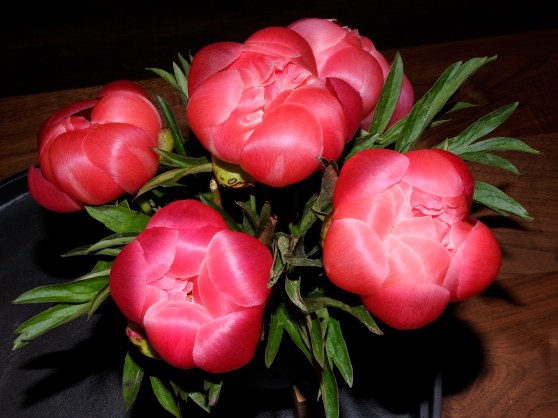
I love flowers. All kinds of flowers. My favorites are the daffodil, peony, tulip, carnation, daisy, and of course the rose.

Last year for Mother’s Day, my son gifted me an orchid plant.

Not having any knowledge of orchids, I did some research, so that this beautiful flower would keep its bloom as long as possible. On the web site “Caring for your orchid dot com”, they suggested not to over water the plant, and to find a perfect spot where the plant would thrive.

I must be doing something right, because to my surprise, the blooms on the orchid lasted for several months. After the pedals all fell off, it lay dormant for about seven months. I continued to keep it watered while new leaf growth appeared. Suddenly two weeks ago I noticed a new bud on the orchid. The other morning when I got up, I was excited to see that a beautiful flower had unfolded over night.

The detail on this flowering orchid was so unusual that I took some photos. There’s a feature on the flower I never noticed before. It looks as though it has two bottom teeth. I’m assuming this is a common feature. If not, I might have to name the plant, Audrey III, from Little Shop of Horrors.

Shine On

Learn Something New Daily

“Even the wisest mind has something yet to learn.”
George Santayana

learn something new

Unable to capture a Strawberry Moon, but did capture a Redondo Red Sunset

This past weekend was a Strawberry Moon and a penumbral lunar eclipse, which when this occurs the Sun, Earth, and the Moon are imperfectly aligned. The June full moon also happens to be the last full moon of Spring.

I’m embarrassed to say, I never heard of a Strawberry Moon. So being the curious kitty I am, I educated myself. As I dove deeper into the rabbit whole, I learned that every monthly Full Moon has been given a name to reflect the changing seasons and nature, like Harvest Moon, Strawberry Moon, or Snow Moon.

Native American tribes, named the months after features they associated with the seasons in the Northern Hemisphere, and many of these names are very similar or identical.

Full Moon Names

2020Full Moons January  Wolf Moon – Named after howling wolves, which may stem from the Anglo-Saxon lunar calendar. Other names: Moon After Yule, Old Moon, Ice Moon, and Snow Moon.

February  Snow Moon – Named after the snowy conditions. Some North American tribes named it the Hunger Moon due to the scarce food sources during mid-winter, while other names are Storm Moon and Chaste Moon.

March Worm Moon – Named because of the earthworms that come out at the end of winter. It’s also known as the Crow Moon, Crust Moon, Sap Moon, Sugar Moon, and Chaste Moon.

April Pink Moon – Named for the pink phlox flowers which bloom in the early Spring. Other names for this Full Moon include Sprouting Grass Moon, Fish Moon, Hare Moon, and the Egg Moon.

May Flower Moon – This moon signifies the flowers that bloom during this month. Other names for the Full Moon in May are Corn Planting Moon, and Milk Moon.

June Strawberry Moon – Named so for the wild strawberries that start to ripen during this month. Other names are Hot Moon, Mead Moon, and Rose Moon.

July Buck Moon – Is so named because the new antlers emerge on deer buck’s foreheads around this time. This Full Moon is also known as Thunder Moon, Wort Moon, and Hay Moon.

August Sturgeon Moon – Named because of the large number of fish in the lakes where the Algonquin tribes fished. Other names for this Full Moon include Green Corn Moon, Barley Moon, Fruit Moon, and Grain Moon.

September Full Harvest Moon – Technically, the Harvest Moon is the Full Moon closest to the September equinox around September 22. Most years it is in September, but around every three years, it is in October. The Harvest Moon is the only Full Moon name which is determined by the equinox rather than a month.

October Hunter’s Moon – Every three years, the Hunter’s Moon is also the Harvest Moon. Traditionally, people in the Northern Hemisphere spent the month of October preparing for the coming winter by hunting, slaughtering and preserving meats for use as food.

November Beaver Moon – According to folklore, the Full Moon in November is named after beavers who become active while preparing for the winter. It is also known as Frosty Moon, and along with the December Full Moon some called it Oak Moon. Traditionally, if the Beaver Moon is the last Full Moon before the winter solstice, it is also called the Mourning Moon.

December Cold Moon – Is the Full Moon when winter begins for most of the Northern Hemisphere.

Some years have 13 Full Moons, which makes at least one of them a Blue Moon, as it doesn’t quite fit in with the traditional Full Moon naming system. However, this is not the only definition of a Blue Moon.

About every 19 years, there is no Full Moon in February. This is one of several definitions of the term Black Moon. The other definitions refer to a New Moon which does not fit in with the equinoxes or solstices, similar to a Blue Moon.

Colonial Americans adopted many of the Native American names and have since incorporated them into the modern calendar.

Sorry for the long post today fellow Blogaholics, but I like to try and learn something new daily.

Shine On

The Beach After Quarantine


“We have been endowed with just enough intelligence
to be able to see clearly just how utterly inadequate
that intelligence is when confronted with what exists.
If this humility could be imparted to everybody,
the world of human endeavors
would become more appealing.”
Albert Einstein

RB After Quarantine Lifted

Shine On