From the Heart

“The best and most beautiful things in the world
cannot be seen or even touched
– they must be felt with the heart.”
Helen Keller

From the Heart

Daisy 1985 to 2005

There’ve been dozens of dogs that I have known throughout my life. All of these dogs were not merely pets, but all were considered family members. All these dogs had unique personalities as unique as their breeds. But, there was one dog of mine that stood out from all the rest. She was a Golden Retriever from the pound and her name was Daisy.

Daisy arrived unexpectedly one day. A friend had obtained Daisy from the pound and because of this friends recent hip surgery she was finding it difficult to care for Daisy.

I was hesitant to adopt a dog. Mostly because I worked at a demanding full-time job, had a young son, and my boyfriend and husband to be was recovering from a massive heart attack. Also, Daisy had a bad reputation for getting into the trash, digging her way out of yards and running away, and was extremely unruly. But, there was something I saw in this dog’s eyes. Something that showed me we were kindred spirits.

One of Daisy’s worst habits was jumping on anyone that entered our home. To my surprise, Daisy was a quick learn. After her first week with us, she stopped getting into the trash, never jumped on anyone ever again, and never ever dug one hole in the yard. In fact, you could leave every door open in the house and she wouldn’t step one paw over the threshold.

I had lots of experience over the year’s training difficult dogs, but Daisy wasn’t difficult by any means. On the contrary, she was the smartest dog I had ever encountered. She was so well-mannered, that one night my husband left a half-eaten roast beef sandwich on the coffee table and Daisy didn’t eat or even lay a paw on the sandwich.

Why was Daisy such a good dog?  It was simple. She had the best food, the best care, was taken for daily walks, and she was loved and groomed like a princess. She was always made to feel secure. Basically, Daisy knew how much we loved her.  A love that we both felt, from the heart.

Shine On
Bird Man of America

“A true conservationist is a man who knows
that the world is not given by his fathers,
but borrowed from his children.”
John James Audubon

Audobon

I recently read, This Strange Wilderness: The Life and Art of John James Audubon. It’s a short book of just 171 pages about Audubon and what he accomplished in his life.

Jean Jacques Audubon was born in Les Cayes in the French colony of Saint-Domingue now known as Haiti on April 26, 1785. He was raised in Couëron, near Nantes, France until 1803 when at the age of 18 his father obtained a false passport for his son to go to America to avoid being drafted in the Napoleonic Wars. Upon arriving in America, his father changed his son’s name to, John James Audubon.

As a young man, Audubon had a kinship for birds. “I felt an intimacy with them…bordering on frenzy that must accompany my steps through life.” Studying American birds, he was determined to illustrate his findings in a more realistic manner than most artists. Along with drawing and painting birds, he also recorded their behavior. He conducted the first known bird-banding on the continent: he tied yarn to the legs of eastern phoebes and discovered that they returned to the same nesting spots every year.

Audubon developed his own methods for drawing birds. First, he killed them, then used wires to prop them into a natural position, unlike the common method of many ornithologists, who prepared and stuffed the specimens into a rigid pose. He became proficient at specimen preparation and taxidermy.

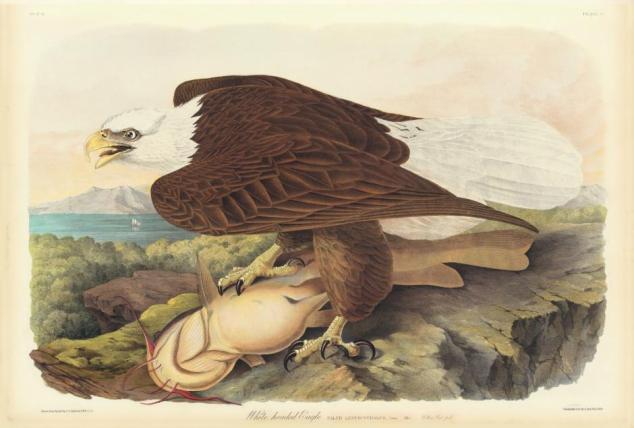
Often when working on a large bird such as an eagle, he would spend up to four 15-hour days, preparing, studying, and drawing it. Each paintings are set true-to-life in their natural habitat, portraying the birds as if caught in motion, especially feeding or hunting.

Although he did paint the birds in his drawings, it was his assistant Joseph Mason who painted the plant life and backgrounds of many of Audubon’s bird studies. Unfortunately, Mason was never credited in any of Audubon’s drawings.

By 1824 Audubon began to seek a publisher for his bird drawings. He met Thomas Sully, one of the most famous portrait painters of the time and a valuable ally, however Audubon was rejected for publication. He took oil painting lessons from Sully and met Charles Bonaparte, who admired his work and recommended he go to Europe to have his bird drawings engraved.

Two years later at age 41, Audubon took his growing collection of work to England. He sailed from New Orleans to Liverpool with his portfolio of over 300 drawings. Audubon quickly gained notoriety in England where he raised enough money to begin publishing his major work, a color-plate book entitled The Birds of America. It was printed on sheets measuring about 39 by 26 inches and contains more than 700 North American bird species, including 25 new species identified by Audubon. The cost of printing the entire work was $115,640 (over $2,000,000 today) and is considered one of the finest ornithological works ever completed.

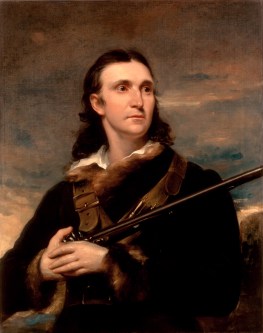
John_James_Audubon_1826.jpg

John James Audubon

Today most copies of The Birds of America can only be found in museums. However, a complete copy of the first edition was sold in January 2012 at Christie’s auction house in Manhattan for $7.9 million.

Audubon died at his family home in northern Manhattan on January 27, 1851. Fifty-four years after his death, George Bird Grinnell, who was appalled by the negligent and mass slaughter of birds that he saw taking place created the National Audubon Society. As a boy, Grinnell was inspired by Audubon’s work. So much so, that when Grinnell decided to create an organization devoted to the protection of wild birds and their eggs, he didn’t hesitate in using Audubon’s name.

Because of market hunting and the fashion industry many of the birds Audubon painted became extinct. Thanks to the work of the National Audubon Society there are thousands of birds that have been saved. John James Audubon’s work and research inspired many. He left a body of work for generations to enjoy which makes him truly, the bird man of America.

Shine On

Sunflower Farm

“To live is so startling
it leaves but little room
for other occupations.”
Emily Dickinson


There’s a YouTube channel I follow and enjoy watching, the Sunflower Farm Creamery. The farm is located in Cumberland, Maine and broadcast on YouTube since January 2012. The farm is owned by husband and wife school teachers that raise Nigerian Dwarf Goats. The couple also make and sell goat cheese, fudge and caramel.

I began following them because I found it extremely relaxing to watch their beautiful old farm and the playful goats.

Recently, with the Coronavirus impacting even this farm, the owner began daily videos showing all her pregnant goats and has included some yoga and meditation to follow along. The 30+ momma goats are due to foal their kids in less than 2 weeks, so I watch daily to see not only their progress but look forward to the arrival of all the kids.

If you want to relax and enjoy a good daily laugh, I’d suggest watching Sunflower Farm.

Shine On