More Science and Less Fiction

“You may not see massive UFO exhibits
at your local science museum, but there’s
no dearth of saucer stories infesting my email.
Every day, I receive several reports of alien sightings,
extraterrestrial plans for Earth, and agitated screeds
about the reluctance of scientists to
take the whole subject seriously.”
Seth Shostak

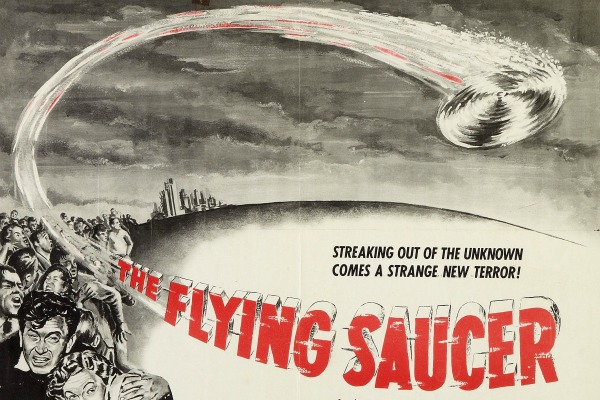
flying_saucer_poster-02

The news report described the sighting of a shiny saucer like object over a small sleepy town in Idaho. The early dusk sighting witnessed by a barber and his customer.

Why is it my fellow Blogaholics, the majority of flying saucer sightings are by Joe Blow from Idaho? Why are sightings rarely seen in large metropolitan areas of the World? Most importantly, when and where did the terror of flying saucer sightings begin?

Apparently, disc-shaped flying objects have been recorded throughout history since the Middle Ages. The first highly publicized sighting was by Kenneth Arnold on June 24, 1947. On that day, Mr. Arnold was flying his small plane near Mount Rainier in Washington State when he saw something unexplainable at the same altitude he was flying. A chain of nine objects shot across the sky, glinting in the sun as they traveled. By his observation, these objects traveled at a speed of 1,700 miles per hour, or three times faster than any manned aircraft of its time.

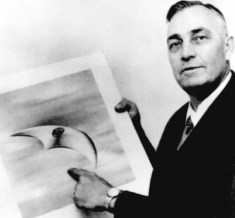
kenneth-arnold

Kenneth Arnold with a sketch of a disc-shaped flying object.

Mr. Arnold never specifically used the term flying saucer. At the time, he was quoted saying the shape of the objects he saw was like a saucer, disc, or pie-plate, and several years later added he had also said the objects moved like saucers skipping across the water. Both the terms flying saucer and flying disc were used commonly and interchangeably in the media until the early 1950s. Then in 1952 the United States Air Force used a much broader term, unidentified flying objects or UFOs.

As time soon proved, this was just the tip of the iceberg and the era of UFO sighting had begun. It wasn’t long until everyone was looking for these new aircraft, which according to the papers were saucer-like in shape. In just a few short weeks, hundreds of reports of these flying saucers were made across the nation. While people thought they were seeing the same things that Kenneth Arnold saw, there was a major irony that nobody at the time realized. Kenneth Arnold hadn’t reported seeing flying saucers.

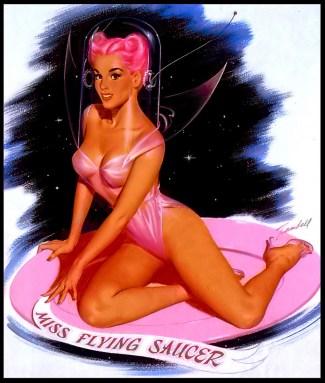
Miss Flying Saucer

Today many of the alleged flying saucer sightings of the era are now believed to be hoaxes. Photographs and movies altered by someone wanting to obtain their fifteen minutes of fame. The flying saucer is now considered largely an icon of the 1950s B-movies and is still a popular subject in science fiction.

This obsession with UFOs may have started several decades ago but it still is an area of science that is unable to be explained. Who knows, maybe in the not too distant future the Miss Universe pageant will be replaced by the Miss Flying Saucer pageant and there will be proof that UFOs are more science and less fiction.

Shine On


Our Furtive Foxy Friend

“A fox is a wolf who sends flowers.”
Ruth Brown


The Fox

The North American Red Fox aka the Vulpes vulpes

Around dusk this past evening, I was on my walk and saw what appeared to be a fox. We have lots of coyotes roaming the city, but a fox? I must have been mistaken.

It piqued my curiosity, so I did a little research about the fox. I found out some interesting facts about foxes on a California website.

The fox, the smallest member of the dog family, is a highly adaptable species that inhabits mostly forest, chaparral, and desert regions, but can be found in nearly all habitats. There are three types of fox common to Southern California, including the Gray Fox, Red Fox, and Island Fox. The Southern California Kit Fox, a subspecies of Kit Fox, died out in Southern California in 1903.

Foxes are more solitary in their habits than are others in the dog family. They are territorial and can be aggressive, especially during the breeding season. Their once-a-year breeding season corresponds with the availability of food.

Despite the fact that urban foxes use human buildings for shelter and human refuse for food, their contact with humans is quite limited. Most people who live in an urban area have never seen a fox in the city. Foxes keep a nocturnal schedule, and in the nighttime are often mistaken for dogs when they are seen.

Red Foxes, the most commonly recognized fox, are known for their cleverness and have the largest range in North America. Although they are close relatives of the Gray Fox, they are considerably larger, normally ranging in size from ten to fifteen pounds. Their coats may be reddish or gray or even black, but their legs and feet are always black. The tail is tipped with white.

In California there are two populations of Red Fox- the native Sierra Nevada Red Fox, a threatened species found only in the Sierra Nevada and Cascade mountain ranges, and the more common, non-native Red Fox. Non-native Red Foxes were introduced decades ago for fox hunting and fur farming. Over time, these foxes escaped or were released. Their populations have grown and gradually spread. Currently, they have been spotted throughout the lowland areas of California including the Sacramento and San Joaquin Valleys, San Francisco Bay-Delta area, the Southern California Coast Range and Coastal Plain and in most major urban areas.

Socially, the fox communicates with body language and a variety of vocalizations. Its vocal range is quite large and its noises vary from a distinctive three-yip “lost call” to a shriek reminiscent of a human scream. It also communicates with scent, marking food and territorial boundary lines with urine and feces.

Now after reading about the fox, I’m positive it was a fox that I saw. I know it wasn’t a dog, because it had all the mannerisms of a fox.  Plus, when the fox saw me, it gave me that look that only can be given by our furtive foxy friend.

Shine On

Learn Something New Daily

“Even the wisest mind has something yet to learn.”
George Santayana

learn something new

Unable to capture a Strawberry Moon, but did capture a Redondo Red Sunset

This past weekend was a Strawberry Moon and a penumbral lunar eclipse, which when this occurs the Sun, Earth, and the Moon are imperfectly aligned. The June full moon also happens to be the last full moon of Spring.

I’m embarrassed to say, I never heard of a Strawberry Moon. So being the curious kitty I am, I educated myself. As I dove deeper into the rabbit whole, I learned that every monthly Full Moon has been given a name to reflect the changing seasons and nature, like Harvest Moon, Strawberry Moon, or Snow Moon.

Native American tribes, named the months after features they associated with the seasons in the Northern Hemisphere, and many of these names are very similar or identical.

Full Moon Names

2020Full Moons January  Wolf Moon – Named after howling wolves, which may stem from the Anglo-Saxon lunar calendar. Other names: Moon After Yule, Old Moon, Ice Moon, and Snow Moon.

February  Snow Moon – Named after the snowy conditions. Some North American tribes named it the Hunger Moon due to the scarce food sources during mid-winter, while other names are Storm Moon and Chaste Moon.

March Worm Moon – Named because of the earthworms that come out at the end of winter. It’s also known as the Crow Moon, Crust Moon, Sap Moon, Sugar Moon, and Chaste Moon.

April Pink Moon – Named for the pink phlox flowers which bloom in the early Spring. Other names for this Full Moon include Sprouting Grass Moon, Fish Moon, Hare Moon, and the Egg Moon.

May Flower Moon – This moon signifies the flowers that bloom during this month. Other names for the Full Moon in May are Corn Planting Moon, and Milk Moon.

June Strawberry Moon – Named so for the wild strawberries that start to ripen during this month. Other names are Hot Moon, Mead Moon, and Rose Moon.

July Buck Moon – Is so named because the new antlers emerge on deer buck’s foreheads around this time. This Full Moon is also known as Thunder Moon, Wort Moon, and Hay Moon.

August Sturgeon Moon – Named because of the large number of fish in the lakes where the Algonquin tribes fished. Other names for this Full Moon include Green Corn Moon, Barley Moon, Fruit Moon, and Grain Moon.

September Full Harvest Moon – Technically, the Harvest Moon is the Full Moon closest to the September equinox around September 22. Most years it is in September, but around every three years, it is in October. The Harvest Moon is the only Full Moon name which is determined by the equinox rather than a month.

October Hunter’s Moon – Every three years, the Hunter’s Moon is also the Harvest Moon. Traditionally, people in the Northern Hemisphere spent the month of October preparing for the coming winter by hunting, slaughtering and preserving meats for use as food.

November Beaver Moon – According to folklore, the Full Moon in November is named after beavers who become active while preparing for the winter. It is also known as Frosty Moon, and along with the December Full Moon some called it Oak Moon. Traditionally, if the Beaver Moon is the last Full Moon before the winter solstice, it is also called the Mourning Moon.

December Cold Moon – Is the Full Moon when winter begins for most of the Northern Hemisphere.

Some years have 13 Full Moons, which makes at least one of them a Blue Moon, as it doesn’t quite fit in with the traditional Full Moon naming system. However, this is not the only definition of a Blue Moon.

About every 19 years, there is no Full Moon in February. This is one of several definitions of the term Black Moon. The other definitions refer to a New Moon which does not fit in with the equinoxes or solstices, similar to a Blue Moon.

Colonial Americans adopted many of the Native American names and have since incorporated them into the modern calendar.

Sorry for the long post today fellow Blogaholics, but I like to try and learn something new daily.

Shine On

New Fashion Normal

“A mask tells us more than a face.”
Oscar Wilde


New Fashion Normal

Marine Serre’s Paris Fashion Week Show

Wearing a mask during a pandemic has a long history behind it. A masks first known medical use dates back to the Middle Ages when the Bubonic plague killed almost half of Europe’s population.

The original mask looked similar to a bird with a long black beak. This mask did little to protect its wearer from the plague. The long beak of the mask contained fresh lavender to act as a barrier from the noxious vapors that was believed to spread the plague.

It wasn’t until 1910 when the Manchurian plague in China killed 60,000 people, did doctors learn the true benefits of the mask. Chinese doctor Wu Lien-teh proved that the Manchurian plague was spread by droplets person to person. Wu was also responsible for promoting the idea of quarantine and the wearing of cloth face masks to combat the plague.

The mask has come a long way not only from social acceptability, but technically. Originally, masks were made from cloth or surgical bandages. These original masks were not as good as today’s N95 mask. The N95 is molded not woven out of synthetic fibers that filters at least 95% of airborne particles.

It’s a mask that owes its design to legendary industrial designer, Sara Little Turnbull, who designed molded bra cups back in the 1960s. Yes, you heard me right fellow Blogaholics, a molded bra cup design inspired the coveted N95 mask we know today.

Today, the face mask is morphing once again from medical to fashion necessity and becoming the new fashion normal.

Shine On

Time Traveling

“Once confined to fantasy and science fiction,
time travel is now simply an engineering problem.”
Michio Kaku

Mr Peabody

Mr. Peabody, his boy Sherman and the “Wayback Machine”

The concept of traveling backward and forward in time has always held my fascination. My interest began as a child. Introduced to the idea of time travel by none other than Mr. Peabody and his Wayback machine.

Conceptually, time travel goes back several centuries. Long before H. G. Wells wrote the book, The Time Machine, Japanese, Hindu, and Buddhist all wrote about time travel. In more recent times, people such as Carl Sagan, Stephen Hawking and Michio Kaku have discussed the possibilities of traveling back and forth in time.

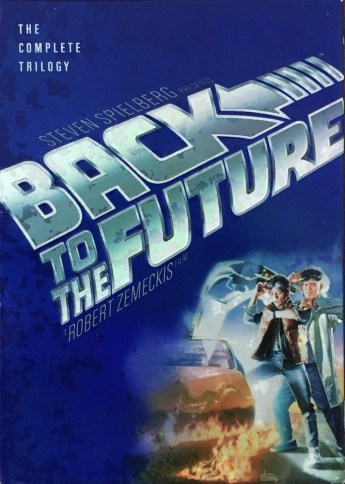
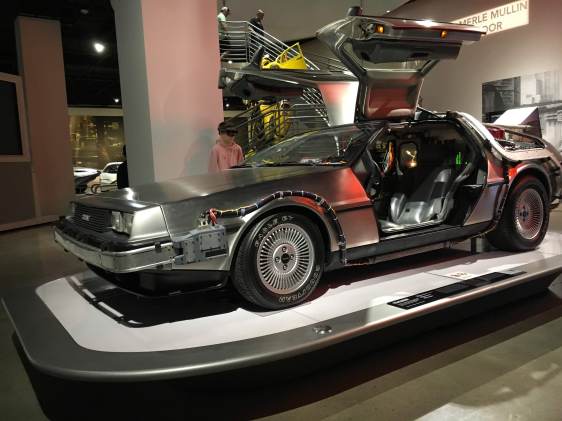
Time travel will forever be one of my favorite genres of novels and movies. Whether I’m reading Stephen King’s novel 11/26/63 or watching, Midnight in Paris, and Back to the Future for the hundredth time, the idea of going back to a time before I existed will always hold my interest in time traveling.

Shine On