African Violets

“Keep calm and grow African Violets.”
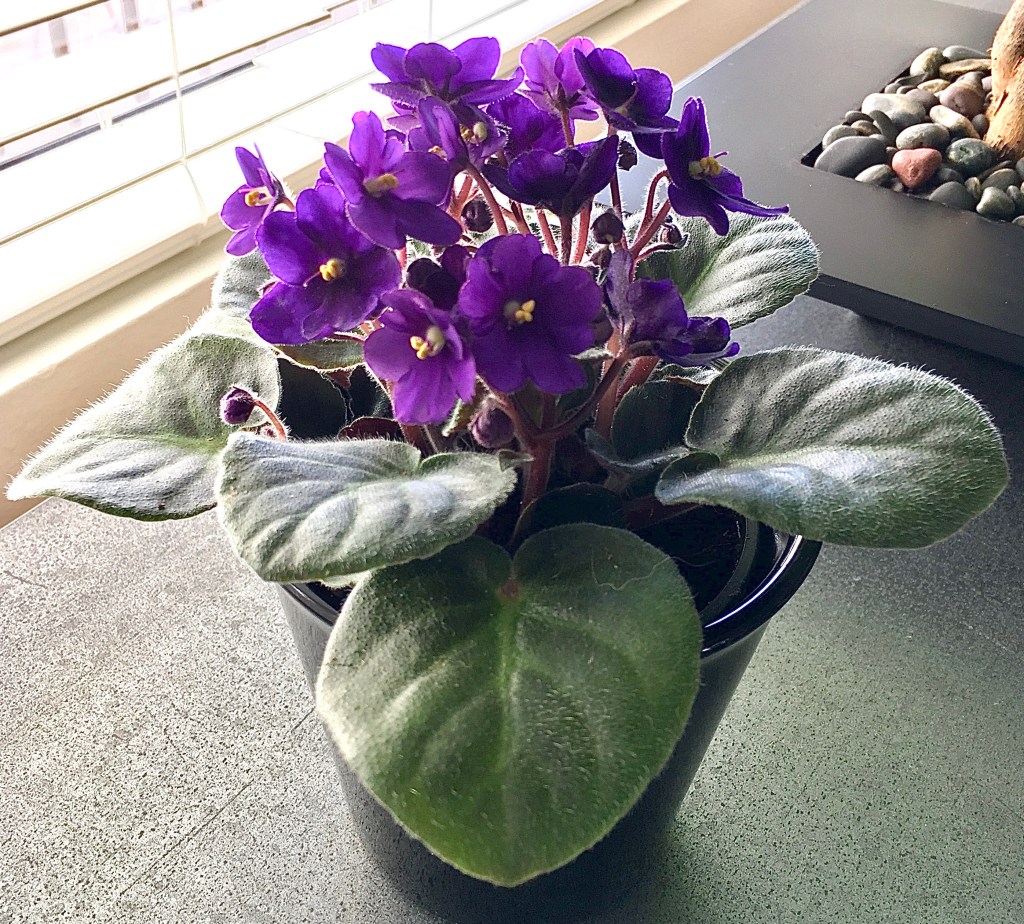
If you live in a small home or apartment, there’s a compact plant that is easy to care for and can cost under $5.00. This colorful flowering plant with clusters of small, fuzzy-leaves originated in East Africa. Thanks to Baron Walter von Saint Paul-Illaire discovery around the 1890s of the Saintpaulia ionantha, now known as the African violet, it grows in homes and offices around the world.

Hardy enough to grow outdoors, the African violets are grown almost entirely as houseplants. There are approximately 10 different species. A full-sized plant typically measures 6 to 9 inches in both height and width. With dark green, thick fuzzy leaves and star-shaped blossoms of white, pink, purple or blue, the African violet makes a boring shelf, coffee table, credenza or desk top more joyful.

African violets are fairly easy to grow. They prefer nighttime temperatures of 65 to 70 degrees Fahrenheit. While daytime temperatures should be in the 75- to 85-degree F range. They can also bloom continuously as long as they are healthy. Just be sure to pinch off wilted flowers at the stem to encourage blooming.

The water needs of this hardy plant are simple. Although, over watering can kill this delicate little plant. I prefer to plant it in a container that has drainage holes at the bottom. Then, I place that container in a shallow tray or decorative pot and fill the pot with about an inch of water, allowing the water to gradually move its way up through the soil. I also never water the top of the plant, to avoid letting water touch the leaves, as this will cause leaf spots and weaken the plant’s system.

During hot summer months, I check to be sure the plant has plenty of water. Usually, I only add water as it evaporates from the bottom.

With minimum care, my African violets blossom throughout the year. Currently, I have three plants and they are one of my favorite indoor flowering plants, the African Violets.

Shine On
Pothos Plants

“Don’t judge each day by the harvest you reap,
but by the seeds that you plant.”
Robert Louis Stevenson

If you’re one of those that believes you don’t have a green thumb, buy a pothos plant and you’ll be surprised to find out how green your thumb can become.

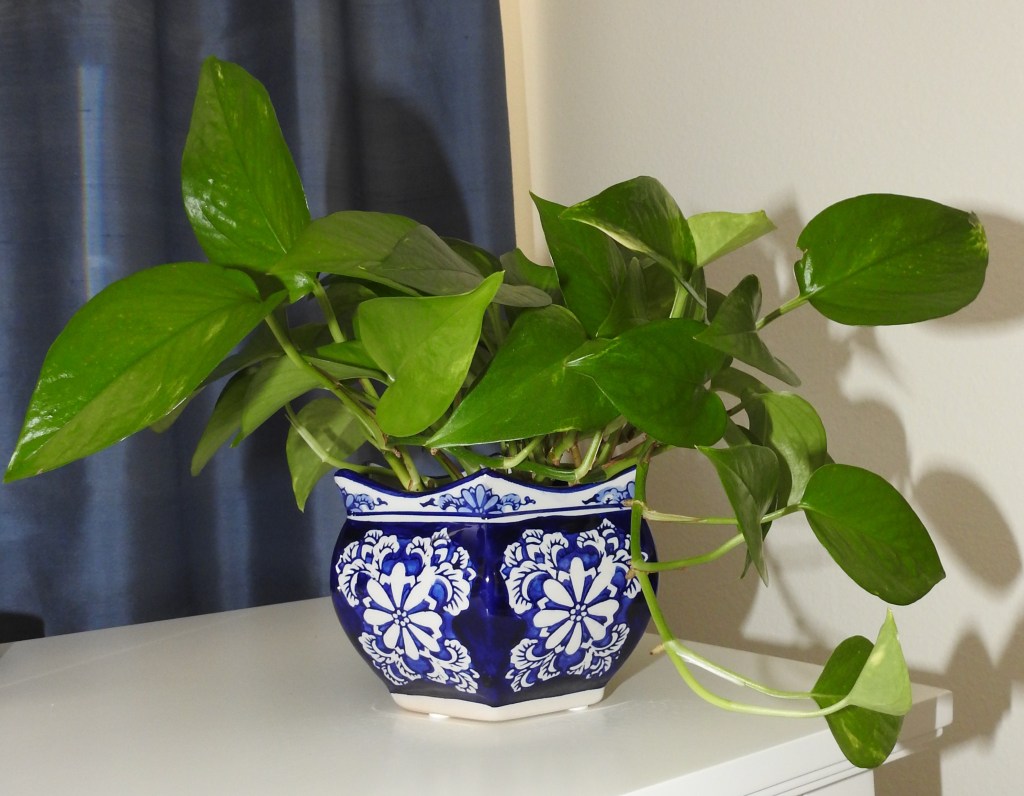
The pothos plant is believed by many to be a great way to get started caring for houseplants. The plants care is undemanding. This hardy plant is an easy way to add some green in your home. They can tolerate low light as well as direct sunlight.

What I love about this plant is its versatility to be grown in water or in dry soil. That’s why propagating them is so easy. Just take a snip off one of the leafy vines, place it in a glass of water and within a week you will have new roots. You can either leave it in the water, as I do sometimes, or plant it in potted soil. The only downside to pothos is they’re poisonous. So, be sure to keep them far enough away from children and animals.

All my plants have been flourishing lately. So much so, that I’ve been propagating a few overgrown ones. Five years ago, I started with one pothos plant and I now have five. Mostly likely by the end of the year, that will grow to half a dozen hardy pothos plants.

Shine On

H is For Hawk


“We carry the lives we’ve imagined
as we carry the lives we have,
and sometimes a
reckoning comes of
all the lives we have lost.”
Helen Macdonald


h-is-for-hawk


Recently I read Helen Macdonald’s book, H is For Hawk.

The book is about the author’s inconsolable grief after the death of her father.

In an effort to heal her soul and regain a connection with her father, she sets out to find and train a hawk. Not just any hawk, a Goshawk.

That is just one of the beauties of her story. She writes about nature and the healing process of her grief through nature and bonding with her Goshawk.

If you are intrigued by birds of prey, as I am, you will enjoy this book immensely. Not only for its behind scenes life of a falconer, but the history of the hobby. Helen Macdonald writes beautiful prose about her life and struggles with depression and how her Goshawk helps her through a difficult time in her life. This book definitely deserves all the attention it has received and I give high marks to H is For Hawk.

Shine On

Bird Man of Our Century


“A bird’s experience is far richer,
complex, and thoughtful than I’d imagined.”
David Allen Sibley


Birdman of the New Millennium
In a previous blog post I wrote about The Bird Man of America, John James Audubon. However, it appears there’s a new bird man of America artist that has been painting and studying birds for over 50 years. He has been called the most important illustrator of birds since Audubon.

David Allen Sibley, ornithologist, self-taught artist and author was born and raised in Plattsburgh, New York. His love of birds began at the age of eight years old while hiking with his father, Fred Sibley, famous ornithologist at Yale University.

Often after hiking with his dad, David would sketch all the different birds he had encountered from memory. His bird-watching hobby became a life-long passion. Much so, that he dropped out of college at Cornell University to pursue the study of birds.

Through the past five decades, Sibley has drawn and painted thousands of species of birds. His love of birds and painting them has never wavered. It was his goal to one day publish a field guide book for other bird watchers. With encouragement from his wife, also an ornithologist, he spent 14 years traveling, researching and painting birds for the book.

His hard work paid off and his goal was achieved in 2000, when his first book, The Sibley Field Guide to Birds was published. Shortly after publication, his first volume was on the New York best seller list and David followed up that book with numerous other popular guide books.

Even after half a century of bird-watching, David Sibley continues to study and learn new things about his favorite topic. When he did research for his recent book, What’s It’s Like to Be a Bird, he became convinced of something he had not previously anticipated: “Birds routinely make complex decisions and experience emotions”. In this book, he also covers such topics as; Do birds have a good sense of smell? Where do birds go at night? Where do they sleep?

With over 8.7 million species of birds throughout the entire world, I’m pretty sure his latest bird book won’t be the last for this bird man of our century.

Shine On

Captivating Comet


“Science is an ongoing process. It never ends.
There is no single ultimate truth to be achieved,
after which all the scientists can retire.”
Carl Sagan


NEOWISE Comet

NEOWISE Comet from Mt. Hood, Oregon by Daniel Springer –  July 2020

A few weeks back, a good friend asked if I had the opportunity to photograph the comet, NEOWISE in the skies over Redondo Beach. Unfortunately, because of overcast evening skies, I have not been able to get a good photo of the comet. However, I still have time since the comet will be visible through mid-August.

This fairly large, 3 mile across comet was first spotted by The Jet Propulsion Laboratory (JPL) on March 27th. NEOWISE is named after the JPL space telescope used to first discover the comet, the Near-Earth Object Wide-field Infrared Survey Explorer aka NEOWISE. To learn more about the NEOWISE JPL Mission visit, https://www.jpl.nasa.gov/missions/neowise/

The newly discovered comet might become known as the Great Comet of 2020 because it won’t be returning to our neck of the world for another 6,800 years. Why? Because, that’s how many years it takes this comet to complete its journey around the sun. It’s also one of the few comets visible without the use of a telescope or even binoculars. According to JPL, NEOWISE is the brightest comet since Comet Hale-Bopp visited us in 1997.

Joseph Masiero, NEOWISE deputy principal investigator at JPL, said in a recent interview that, “. . . by combining the infrared data with visible-light images, we can tell that the comet’s nucleus is covered with sooty, dark particles left over from its formation near the birth of our solar system 4.6 billion years ago.”

If you’re interested in capturing a beautiful photograph like the one my friend’s son Daniel took at Mt. Hood in Oregon, start looking up at the sky about one hour after sunset. According to the Sky & Telescope magazine, you’ll find the comet just over the northwest horizon as the last of twilight fades into darkness. Look about three fists below the bowl of the Big Dipper. The comet has also been getting brighter and brighter in the early morning sky as well.

Good luck my fellow Blogaholics in photographing or just experiencing this captivating comet.

Shine On