Redondo Beach Foxes

It only takes one clever fox
to best a thousand men.”
Nina Varela
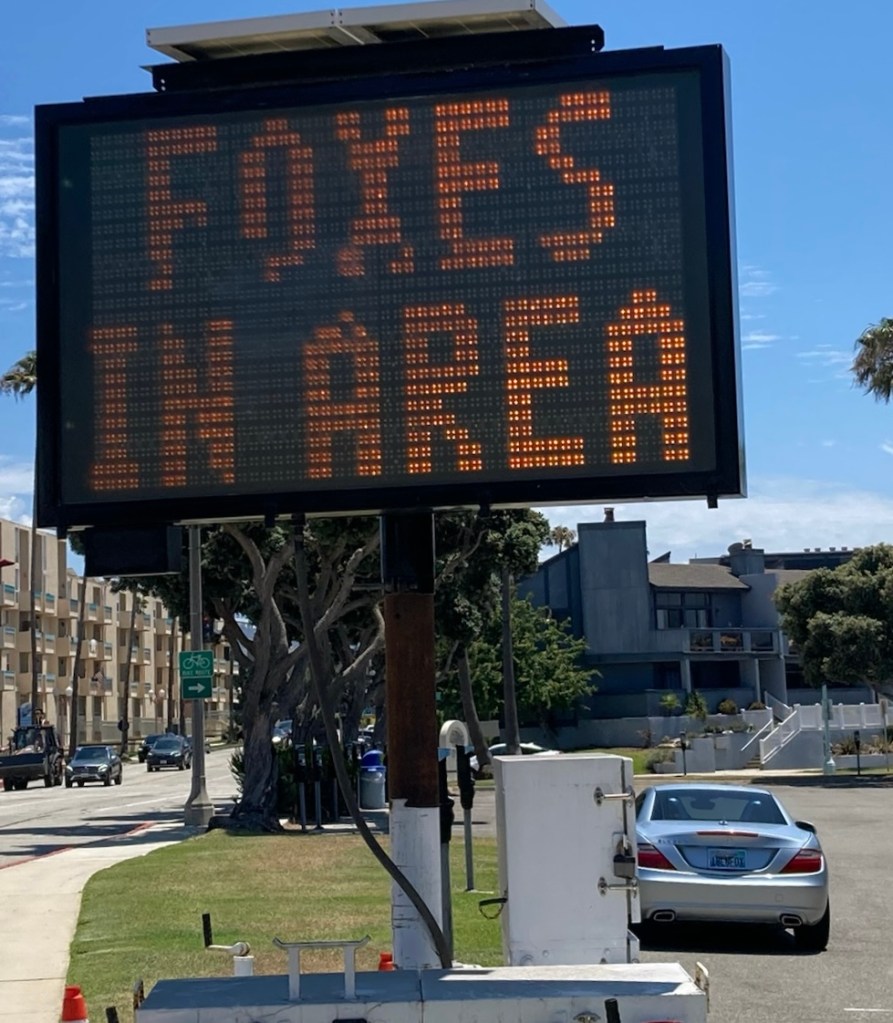


While driving home the other day, I saw this Dynamic Message Sign (DMS), “FOXES IN AREA”. I pulled over to take a photo. That’s my blue car in the bottom right. It’s hard to read my license plate but it reads: IBLUFOX. Yes, I’m a big fan of the fox, so much so I nicknamed my car, “Blue Fox”.

Over ten years ago, I saw a red fox on my daily evening walks. When I got home and told my husband, his response was: “We live at the beach. The only foxes I’ve ever seen are the bikini-clad ones.”

I wish my husband was alive today to witness the City of Redondo Beach announcing foxes in the area.
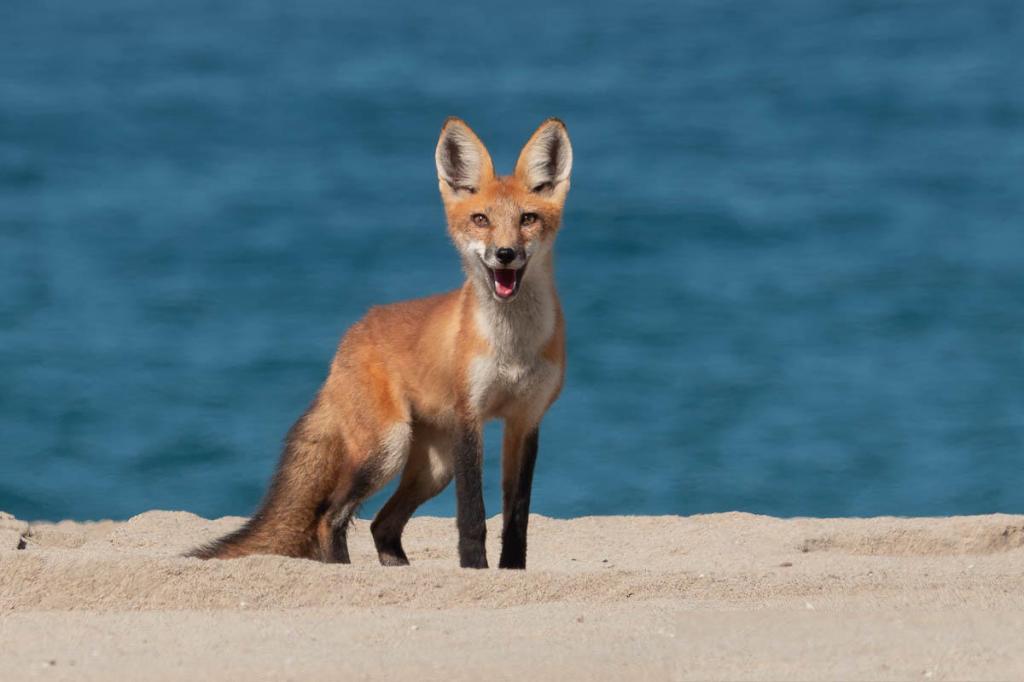
In California there are two populations of Red Fox – the native Sierra Nevada Red Fox, a threatened species found only in the Sierra Nevada and Cascade mountain ranges, and the more common, non-native Red Fox. Non-native Red Foxes were introduced decades ago for fox hunting and fur farming.

In my neighboring area of Palos Verdes, back in the 1920s they had fox hunting. Obviously, the foxes they released “outfoxed” the riders and headed to Redondo Beach to be closer to the ocean. Their populations have grown and gradually spread.

The fox, the smallest member of the dog family, is a highly adaptable species that inhabits mostly forest, chaparral, and desert regions, but can be found in nearly all habitats. There are three types of fox common to Southern California, including the Gray Fox, Red Fox, and Island Fox. The Southern California Kit Fox, a subspecies of Kit Fox, died out in Southern California in 1903.
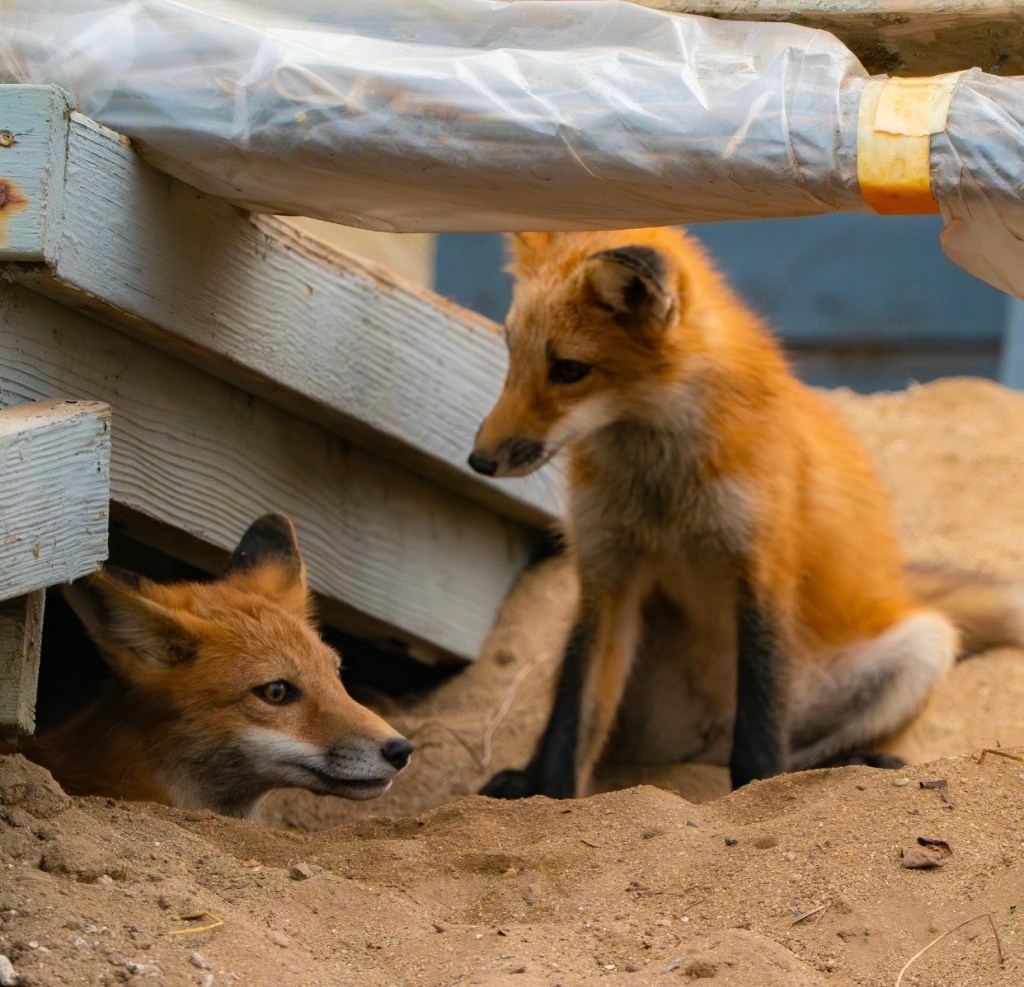
Two Red Foxes living at the beach under a lifeguard stand

Foxes are more solitary in their habits than are others in the dog family. They are territorial and can be aggressive, especially during the breeding season. Their once-a-year breeding season corresponds with the availability of food.

Despite the fact that urban foxes use human buildings for shelter and human refuse for food, their contact with humans is quite limited. Most people who live in an urban area have never seen a fox in the city. Foxes keep a nocturnal schedule, and in the nighttime are often mistaken for dogs when they are seen.

Red Foxes, the most commonly recognized fox, are known for their cleverness and have the largest range in North America. Although they are close relatives of the Gray Fox, they are considerably larger, normally ranging in size from ten to fifteen pounds. Their coats may be reddish or gray or even black, but their legs and feet are always black. The tail is tipped with white.

Socially, the fox communicates with body language and a variety of vocalizations. Its vocal range is quite large and its noises vary from a distinctive three-yip “lost call” to a shriek reminiscent of a human scream. It also communicates with scent, marking food and territorial boundary lines with urine and feces.

With all our fires and oil spills the last few years, our wild life has had to relocate and adapt. The bright side is some of our wild life thought to be outsourced by fires, and over building in rural areas have actually been thriving.

It’s exciting to witness one of my favorite animals in my own backyard, the Redondo Beach foxes.

Shine On
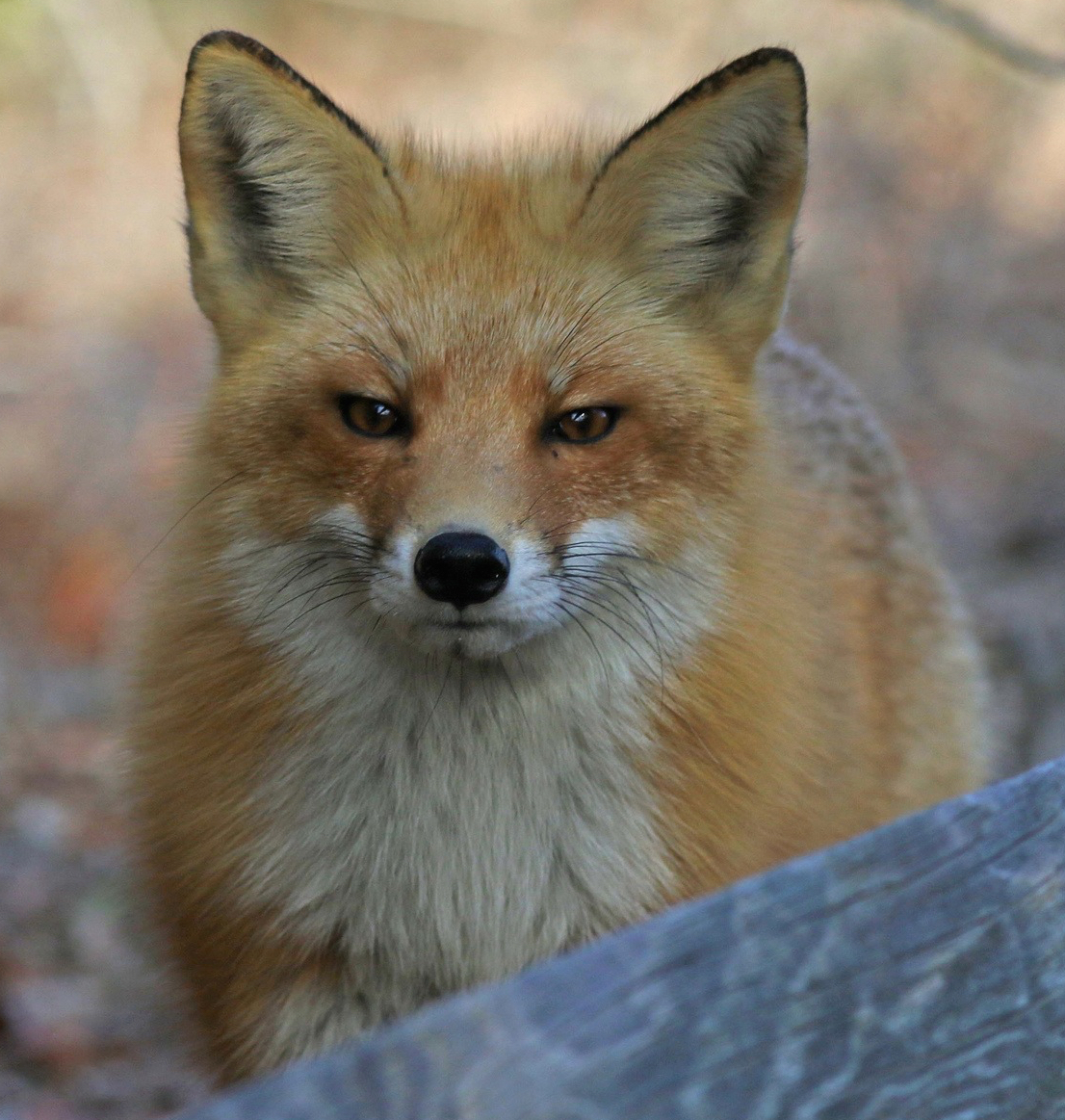
Our Furtive Foxy Friend

“A fox is a wolf who sends flowers.”
Ruth Brown


The Fox

The North American Red Fox aka the Vulpes vulpes

Around dusk this past evening, I was on my walk and saw what appeared to be a fox. We have lots of coyotes roaming the city, but a fox? I must have been mistaken.

It piqued my curiosity, so I did a little research about the fox. I found out some interesting facts about foxes on a California website.

The fox, the smallest member of the dog family, is a highly adaptable species that inhabits mostly forest, chaparral, and desert regions, but can be found in nearly all habitats. There are three types of fox common to Southern California, including the Gray Fox, Red Fox, and Island Fox. The Southern California Kit Fox, a subspecies of Kit Fox, died out in Southern California in 1903.

Foxes are more solitary in their habits than are others in the dog family. They are territorial and can be aggressive, especially during the breeding season. Their once-a-year breeding season corresponds with the availability of food.

Despite the fact that urban foxes use human buildings for shelter and human refuse for food, their contact with humans is quite limited. Most people who live in an urban area have never seen a fox in the city. Foxes keep a nocturnal schedule, and in the nighttime are often mistaken for dogs when they are seen.

Red Foxes, the most commonly recognized fox, are known for their cleverness and have the largest range in North America. Although they are close relatives of the Gray Fox, they are considerably larger, normally ranging in size from ten to fifteen pounds. Their coats may be reddish or gray or even black, but their legs and feet are always black. The tail is tipped with white.

In California there are two populations of Red Fox- the native Sierra Nevada Red Fox, a threatened species found only in the Sierra Nevada and Cascade mountain ranges, and the more common, non-native Red Fox. Non-native Red Foxes were introduced decades ago for fox hunting and fur farming. Over time, these foxes escaped or were released. Their populations have grown and gradually spread. Currently, they have been spotted throughout the lowland areas of California including the Sacramento and San Joaquin Valleys, San Francisco Bay-Delta area, the Southern California Coast Range and Coastal Plain and in most major urban areas.

Socially, the fox communicates with body language and a variety of vocalizations. Its vocal range is quite large and its noises vary from a distinctive three-yip “lost call” to a shriek reminiscent of a human scream. It also communicates with scent, marking food and territorial boundary lines with urine and feces.

Now after reading about the fox, I’m positive it was a fox that I saw. I know it wasn’t a dog, because it had all the mannerisms of a fox.  Plus, when the fox saw me, it gave me that look that only can be given by our furtive foxy friend.

Shine On

Time Traveling

“Once confined to fantasy and science fiction,
time travel is now simply an engineering problem.”
Michio Kaku

Mr Peabody

Mr. Peabody, his boy Sherman and the “Wayback Machine”

The concept of traveling backward and forward in time has always held my fascination. My interest began as a child. Introduced to the idea of time travel by none other than Mr. Peabody and his Wayback machine.

Conceptually, time travel goes back several centuries. Long before H. G. Wells wrote the book, The Time Machine, Japanese, Hindu, and Buddhist all wrote about time travel. In more recent times, people such as Carl Sagan, Stephen Hawking and Michio Kaku have discussed the possibilities of traveling back and forth in time.

Time travel will forever be one of my favorite genres of novels and movies. Whether I’m reading Stephen King’s novel 11/26/63 or watching, Midnight in Paris, and Back to the Future for the hundredth time, the idea of going back to a time before I existed will always hold my interest in time traveling.

Shine On

Our Men of Honor

“A nation reveals itself not only by the men it produces,
but also by the men it honors, the men it remembers.”
John F. Kennedy

Lincoln Memorial

The Lincoln Memorial, Washington D.C. This nineteen-foot tall statue of Abraham Lincoln emerged from the design of Massachusetts sculptor Daniel Chester French whose attention to detail, accuracy, and composition created a masterpiece.

Today, March 3, 1865 marks the 150th anniversary of the day President Abraham Lincoln signed a law to establish a national soldiers and sailors asylum. It was signed a month before the Civil War ended and the day before his second inauguration. Its roots can be traced back to 1636, when the Pilgrims of Plymouth Colony were at war with the Pequot Indians.

The Pilgrims passed a law that stated that disabled soldiers would be supported by the colony. Later, the Continental Congress of 1776 encouraged enlistments during the Revolutionary War, providing pensions to disabled soldiers. In the early days of the Republic, individual states and communities provided direct medical and hospital care to Veterans. Then, in 1811, the federal government authorized the first domiciliary and medical facility for Veterans. Also in the 19th century, the nation’s Veterans assistance program was expanded to include benefits and pensions not only for Veterans, but for their widows and dependents.

Home for Disabled Veterans

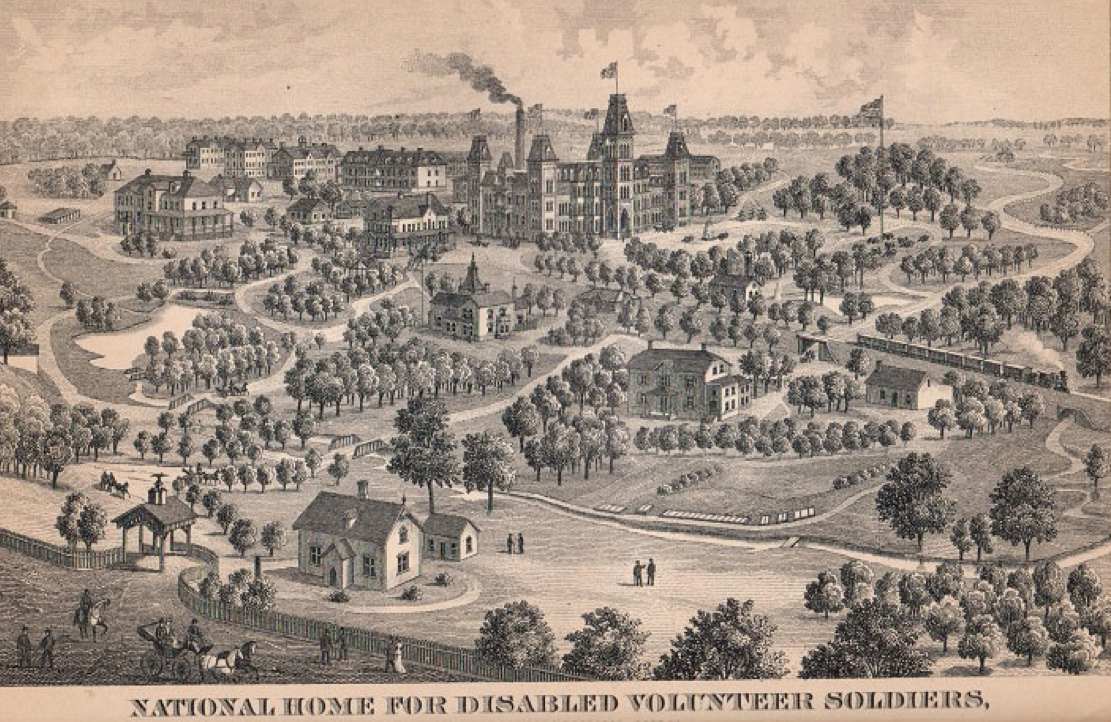
An illustration of the Milwaukee location of the National Home for Disabled Volunteer Soldiers, from the 1885 edition of the Wisconsin Blue Book.

It wasn’t until 1873 that the National Home for Disabled Volunteer Soldiers was established. It was the first-ever government institution created specifically for honorably discharged volunteer soldiers. The first national home opened November 1, 1866, near Augusta, Maine. These national homes were often called “soldiers’ homes” or “military homes,” and only soldiers who fought for the Union Army—including U.S. Colored Troops—were eligible for admittance.

The sprawling campuses became the template for future generations of federal Veterans’ hospitals. Because of President Lincoln, today the United States has the most comprehensive system of assistance for Veterans of any nation in the world.

Thank you President Lincoln for being the first in our government to have the compassion and the forethought to look after all of our past, present and future war veterans. Our men of honor.

Shine On