Keaton Connoisseur


“A comedian does funny things
A good comedian does things funny.”
Buster Keaton
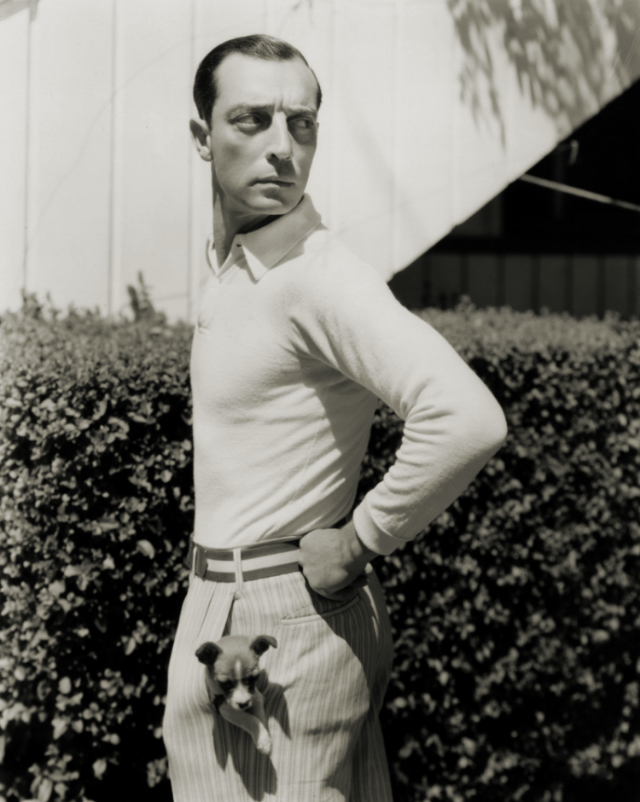

Buster Keaton was one of the most talented writer, director, producer, stunt man and actor of silent films. His acrobatic ability and his films paved the path for future films. Today, there are several writers, comedians and directors who attribute their success by studying and replicating Keaton’s talent for comedy and action movies. From Orson Welles, Mel Brooks, Steven Spielberg to especially Jackie Chan, they all have copied scenes and stunts from Keaton movies.

As a fan of the TCM channel, I enjoy watching their “Sunday Night, Silent Movies”. A few years ago, they showed several Buster Keaton silent movies I had never seen before. Enamored with Buster’s talent, I found myself watching every silent and talking movie Keaton ever starred in or produced. Most of these century old movies can be found on YouTube.

Obsessed with everything Keaton, friends and family began calling me the Keaton Connoisseur. So I created an Instagram handle dedicated to this amazing talented man, which I appropriately named, Keaton Connoisseur.

As a teenager, Keaton was my favorite silent movie star. Point of fact, he lived just a few miles down the street from my house in the San Fernando Valley but unfortunately he died on February 1, 1966 before I could ever get my chance to meet him.

If you are one of the rare people that’s never heard of Buster, please go to YouTube and watch any of his brilliant silent movies. I suggest starting with, The General which he wrote, starred and directed. It is the first movie produced with Buster performing all his own dangerous and exciting stunts. The film is a comic masterpiece. The best stunt in the movie involves him pulling a railroad tie out from being lodged into the track. Then, with the train steadily approaching, he’s sitting on the cow-catcher of the slow-moving train while carrying the tie. He then tosses it at another tie to dislodge it from the tracks. All seamlessly performed with pure Keaton perfection.

When I first saw The General, I couldn’t help but realize this film is one of the first silent action movies. As I watched, it reminded me of the best action movie from 1981, Raiders of the Lost Ark. Coincidently, I recently saw an interview with Steven Spielberg talking about how The General inspired his movie, Raiders of the Lost Ark.
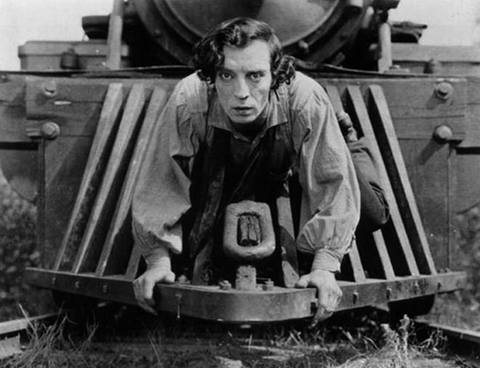

The General was released a century ago in 1926 at the end of the silent era. Buster’s hobby was model trains and the history of trains. He had read the 1889 book, The Great Locomotive Chase by William Pittenger and wanted to make a movie based on this book. At the time of its initial release, The General was billed as an action comedy adventure film and was not well received by critics and audiences.

In a 1963 interview, Keaton said, “I was more proud of that picture than any I ever made. Because I took an actual happening out of the history books, and I told the story in every detail too.”

If you’re interested in learning more about Buster Keaton, I highly recommend starting with watching The General on YouTube. Then I recommend reading James Curtis book, “A Filmmaker’s Life”.

There was no CGI, special effects or even professional stunt men when Keaton made his early movies. He preformed his own stunts; often he sustained major injuries and several times risked his life.

He was the real deal in movies and in life. A rare performer, writer and director and my favorite silent film icon of this Keaton Connoisseur.

Shine On
Yearning To Breathe Free


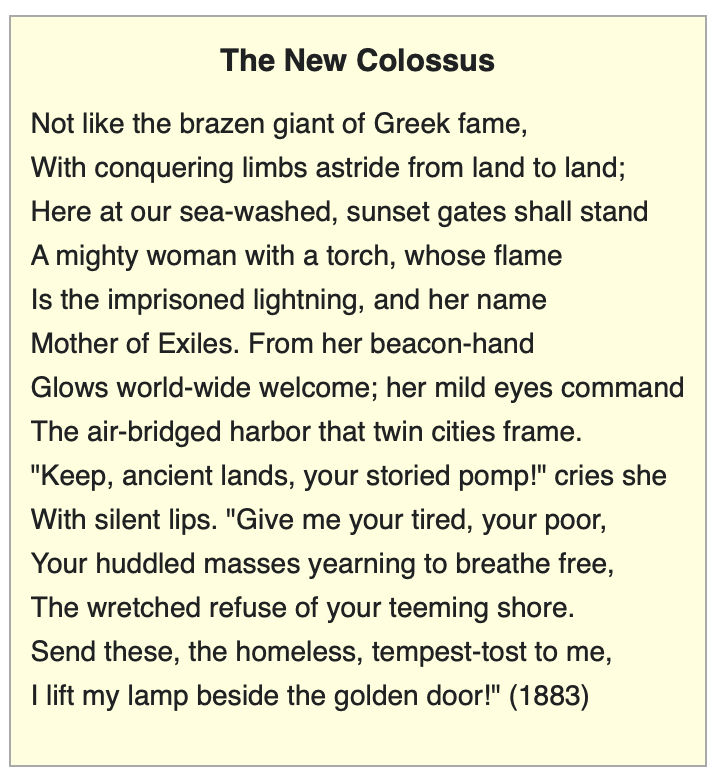
“Give me your tired
Your huddled masses yearning to breathe free
The wretched refuse of your teeming shore
Send these, the homeless, tempest-tost to me
Lift my lamp beside the golden door”
Emma Lazarus

Statue of Liberty


Most American’s don’t know who Emma Lazarus was or why she’s very relevant today. They don’t know she was an American author of poetry, prose and an activist for Jewish causes. Emma’s fame came not from her writing and activism but from a few words on one of our countries most iconic symbols for freedom.

Emma Lazarus was born on July 22, 1849 in New York City, the fourth of seven children. Born to a wealthy Sephardic Jewish family of Portuguese descent, her father, Moses, was a successful sugar merchant who made certain his children got the best education.

Her siblings and she studied with private tutors and learned multiple languages including German, French, and Italian. Excelling in academics, by the time she was seventeen, she had already written a book of poems called Poems and Translations: Written Between the Ages of Fourteen and Sixteen.

As she continued to write, she used her poems and essays to speak out against the persecution of Jews in Europe and growing anti-Semitism in the United States. She publicly proclaimed her identity as a Jewish poet and advocated for Jewish issues internationally. Lazarus wrote in various publications promoting Zionism and a Jewish homeland in Palestine. In addition to her writing, she also met with immigrants and refugees, volunteered at the Hebrew Immigrant Aid Society, and helped establish the Hebrew Technical Institute in New York to provide Jewish immigrants with vocational training.

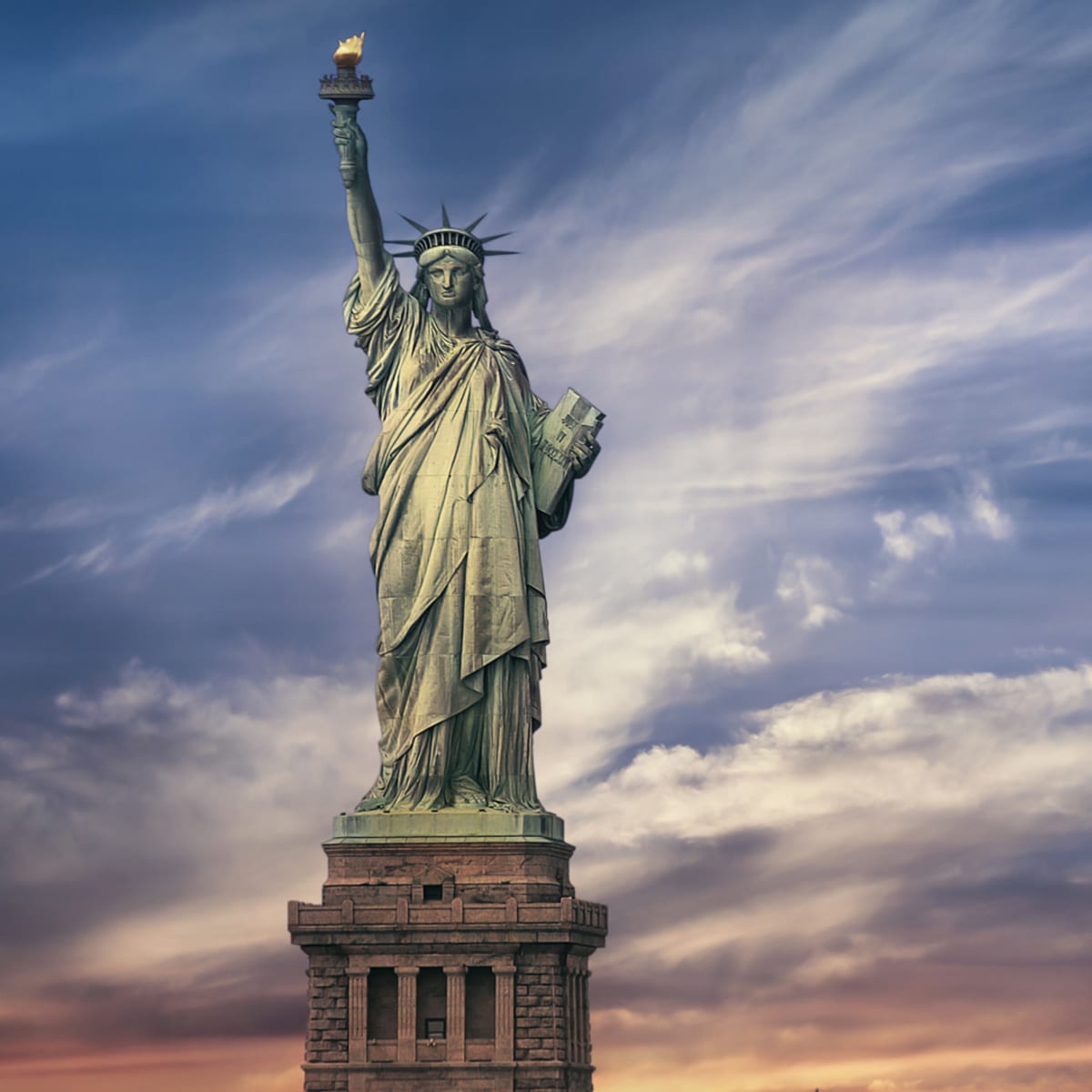
In 1883, Lazarus formed the Society for the Improvement and Colonization of East European Jews. That same year, she wrote The New Colossus, to be presented at auction to raise money for the pedestal of the Statue of Liberty. The organizers decided to print the poem in the Catalogue of the Pedestal Fund Art Loan Exhibition at the National Academy of Design to inspire continued work on the statue. Then late in 1883, one of the lines from Colossus was inscribed on a bronze plaque, and in 1903 wss installed on the pedestal of the Statue of Liberty.

The last stanza of the sonnet was used by many creative people. It was set to music by Irving Berlin in his song “Give Me Your Tired, Your Poor” for the 1949 musical Miss Liberty, which was based on the sculpting of the Statue of Liberty Liberty Enlightening the World. The stanza was also set by Lee Hoiby in his song “The Lady of the Harbor” written in 1985 as part of his song cycle Three Women.

From what I’ve read about Emma, those words on the Statue of Liberty are among her proudest accomplishments. She was a champion in helping immigrants. She knew first hand immigrants experiences coming to a new country and assimilating. She knew how badly they were treated. Her work always produced sensitivity and enduring lessons regarding immigrants and their need for dignity. She contributed toward shaping the self-image of the United States as well as how the country understands the needs of those who immigrated to the United States.

As we celebrate the 250 Anniversary of this country, Emma’s words must be embraced. Because in the current climate of this country, our democracy, our freedom of speech, our immigrants and future immigrants are all in danger.

Now and perhaps more than ever in this country’s history, the inscription on Miss Liberty, rings true for all of us. Especially our immigrants, most of which were our own parents, grandparents and great grandparents. None of us are native to this country except all the Indigenous people.

She never married or had children. Sadly, she died at the young age of 38 years old on November 19, 1887, from Hodgkin’s Lymphoma. Her short lived life was dedicated to her family heritage. Her tour de force in life was helping those like herself, yearning to breathe free.

Shine On

Musicophile

“Music is the soundtrack of your life.”
Dick Clark


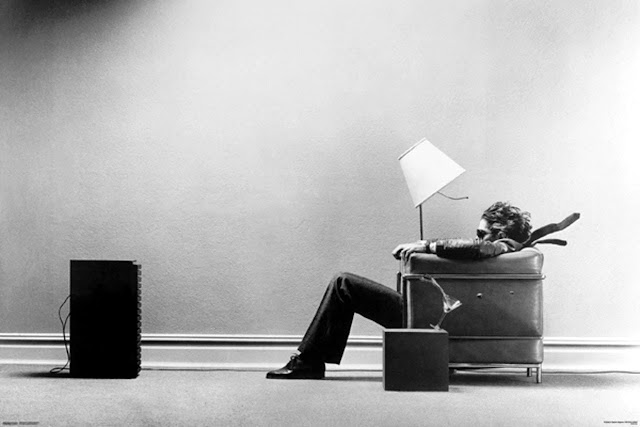
The definition of a musicophile is an avid lover and enthusiast of music. Point of fact, a musicophile’s passion is deeply rooted in the artistry, history, and emotional experience of the music itself. If this definition is true, I believe most people would call themselves a musicophile.

My love of all styles and types of music began as a child. There was music always playing in our home. My parents had a large collection of albums, 45s and even large reel tapes. I learned how to use the record player long before I could read.

Recently I read Oliver Sacks 2007 book, Musicophilia: Tales of Music and the Brain. In this book, Dr. Sacks explores a range of psychological and physiological ailments and their connections to music. He wrote the book in an attempt to widen the general populace’s understanding of music and its effects on the brain. Sacks states at the outset of the book’s preface, music is omnipresent, influencing human’s everyday lives in how we think and act. 

For those of you not familiar with Dr. Sacks work, he wrote the book, Awakenings, which the 1990 feature film by the same name is based. In the book and movie he describes his medical experiences using a drug levodopa on Parkinson’s and post-encephalitic patients at the Beth Abraham Hospital, later Beth Abraham Center for Rehabilitation and Nursing, in New York.

Since the 1970s, there have been multiple studies on the benefits of music therapy for people with medical conditions, trauma, learning disabilities, and handicaps. Most of the documented studies for children have shown a positive effect in promoting self-actualization and developing receptive, cognitive, and expressive capabilities. 

For me, music can evoke a time in my life. Can evoke emotions and even the memory of pleasant scents from decades past. All this from listening to a single song.

During 2023 I published my first poetry book, Heartstrings, An Anthology From A to Z. All the poems in my book I always imagined as lyrics to songs. Then in 2026, I wrote, produced and put together a 13 track album, Dragonfly. I’ve uploaded the album to SoundCloud and will soon add the album to Spotify and Apple Music.

My life long love of music has come full circle, for this full-blown musicophile.

Shine On

Persistent Illusion


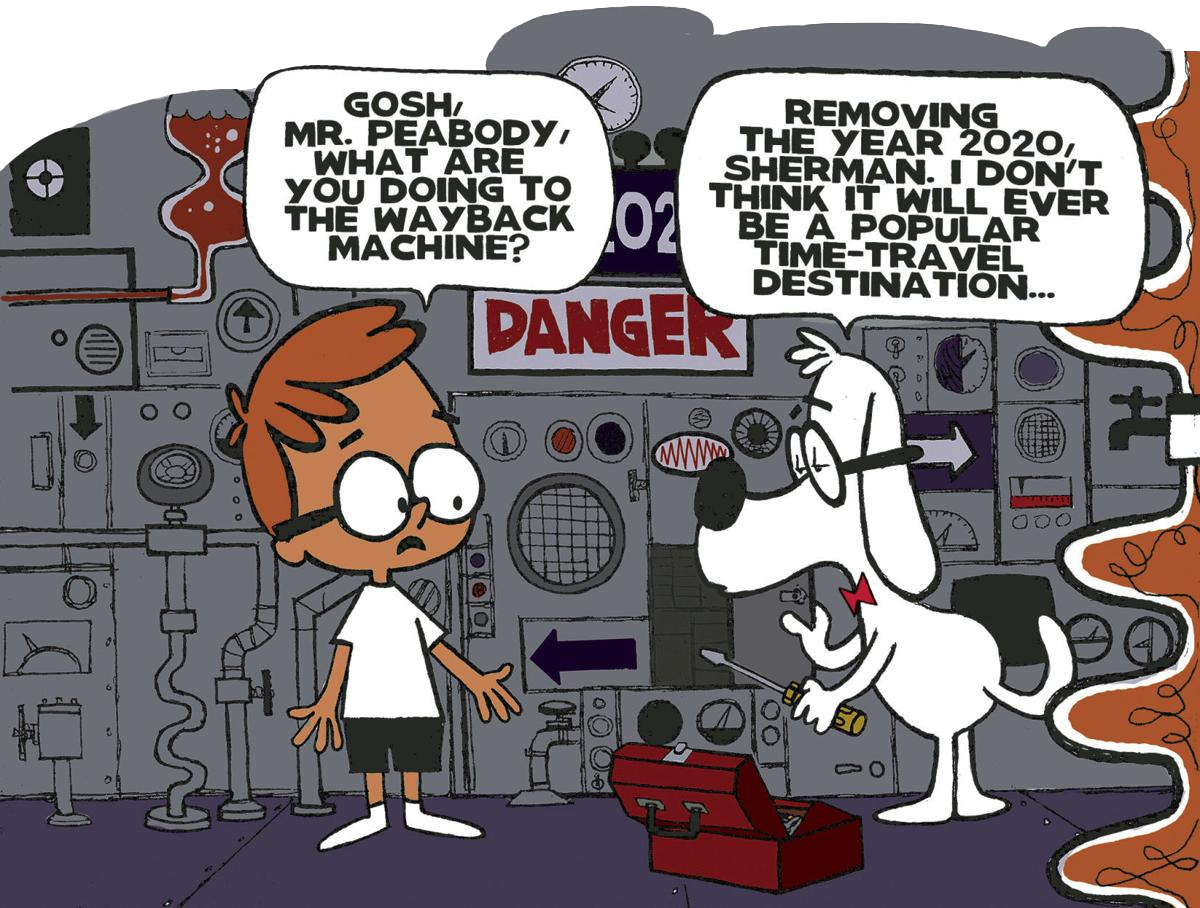
“People like us, who believe in physics, know that the distinction
between past, present and future is only
a stubbornly persistent illusion.”
Albert Einstein

Shine On

Musketeer Mania


“One for all and all for one.”
Musketeer Motto


As a child I was captivated by the French writer Alexandre Dumas 1844 novel, The Three Musketeers. Dumas was the Stan Lee of his time, creating the first youthful super heroes, Aramis, Porthos, Athos, and their protege D’Artagnan. The only difference is, Musketeers actually did exist and Dumas based his characters on some of the most famous of Musketeers.

Anything I could find to read or watch about the Musketeers was on my radar. Mostly because they were excellent equestrians and fencers, two of my favorite combinations, and all Musketeer entertainment had plenty of those two activities. 

My late great uncle was an Olympic fencer. I never had the honor of meeting him, but I like to imagine his passion and talent for fencing was passed on to me. I was fortunate to attend a high school that offered beginning fencing, and this was my first hands-on introduction to this 14th century sport. It’s amazing how much fencing requires a great deal of  mental and physical stamina, balance and fast reflexes. I took to this sport quickly, learning all the common moves and French words for them such as, Advance Lunge, Assault, Extension, Flick, Touché and the most famous En-garde.

Most are introduced to fencing through Hollywood movies. There have been numerous movies about the Musketeers dating as far back as the 1921 silent film adaptation starring Douglas Fairbanks. The first movie I remember watching about the Musketeers was on TV in the 1960s, and was the 1948 movie with Gene Kelly. It’s still one of my favorites because it not only had fencing and horses, but as an extra bonus it had Gene Kelly performing ballet type moves while fencing.

In the 1970s the studios came out with a Raquel Welch and Michael York Musketeer version, which wasn’t one of my favorites. As a little trivia note, this movie was originally proposed in the 1960s as a vehicle for The Beatles. 

Disney released their Musketeer movie adaptation in 1993 starring Charlie Sheen, Kiefer Sutherland, Oliver Platt and Chris O’Donnell. This became my favorite version of all time, until now.

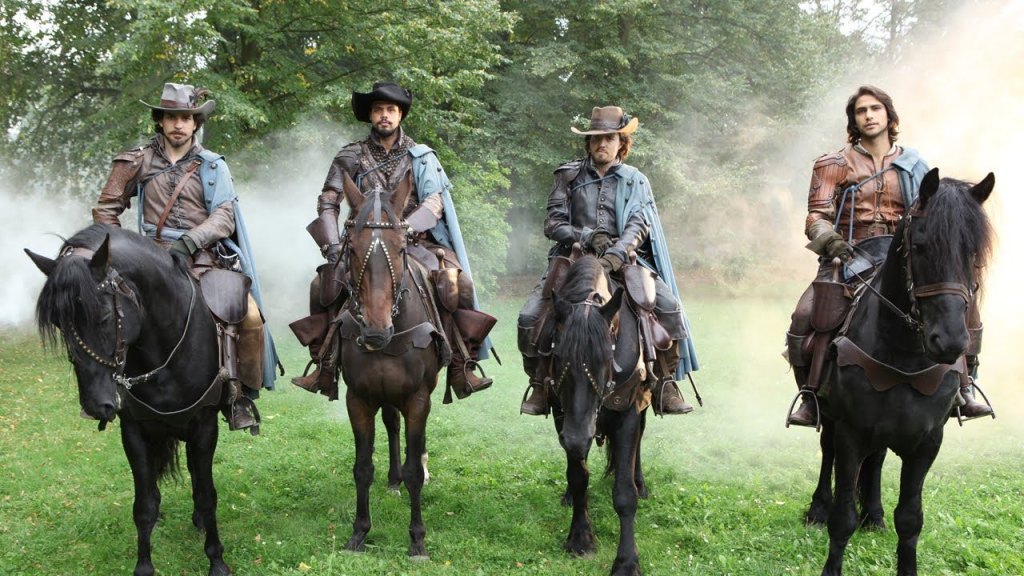
A few weeks back, I discovered on Amazon Prime a 2014 BBC Musketeer series. This exceptional rendition of the swashbuckling Musketeers is now one of my top go to TV series. The acting, costumes, romantic locations, storylines and cinematography is awe inspiring. If you’re looking for some great entertainment to fill your evenings, I highly recommend this series. It certainly is fulfilling my Musketeer mania.

Shine On