A selfie is one way to show off your impeccable fashion, as well as proof that you did something or met someone cool. It’s even turned a few lucky, ordinary people with no special talent, into having a profitable career.
Selfies have been around for more than thirty years. It became popular after Paris Hilton and Britney Spears posed for a selfie.
I was surprised to learn, the first selfie was taken in 1839 on a daguerreotype camera by Robert Cornelius in Philadelphia. Cornelius was an amateur chemist and photography enthusiast. He took the image by removing the lens cap and then running into frame where he sat for a minute before covering up the lens again.
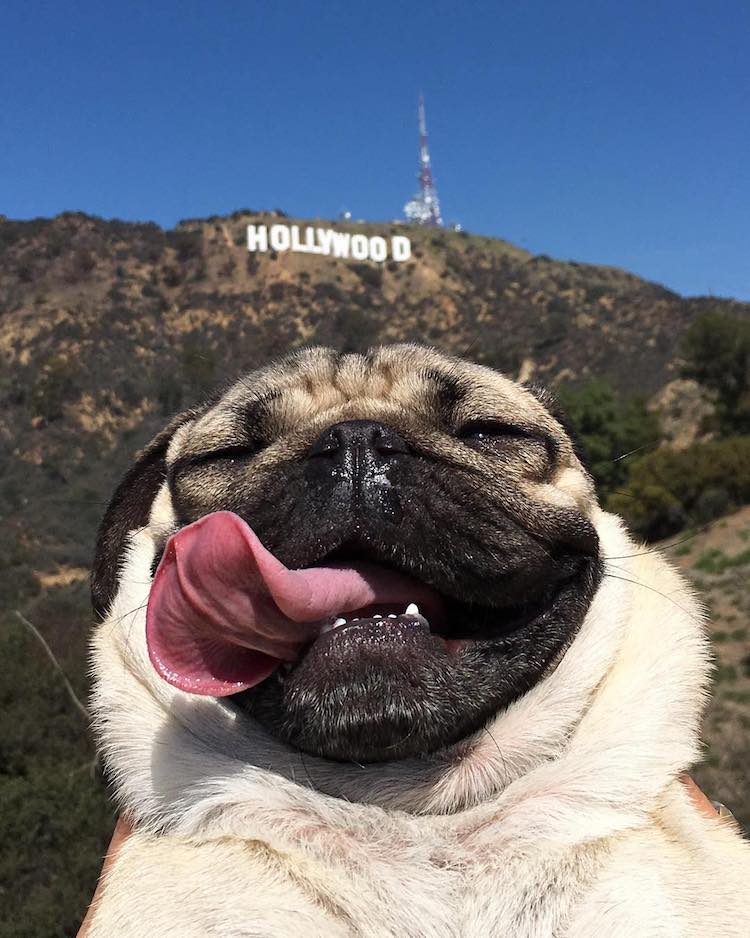
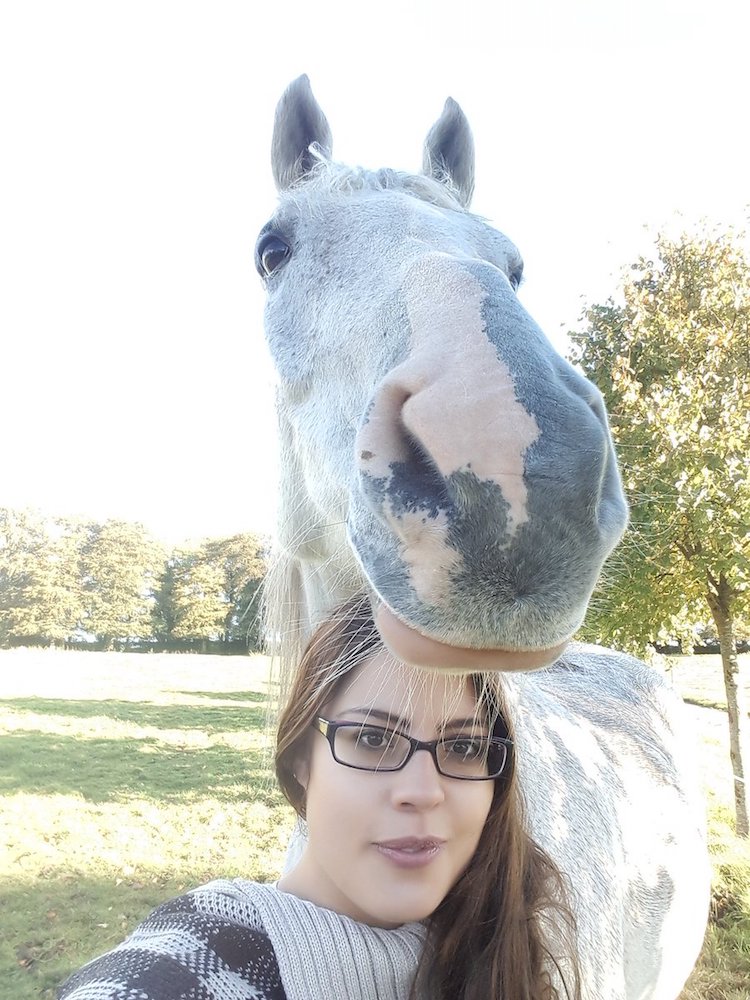
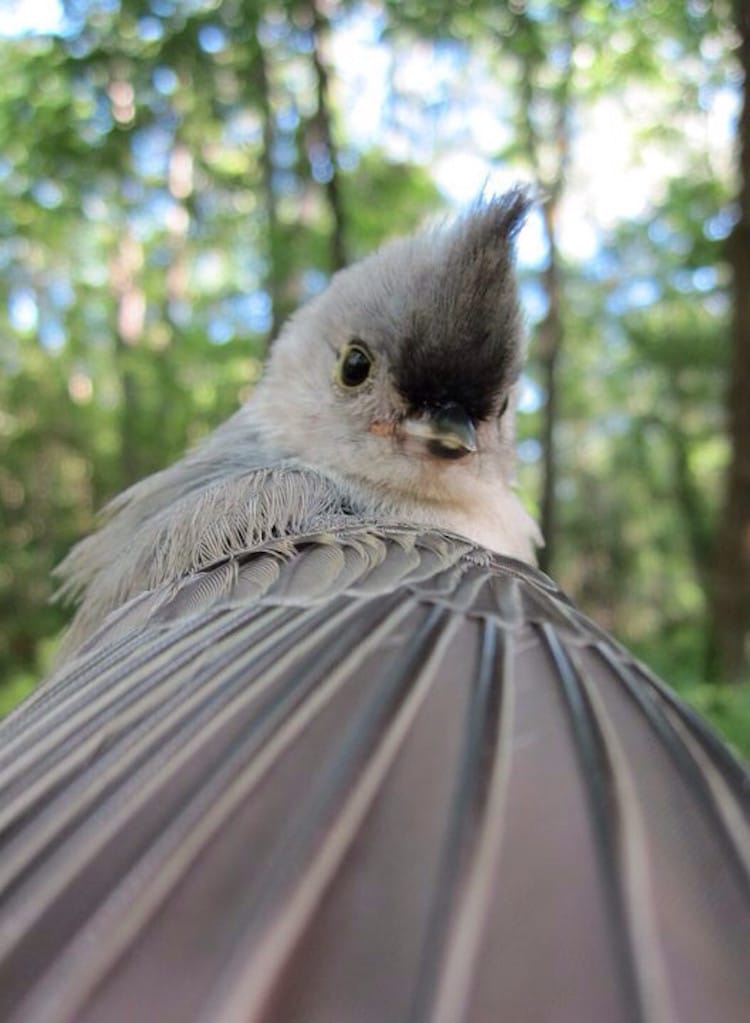
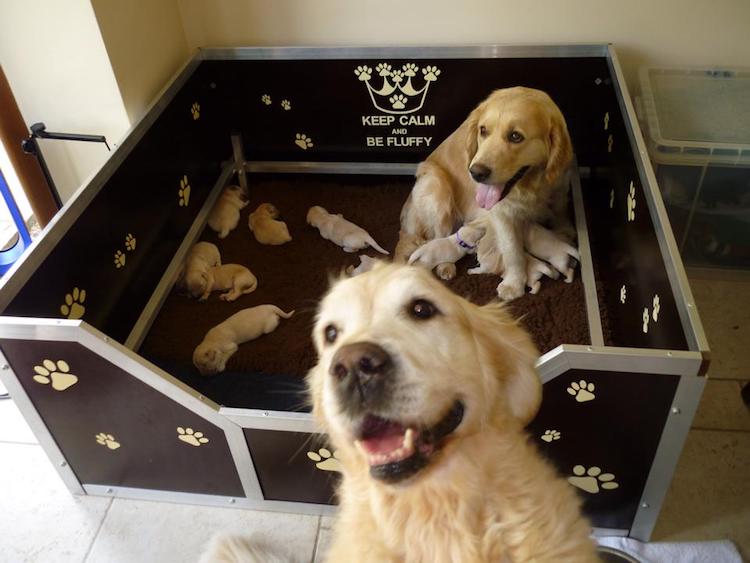
As if there isn’t enough selfie competition, lately the animal kingdom has gotten into the game. Animal selfies are not only amusing, but they might even make you a bit jealous. Some of them are indubitably photogenic.
From wild animals to domesticated pets, these creatures have perfected the art of selfies.
“When we stand together there is nothing, nothing, nothing we cannot accomplish.” Bernie Sanders
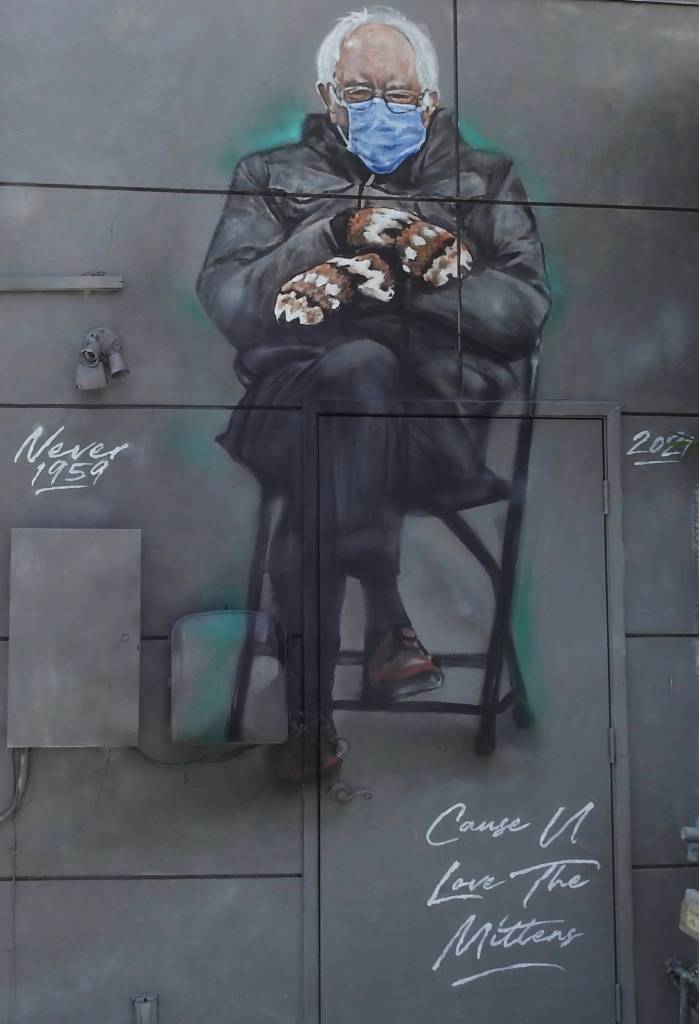
Local Artist Jonas Never Mural of Senator Bernie Sanders – Culver City, California
In my youth, I was never a fan of politics. Mostly because, I once worked for a Fortune 500 Corporation as their PAC Administrator. I experienced firsthand how major organizations dole out large sums of money to politicians they buy with their PAC funds. This job highly enlightened me to the true inner workings of politics.
My view of politicians changed dramatically, when in 1993 I saw Bernie Sanders, Independent Vermont Senator interviewed on CSPAN. I had never heard of Sanders before, but he caught my attention that day. He was the first politician I ever saw who was honest and real, which is never two words that are used simultaneously when describing a political figure.
In the past several decades Sanders has never wavered in his viewpoint against wars, helping veterans, private health care options for veterans, improving our healthcare system and attempting to narrow the gap between the rich and the poor. Funny, how half of America despises the only politician who can’t be bought and never changes his moral values and conduct.
My late husband was a disabled Vietnam veteran. As a wife/caregiver, I always followed any and all news about veterans. Back in 2013, I was watching closely a Veterans Bill that was being turned down by both Democrats and Republicans. At the time, Bernie Sanders was the chairman of the Senate Veterans Committee. Sanders was working tirelessly to get this bill passed. An important bill that would help all veterans.
Meanwhile, during the fight over the bill, national news broke that Veterans across the country were waiting months on end for appointments and the wait times were being hidden. Up to 40 veterans in Phoenix died while waiting for appointments. Hundreds never even got onto a list. And retaliation was the order of the day for those who tried to blow the whistle.
It turned out that nationwide, the VA was coping with the spike in demand by delaying appointments and treatment, manipulating schedules, falsifying records and possibly engaging in fraud. An interim report from the VA Inspector General on May 28, 2014 found it was taking an average 115 days for veterans in Phoenix to get primary care, as opposed to the 24 days shown on official records and 1,700 people seeking appointments were not on any list at all. The IG called the Phoenix problems systemic and said he had opened investigations at 42 VA health centers. On June 9, the VA reported that 57,000 veterans at its facilities were waiting more than 90 days for an appointment, and another 64,000 were not on a waiting list although they had sought care.
My husband and I were not surprised by the news reports concerning the deaths and wait times. We had experienced personally these same problems with the VA for years.
From the moment the scandal broke in April 2014, it took Congress less than four months to produce a new law, a split second by Capitol Hill standards. That it happened at all, and so fast, was a testament to the determination of Sanders and his partners to surmount the red-blue divide in American politics.
In the end, both votes were close to unanimous, a 420-5 in the House and 91-3 in the Senate. Obama signed the VA bill August 7, 2014. The new law, helped ensure that veterans have access to the care that they’ve earned.
Before this bill passed, my husband and I were stressed dealing with the VA and their lack of medical care. I would often wait hours on hold, get disconnected and worse yet, couldn’t get a needed doctor appointment for my husband. After the bill passed, I saw a dramatic improvement in the respect my husband received along with improved medical care and response times from the VA. The biggest improvement was the use of non-VA medical care my husband desperately required.
I truly believe, without Bernie Sanders determination to help veterans, the problems at VA medical facilities would have never improved and more deaths would have occurred.
Most people only know Sanders as that old crazy Independent Senator from Vermont who ran for president in 2016. But, that all changed when Bernie showed up at the 2021 Biden Inauguration dressed in casual attire wearing a heavy parka and hand-made wool mittens from a Sanders fan.
As of today, that image of Bernie bundled up has not only created countless memes and late night jokes, the senator seized on the opportunity to reprint the image on different products that he began selling on his website, Berniesanders.com the following day. The merchandise all sold out in less than 30 minutes, and Bernie has raised over $1.8 million for charities in his home state.
“Jane and I were amazed by all the creativity shown by so many people over the last week, and we’re glad we can use my internet fame to help Vermonters in need,” Sanders said in a written statement.
My son knows how much respect I have for Bernie Sanders, so this past week, he texted me a photo of a mural that a local artist created of Bernie.
I probably will never have the honor of meeting Mr. Sanders. So, being the die-hard Bernie fan that I am, I drove to Culver City and got the next best thing. A photo of this giant, magnificent fresco of my hero, Bernie Sanders bundled up.
“A wheeled vehicle without a horse
is a thing so preposterous to the eyes of
aldermen that it must be forbidden altogether.” The New York Herald Article
circa 1800
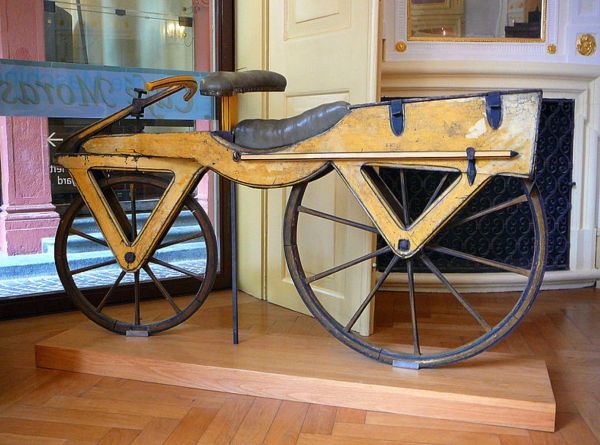
The Baron’s Laufmaschine displayed at the Kurpfälzisches Museum in Heidelberg, Germany
Early in 1817 the Baron built out of cherry tree wood and softwood a “running machine”, which he called a Draisine or a Laufmaschine. The machine was more pony-sized than horse-sized so that the riders feet reached the ground for propulsion.
This early bicycle consisted of a saddle seat, handlebars and a steerable front wheel. Testing and improving it throughout the next few years, the Baron finished his invention and patented the running machine in January of 1818.
Almost overnight the Baron’s Laufmaschine became a sensation. News of the running machine spread westward across Europe. Enthusiasm grew among a small circle of young aristocratic men known as “dandies”. Demonstrating one’s manly abilities was key for “dandies”, and the Laufmaschine was a novelty too challenging and exciting for any dandy to pass up.
The Laufmaschine name was a bit foreign to British, so they renamed it the “dandy horse”. Before long, every young gentleman who aspired to the dandy ideal owned a dandy horse. A basic dandy horse in 1818 cost the equivalent of about $900 in today’s money, which made it a rather expensive plaything. The best of these were constructed by carriage builders; the more crude ones were cobbled together by blacksmiths.
As quickly as it appeared, the dandy horse disappeared. By 1820, the price of oats was back down to pre-1815 levels, and horses were readily available to those who could afford them. It wouldn’t be until the mid-1860s that someone had the idea to put pedals on the front wheel of a dandy horse, giving it an improved means of locomotion, as well as a scrub brake for the rear wheel; an improvement for stopping one from crashing it into a hedge.
So, what happened to the Baron Drais? He went on to also invent the earliest typewriter with a keyboard (1821). He later developed an early stenograph machine which used 16 characters (1827), a device to record piano music on paper (1812), the first meat grinder, and a wood-saving cooker including the earliest hay chest.
The Baron had the misfortune to belong to the losing political party when the Prussians took over Baden, and had his title and property stripped. At age 66, on December 10, 1851, he died penniless and forgotten.
Without the Baron’s aristocratic plaything he invented, the history of the bicycle might have been very different, and certainly less colorful without the creative endeavors of the Baron Drais.
“Truly, the bicycle is the
most influential piece of
product design ever.” Hugh Pearman
1815 Eruption of Mount Tambora, Indonesia
It was the early-18th century in Western Europe when man first began experimenting with human-powered vehicles. In the beginning, these vehicles consisted of four or more wheels and could accommodate up to seven passengers. Much different than carts or carriages, they had handles or ropes for men on foot to push or pull. They were attempts at replacing horses with humans.
Even back in the 1800s, the purchase of a horse was expensive for the working man. No fit and wealthy gentleman would be without a horse for pleasure riding. They usually had horses for drawing carriages, but most affluent European men owned horses for leisure riding.
That all changed in 1815 when the world was thrown into turmoil. A turmoil not from a war or an economic crisis, but because of a small island over six thousand miles from Europe in the South Pacific.
On April 10, 1815, halfway between Asia and Australia, Mount Tambora erupted in Indonesia. It was to become the largest volcanic explosion in recorded history as well as claiming the most fatalities. Mount Tambora’s eruption killed well over 71,000 of its people. This once silent volcano erupted with the power equivalent to 1,000 atomic explosions, blasting about 38 cubic miles of ash, pumice and other matter into the atmosphere.
Ashes reflected the sun’s light and cooled the earth’s surface. Temperatures dropped below freezing in July from Mexico to Vienna. Unexpected snowstorms and rainstorms brought travel to a stop. Farms and grain stores were washed away. Crops failed. Livestock died by the tens of thousands. The world was gripped by the worst famine in a century, and infectious diseases such as typhus was rampant. The year 1816 would become known as “the year without a summer.”
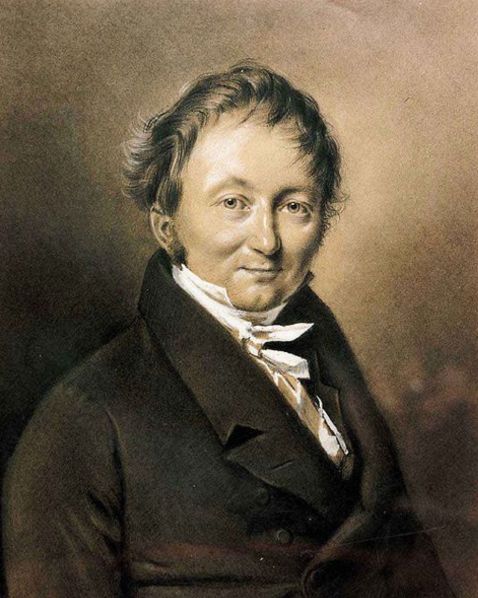
Karl Wilhelm Friedrich Christian Ludwig Drais
With all the soot and ash engulfing Europe, there was one ray of hope to this gloomy disaster. He was a 31-year-old aristocrat, an expert in forestry, an enthusiastic and passionate horseman as well as an avid inventor from Baden, Germany. His name was Karl Wilhelm Friedrich Christian Ludwig Drais, otherwise known as Baron Drais von Sauerbronn. Baron Drais’ beloved horses died from environmental causes from the volcano eruption, and set the Baron on a journey to invent the bicycle.
It’s not known for sure what the impetus was for the Baron to think about the problems confronting the horses, and how those factors affected gentlemen who rode for pleasure. But somehow, his grief from losing his horses, led him to thinking about the basic form of the horse and its accommodations for a rider. He began with experimenting with a wooden and wrought iron frame and a pair of carriage wheels in tandem. The result would be recognized by anyone today as, the ancestor of all bicycles.
“Cycling has done more to
emancipate women
than anything else in the world.” Susan B Anthony
My passion for bikes was passed onto my son. A decade ago, I owned a bright orange Mongoose Mountain bike and my son had his first dream bike he hand-picked from numerous models, a Maverick 18-speed mountain bike, his pride and joy.
When my son went off to college, although he had outgrown the Maverick bike, he wouldn’t part with it and brought it with him to his university. He was heartbroken when it was stolen. I helped him buy another bike which was subsequently stolen. Instead of purchasing another new bike, I gave him my Mongoose Mountain bike to use. Luckily this bike wasn’t stolen but by the time I got this bike back it was trashed from him riding it hard on mountain trails.
I decided it was time to get myself a new bike. I thought long and hard about what kind of bike I wanted and I remembered how much as a kid I loved riding my Schwinn Sting Ray. So began my quest for a Schwinn Sting Ray bike.
My first place to look was Craigslist, but I soon discovered how expensive and how desirable these bikes had become. Craigslist led me to eBay, at which point I learned that a great deal of these bikes where halfway across the country. All I wanted was to find an inexpensive bike that I didn’t have to ship to California from Omaha.
After several days looking on eBay, I discovered eBay Classified, and found a bike located 75 miles from me out in Acton, California.
When I first saw the photo of the bike, I knew instantly the bike was vintage. The funny thing was, it was the spitting image of my bike from the 1960s. After speaking with the owner I found out she had purchased it used in the 1990’s for her daughter and she didn’t know how old it was. It had been in her garage for the past fifteen years. After a long telephone conversation with this nice woman, I decided to make the long drive out to Acton to check out the bike.
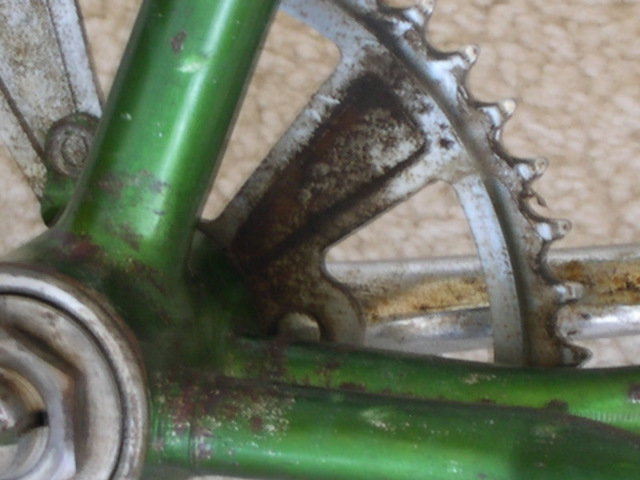
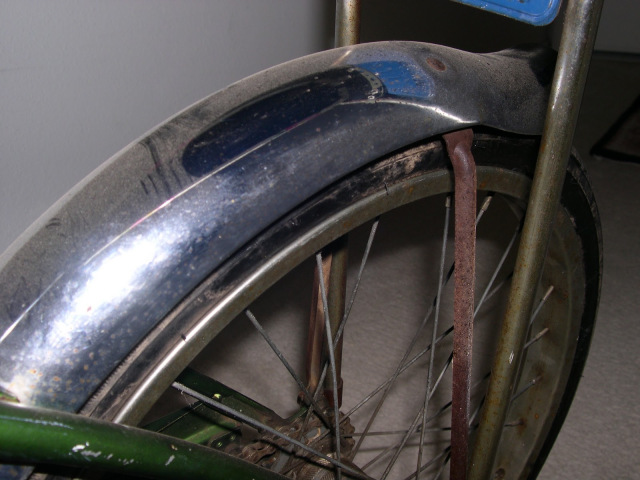
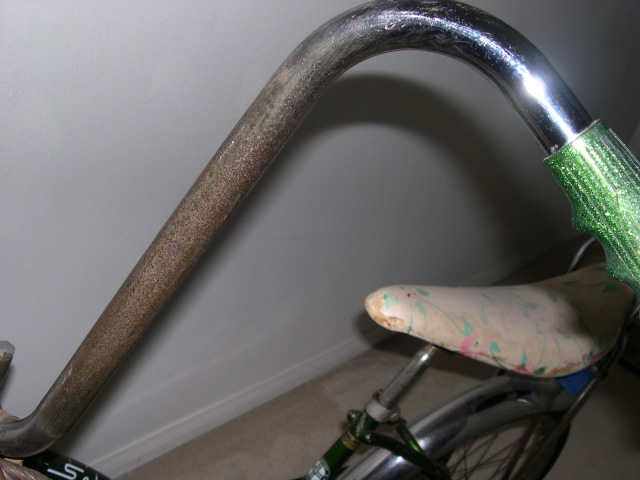
The bike was not in pristine condition, but it was rideable and the price was right, $50. However, when I got the bike home, my husband decided that it needed some major cleaning up. At which point hubby began taking it completely apart and the cleaning and polishing began.
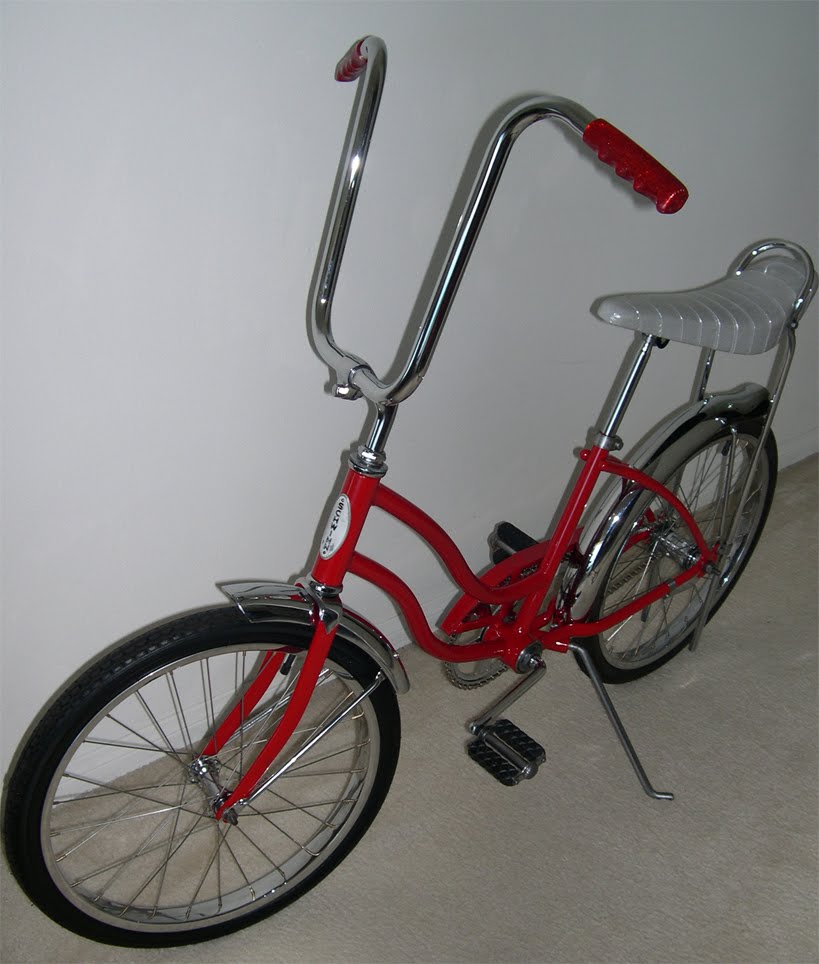
Excited about my new bike I began voraciously researching information about this bike and found websites that allowed me to plug in the serial number and find out the exact month and year it was built. I quickly learned it was a 1969 My Fair Lady model built in August and originally sold in Massachusetts for $49.95.
My husband suggested I call some local bike shops and find a replacement seat for the bike, even though the seat was in good condition.
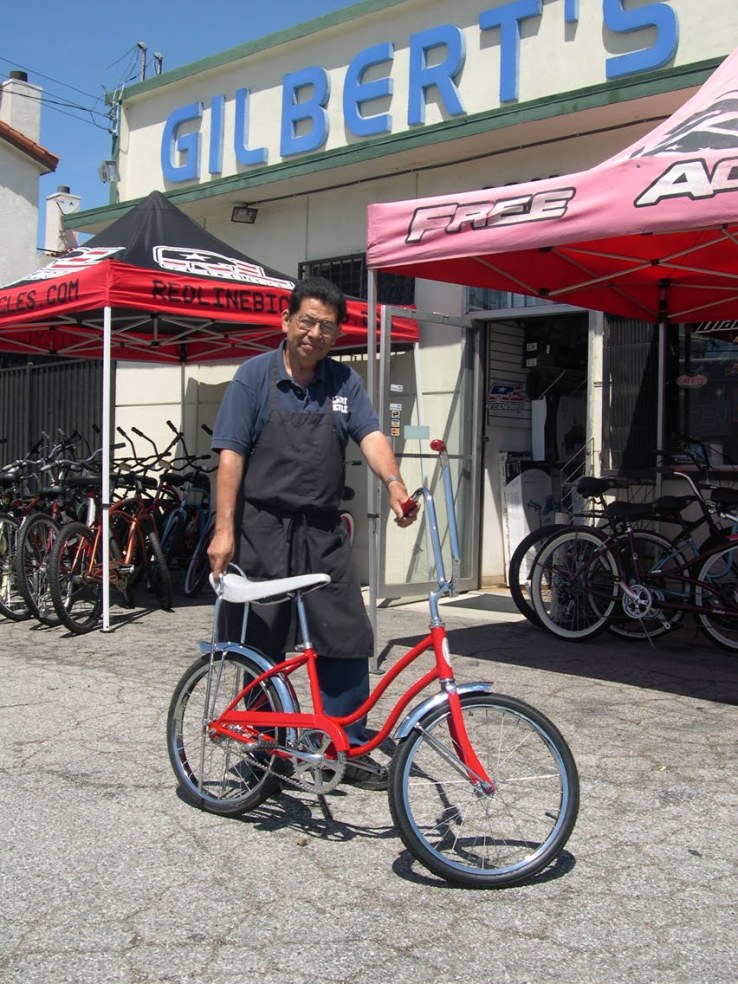
I found a few local bike shops that had Schwinn replica seats. The bike shop I decided to deal with was Gilbert’s Bicycles in Torrance, California. Gilbert, the owner has been in business for over 30 years. He’s extremely knowledgeable about bikes, especially vintage Schwinn bikes. He was also the most personable when I called all the bike shops.
Gilbert’s shop is five miles from me, so I drove over immediately to buy a replacement seat. After speaking with Gilbert and telling him about my purchase, he showed me a vintage Schwinn bike he recently had powder-coat painted. It was a beautiful cobalt blue and the smoothest powder-coat finish I had laid my hands on. He suggested I bring in the frame and he would get me a quote. Meanwhile, I purchased a white sparkle replica seat and returned home to tell my husband about the powder-coated Schwinn.
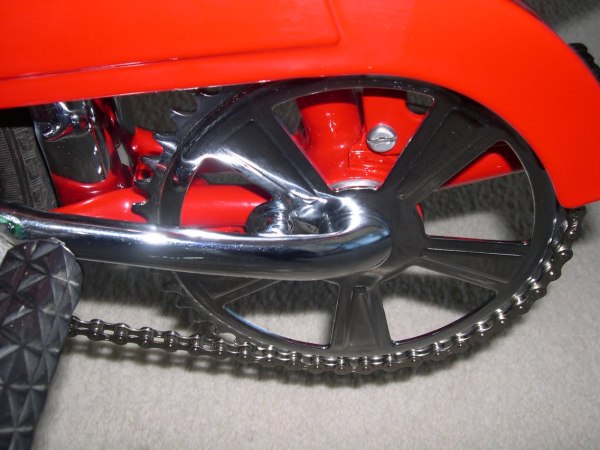
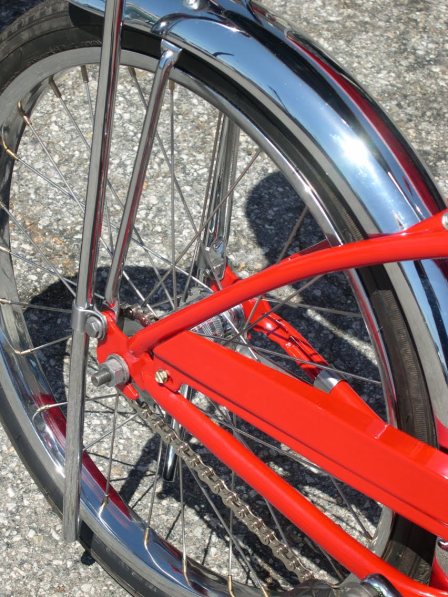
After a week of sanding, soaking and attempts to put back the shine in the Sting-Ray, it became apparent that the bike needed more than a little elbow grease. My husband wanted me to have the bike frame and chain guard powder-coated and have all the chrome redone. So, back to Gilbert I went. At this point, Gilbert and I had become quick friends and he began calling me, Schwinn Lady.
My second trip to Gilbert was to get a price on the powder-coating. After discussing the quote with my husband, we decided to get the frame powder-coated. That led to a third, fourth, fifth and sixth visit which I ended up having Gilbert do the re-chroming of the handle bars, which led to the re-chroming of the sissy bar and fenders, which led to the re-chroming of the crank and the seventh visit was to get the kick-stand, tire rims and spokes re-chromed.
My $50.00 bargain bike quickly turned into a bottomless bike pit. The cost to refurbish my $50 bike ended up costing around $1,000 when the bike was completely restored to better than new condition.
Here’s some before and after photos of sections of the bike:
It took exactly a month of working closely with Gilbert to restore the Schwinn. Most of the restoration was completed by Gilbert or the people that did the re-chroming and powder-coating. However, I am so grateful to my husband for his hard work and determination to help me get the details, such as all the custom screws and bolts cleaned and polished for my bike. We both spent a great deal of time getting the fine details just right. The bike looks better than new and rides quiet and smooth.
On my first hour ride along the beach, I was stopped by several people who were excited to see a restored vintage Schwinn Sting Ray bike they grew up riding. Although it was a pricey endeavor restoring this children’s bike, I would do it all over again. You can’t put a price on the happiness that the bike provides this vintage Schwinn Lady.











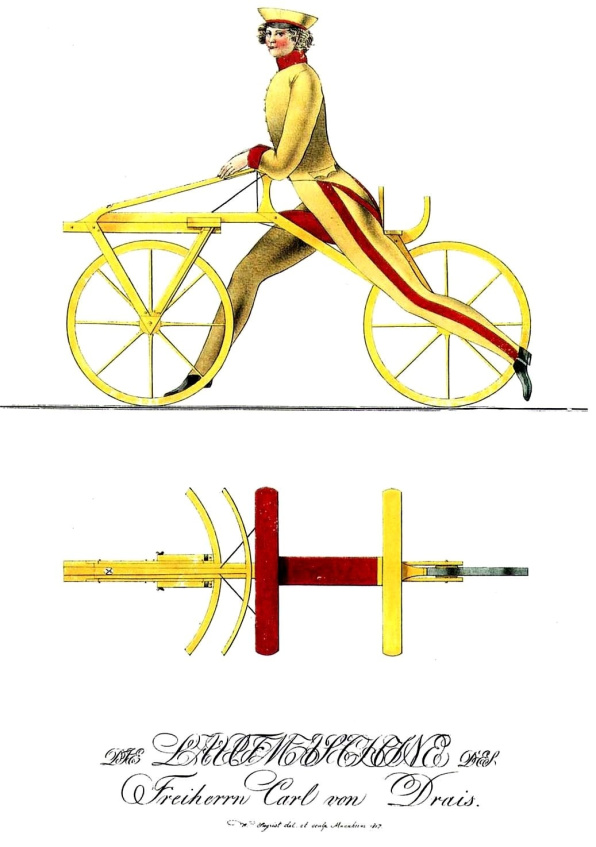 The Laufmaschine name was a bit foreign to British, so they renamed it the “dandy horse”. Before long, every young gentleman who aspired to the dandy ideal owned a dandy horse. A basic dandy horse in 1818 cost the equivalent of about $900 in today’s money, which made it a rather expensive plaything. The best of these were constructed by carriage builders; the more crude ones were cobbled together by blacksmiths.
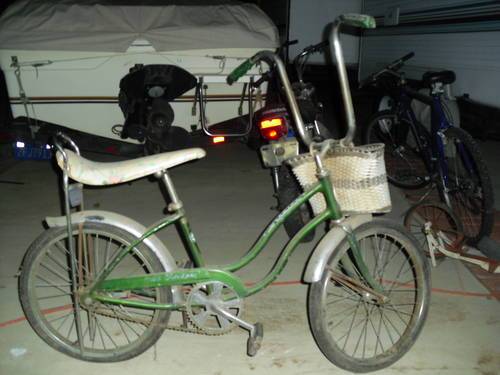 When I first saw the photo of the bike, I knew instantly the bike was vintage. The funny thing was, it was the spitting image of my bike from the 1960s. After speaking with the owner I found out she had purchased it used in the 1990’s for her daughter and she didn’t know how old it was. It had been in her garage for the past fifteen years. After a long telephone conversation with this nice woman, I decided to make the long drive out to Acton to check out the bike.