Bicycles Beginning

“Every time I see an adult on a bicycle,
I no longer despair for the future of the human race.”
H. G. Wells
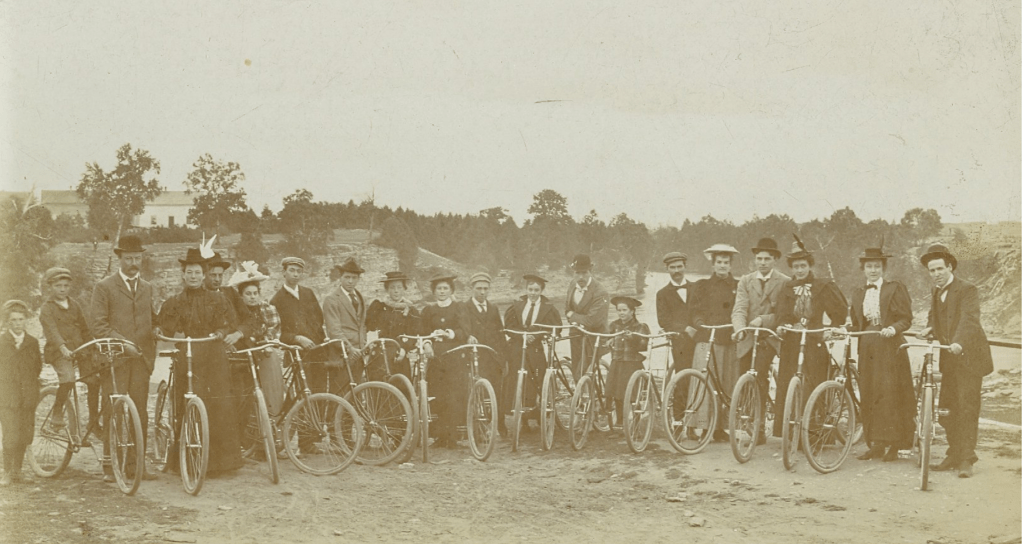

It was the early-18th century in Western Europe when man first began experimenting with human-powered vehicles. In the beginning, these vehicles consisted of four or more wheels and could accommodate up to seven passengers. Much different from carts or carriages, they had handles or ropes for men on foot to push or pull. They were attempts at replacing horses with humans.

Even back in the 1800’s, the purchase of a horse was expensive for the working man. No fit and wealthy gentleman would be without a horse for pleasure riding. They usually had horses for drawing carriages, but most affluent European men owned horses for leisure riding.

That all changed in 1815 when the world was thrown into turmoil. A turmoil not from a war or an economic crises, but because of a small island over six thousand miles from Europe in the South Pacific.

On April 10, 1815, halfway between Asia and Australia, Mount Tambora erupted in Indonesia. It was to become the largest volcanic explosion in recorded history as well as claiming the most fatalities. Mount Tambora’s eruption killed well over 71,000 of its people. This once silent volcano erupted with the power equivalent to 1,000 atomic explosions, blasting about 38 cubic miles of ash, pumice and other matter into the atmosphere.

Ashes reflected the sun’s light and cooled the earth’s surface. Temperatures dropped below freezing in July from Mexico to Vienna. Unexpected snowstorms and rainstorms brought travel to a stop. Farms and grain stores were washed away. Crops failed. Livestock died by the tens of thousands. The world was gripped by the worst famine in a century, and infectious diseases such as typhus was rampant. The year 1816 would become known as “the year without a summer”.
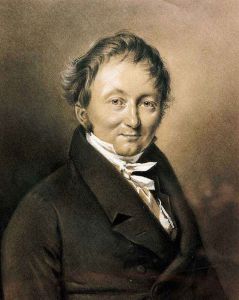
karl-wilhelm-friedrich-christian-ludwig-drais
Karl Wilhelm Friedrich Christian Ludwig Drais

With all the soot and ash engulfing Europe, there was one ray of hope to this gloomy disaster. He was a 31 year-old aristocrat, an expert in forestry, an enthusiastic and passionate horseman as well as an avid inventor from Baden, Germany. His name was Karl Wilhelm Friedrich Christian Ludwig Drais, otherwise known as Baron Drais von Sauerbronn. Baron Drais’ beloved horses died from environmental causes from the volcano eruption, and set the Baron on a journey to invent the bicycle.

It’s not known what the impetus was for the Baron to think about the problems confronting the horses, and how those factors affected gentlemen who rode for pleasure. But somehow, this led him to thinking about the basic form of the horse and its accommodations for a rider in a wooden and wrought iron frame with a pair of carriage wheels in tandem. The result would be recognized by anyone today as the ancestor of all bicycles.

Baron Bike
Baron Drais on his original Laufmaschine, the earliest two-wheeler, Circa 1819

Early in 1817 the Baron built out of cherry tree wood and softwood a “running machine”, which he called a Draisine or a Laufmaschine. The machine was more pony-sized than horse-sized so that the riders feet reached the ground for propulsion.

This early bicycle consisted of a saddle seat, handlebars and a steerable front wheel. Testing and improving it throughout the next few years, the Baron finished his invention and patented the running machine in January of 1818.

Almost overnight the Baron’s Laufmaschine became a sensation. News of the running machine spread westward across Europe. Enthusiasm grew among a small circle of young aristocratic men known as “dandies”. Demonstrating one’s manly abilities was key for “dandies”, and the Laufmaschine was a novelty too challenging and exciting for any dandy to pass up.

First Bike
The Baron’s Laufmaschine displayed at the Kurpfälzisches Museum in Heidelberg, Germany

The Laufmaschine name was a bit foreign to British, so they renamed it the “dandy horse”. Before long, every young gentleman who aspired to the dandy ideal owned a dandy horse. A basic dandy horse in 1818 cost the equivalent of about $900 in today’s money, which made it a rather expensive plaything. The best of these were constructed by carriage builders; the more crude ones were cobbled together by blacksmiths.
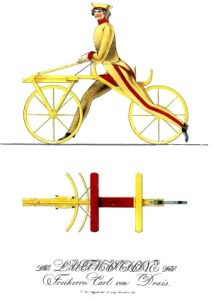
image28
Original Draisine Circa 1817 Made to Order

As quickly as it appeared, the dandy horse disappeared. By 1820, the price of oats was back down to pre-1815 levels, and horses were readily available to those who could afford them. It wouldn’t be until the mid-1860s that someone had the idea to put pedals on the front wheel of a dandy horse, giving it an improved means of locomotion, as well as a scrub brake for the rear wheel; an improvement for stopping over crashing it into a hedge.

So what happened to the Baron Drais? He had the misfortune to belong to the losing political party when the Prussians took over Baden, and he had his title and property stripped; he died penniless and forgotten two years later. But without the Baron and the aristocratic plaything he invented, life might have been very different, and certainly less colorful as the bicycles beginning.

Shine On
Father of the Cell Phone

“An inventor is one who can see the applicability
of means to supply demand five years before it is
obvious to those skilled in the art.”
Reginald Fessenden

Our cell phones have the capability of a supercomputer. They can perform as a cell phone and instantly they are a computer, television, music playing device, camera, video camera, library, GPS, and a gaming system.

What I find interesting is that I use it less and less as a phone. My monthly cell phone bill shows zero actual phone minutes used and thousands of kilobytes used for data.

For example, at the DMV the other day, the line was hours long. So I pulled out my cell phone, and began reading a book from my OverDrive account.

When I looked around the long line of people, I noticed they too were engaged in cell phone activity. I began to wonder, how did cell phones first get started? So, I pulled up Google on my trusted cell phone.

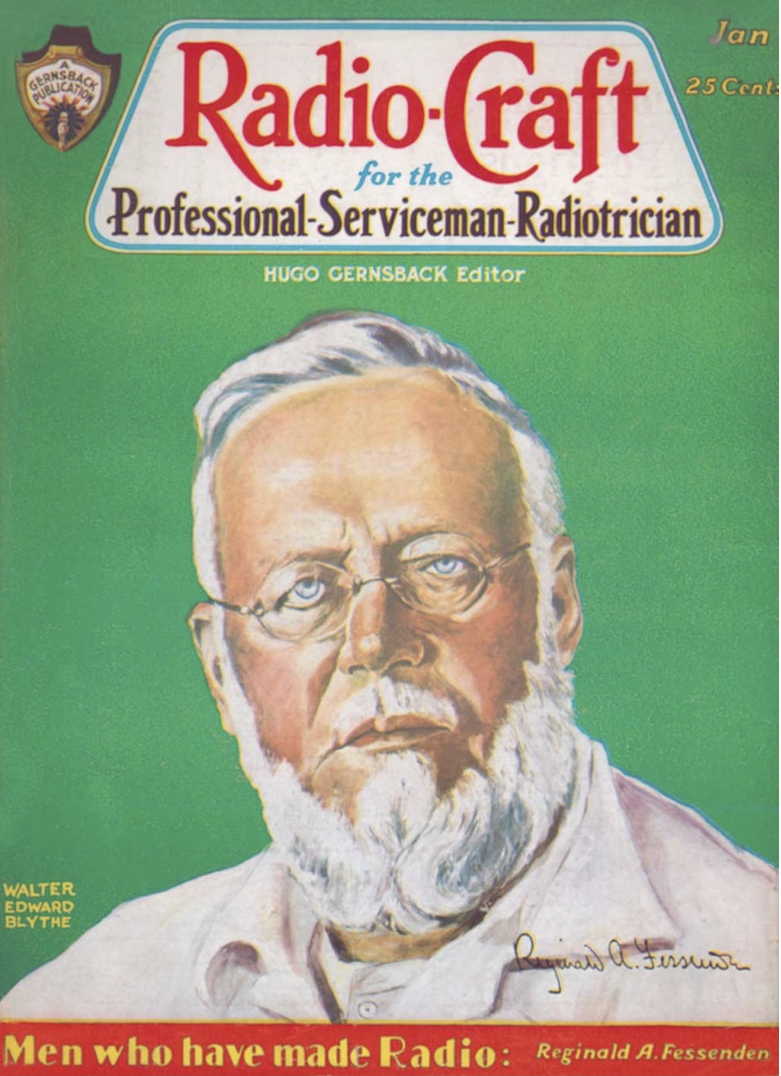
The cell phone dates back to its early inception of the shore-to-ship radio telephony during the Second World War. The inventor, Reginald Fessenden probably never anticipated the huge impact he would have on society. An inveterate tinkerer, Fessenden eventually became the holder of more than 500 patents. His rendition of ‘O Holy Night‘ from a 1906 broadcast was the first coherent audio transmission to be received.

The telephony developed into mobile phones that were first used for automobiles in the 1940’s. The early mobile phones of the 1970’s to the 1990’s were bulky, consumed high power and the telephone network supported only a few simultaneous conversations. The first cell phone I used in 1993 could only be used in the car and was the size of a man’s size 12 shoe.

I wonder how Reginald Fessenden would react to the huge success of his invention? No doubt he would be proud. But, I bet he would of had no idea how far his inventions would take us and that he would become the father of the cell phone.

Shine On

Persistent Illusion


“People like us, who believe in physics, know that the distinction
between past, present and future is only
a stubbornly persistent illusion.”
Albert Einstein

Shine On

Female Nobel Laureates

“Be less curious about people and
more curious about ideas.”
Marie Curie

Yesterday it was announced that Andrea Ghez, UCLA’s Lauren B. Leichtman and Arthur E. Levine Professor of Astrophysics, along with Roger Penrose, and Reinhard Genzel was awarded the 2020 Nobel Prize in physics.

Ghez is the 53rd women to have been awarded a Nobel Prize out of more than 900 recipients. She is also only the fourth woman to receive the physics prize, following Marie Curie in 1903, Maria Goeppert Mayer in 1963 and Donna Strickland in 2018.

Often when we think of female Nobel Prize winners, Mother Teresa, Marie Curie and Malala Yousafzai probably come to mind. But, women who received Nobel Prizes were involved in all sorts of projects, from physics experiments to masterful novels, and they changed how we think about art, animals and the human body.

For example, American public philosopher Jane Addams set out to better the lives of working-class people, immigrants, women and children in a very direct way, and her success was kind of astonishing. She found an old mansion in Chicago, cleaned it up and turned it into a community center. Not your ordinary community center, though: Hull House, as she called it, provided social services, but it also fostered rich debate and research into designing a better society. The environment was meant to encourage democratic cooperation and collective action, rather than individualism. Her work won her the Nobel Peace Prize in 1931.

Throughout history, the scientific and artistic achievements of men have always been renowned and honored by the experts and the public alike. More often than not, women who work as doctors, engineers, writers, and scientists find themselves fighting a seemingly endless battle to gain recognition within their male-dominated industries, sometimes even losing credit for their work in the process. Many of these women had to contend with extreme sexism in male-dominated professions. Some female Nobel Prize winners even had to overcome physical violence. All their stories are unique and equally inspiring.

As of 2020, Marie Curie is the only woman who has been awarded a Nobel Prize twice, one in 1903 and the other in 1911. Whether we realize it or not, these women greatly impacted the World and hopefully more women throughout the World will continue to become female Nobel Laureates.

Shine On

2020 Nobel Laureates

“Justice is to be found only in the imagination.”
Alfred Nobel

Today, the Nobel Prize Awards will begin announcing the winners for 2020. It will kick off with the awards for Physiology or Medicine on Monday October 5, 11:30 CEST at the earliest. Then they will announce the awards for Physics on Tuesday October 6, Chemistry on Wednesday October 7, Literature on Thursday October 8, The Peace Prize on Friday October 9, and then finally the award for Economic Sciences on Monday October 12.

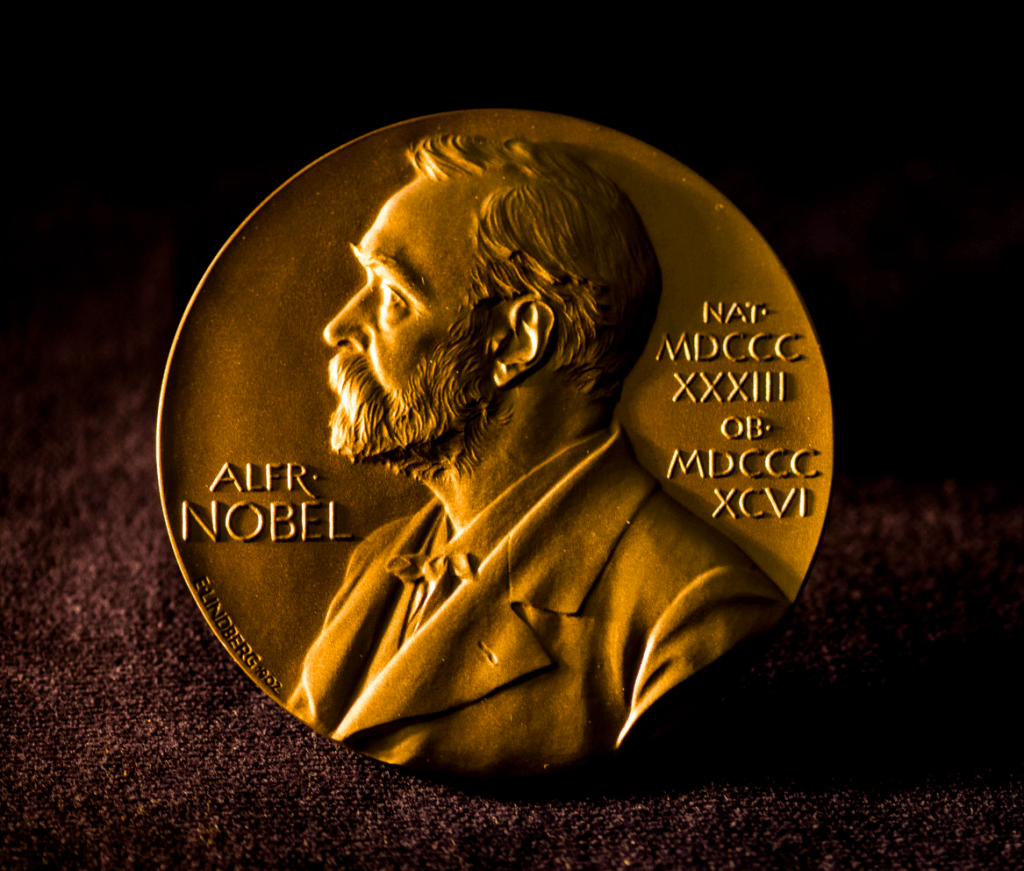
One of the most prestige’s awards in the World, it was established by the late Alfred Nobel, a Swedish chemist and the inventor of dynamite.

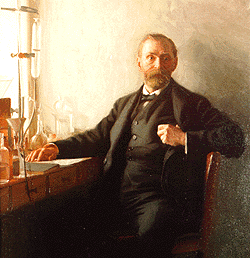
Alfred Nobel was born on October 21, 1833 in Stockholm, Sweden. His father was an engineer and inventor. In 1842, Nobel’s family moved to Russia where his father opened an engineering firm providing equipment for the Tsar’s armies. Around 1850, Nobel’s father sent him abroad to study chemical engineering. During a two-year period, Nobel visited Sweden, Germany, France and the United States. He returned to Sweden in 1863 with his father after the family firm went bankrupt.

While in Sweden, at the age of 30 years old, Nobel devoted himself to the study of explosives. He was particularly interested in the safe manufacture and use of nitroglycerine, a highly unstable explosive. Nobel’s brother Emil had been killed in a nitroglycerine explosion in 1864. Deeply affected, by the death of his beloved brother, Nobel incorporated nitroglycerine into silica, an inert substance, which made it safer and easier to manipulate. This he patented in 1867 under the name of ‘dynamite’. Nobel’s dynamite was soon used in blasting tunnels, cutting canals and building railways and roads all over the world. Nobel went on to invent a number of other explosives.

In the 1870s and 1880s, Nobel built up a network of factories all over Europe to manufacture explosives. Then, In 1888, Nobel’s brother Ludvig died while in France. A French newspaper erroneously published Alfred’s obituary instead of Ludvig’s and condemned Nobel for his invention of dynamite. Provoked by the event and disappointed with how he felt he might be remembered, Nobel set aside a bulk of his estate to establish the Nobel Prizes to honor men and women for outstanding achievements in physics, chemistry, medicine, literature and for working toward peace. 

In 1894, he bought an ironworks at Bofors in Sweden that became the nucleus of the well-known Bofors arms factory. He continued to work in his laboratory, inventing a number of synthetic materials and by the time of his death he had registered 355 patents.

After years of acquiring enormous wealth through his patents and business ventures, in November 1895, Nobel signed his final last will providing for the establishment of the Nobel Prizes. He set aside the bulk of his huge fortune to establish annual prizes in Physics, Chemistry, Physiology or Medicine, Literature and Peace. An Economics Prize was added later.

Nobel died at his home in San Remo, Italy of a stroke on December 10, 1896. After taxes and bequests to individuals, Nobel left 31,225,000 Swedish kronor (equivalent to 250 million U.S. dollars in 2008) to fund the Nobel Prizes.

The first Nobel Prize was awarded in 1901 to Frédéric Passy and Henry Dunant, who shared the Peace Prize award. The official Nobel Prize Award Ceremonies is held every year December 10th.

Each Nobel Laureates receives three things: a Nobel diploma, a Nobel Medal and a document confirming the Nobel Prize amount. The Nobel Prize amount for 2020 is set at Swedish kronor (SEK) 10.0 million per full Nobel Prize. (In US Dollars is approximately, $1,119,278.) Each Nobel diploma is a unique work of art, created by foremost Swedish and Norwegian artists and calligraphers. The Nobel Medals are handmade with careful precision and in 18 carat recycled gold.

In over a century of Nobel Awards, we have seen such people as Marie Skłodowska Curie win for Chemistry and Physics and the youngest to win, 17-year old Malala Yousafzai for Peace. With such a historical year in the World that all of us have been experiencing, I know I’ll be curious to learn who will be the 2020 Nobel Laureates.

 Shine On