Icon of American Art

“People should take time to be happy.”
  Grandma Moses
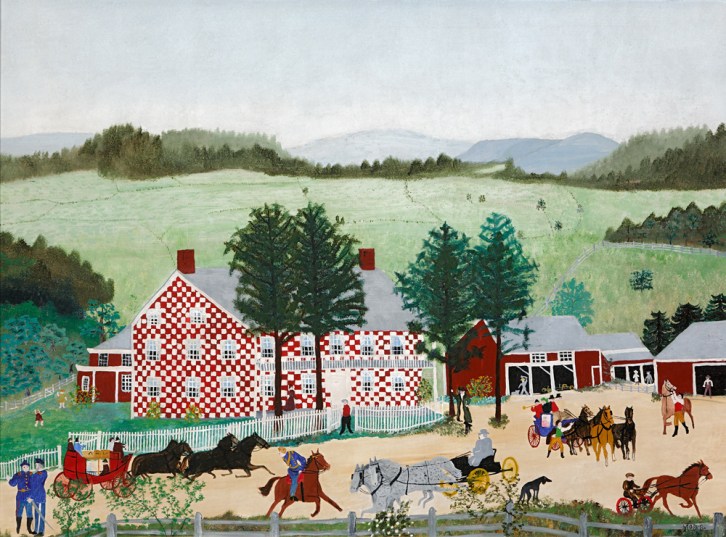
grandma-moses-painting1

The Old Checkered House, 1943 oil on pressed wood


I have quite a few hobbies, but there’s one I really enjoy, drawing and watercolor painting. It’s one hobby that can put me into that zone of a perfect “flow”.

There are many artists I admire and try to emulate. When I started drawing and painting again in my 60’s, my late husband would kid me about becoming the next Grandma Moses. I always admired her recognizable Naïve art style, but knew little about the woman, so I read her 1952 autobiography.

Anna Mary Robertson Moses, known throughout the world as “Grandma Moses” was born September 7, 1860 in Greenwich, New York. In her 101-year life span, she witnessed the Civil War, a pandemic, two World Wars, the advent of the telegraph, the telephone, automobiles, airplanes and countless other innovations. She had always dabbled in the field of art all her life but it was only after all 10 of her children were grown and the burden of farm life lifted, did she begin painting full time.

Her life is really the story of twentieth-century folk art. Although she was not the first folk artist, she was the most well known throughout history and the world. How did she come to be so revered? The answer would appear to lie in a combination of factors. The nature of the field, the personality of the artist, and timing, which we all know is everything.

She had just turned 80 when in the 1940s Americans were reeling from the effects of a prolonged financial depression and filled with dread of rising fascism in Europe. In this time of tribulation, she emerged as an artist whose work embodied everything that seemed good about America.

She painted scenes of the farms and small towns that were then either the present or the near past for many citizens. She proclaimed the virtues of family, church, community and the nation at a moment when these were under attack from without and within, and she lived these virtues. Her basic honesty, generosity and good-heartedness shined forth both in her life and in her art.
grandma-moses-life-cover

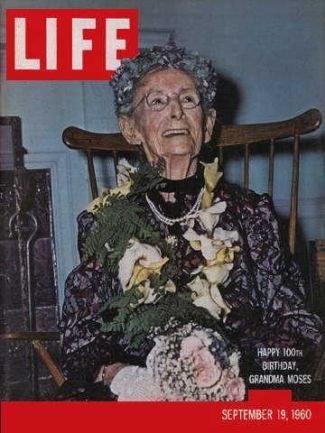
When her paintings began to sell for sizable sums, she became the first artist whose work was routinely licensed for such products as greetings cards, textiles, and the like. In 1953 she appeared on the cover of Time magazine. In 1955 she was interviewed on live television by Edward R. Murrow. Then, for her 100th birthday on September 19, 1960, Life magazine did a cover story to celebrate this remarkable woman.

Grandma Moses passed away on December 13, 1961, at the age of 101, having witnessed a broad swath of American history. She was born the year Lincoln was elected, and died while Kennedy was president.

Both her work and her legend endures here and abroad. This reflects not only the quality of her work but also the fact that she remains an icon of American art.

Shine On

A Magical Place to Live

“Life is like a landscape.
You live in the midst of it
but can describe it only
from the vantage point of distance.”
Charles Lindbergh

magical-place-to-live

Over three hundred years ago the Chowigna Indians lived along the fertile land in Redondo Beach. They lived off the rich soil and fishing the ocean. There was an abundance of fish such as halibut, lobster, and sea bass.

Then in 1854 the Chowigna were sent off to missions and the wealthy Manuel Dominguez sold Redondo Beach to Henry Allanson and William Johnson. These two men saw the possibilities that Redondo would hold. In 1892, Redondo Beach was incorporated and became a major tourist attraction for all walks of life.

Redondo was once described as “The Gem of The Continent” in the Los Angeles Daily Herald newspaper. Through the years famous attractions such as the Redondo Hotel have long disappeared. They say the Redondo Hotel induced more visitors than ever before to venture to the coast.

During prohibition the Hotel Redondo closed its doors and in 1925 was sold for scrap lumber. Big time gambling, complete with mobsters and shooting incidents, found its way to Redondo during the Depression. Chip games, bingo parlors, and a casino were run in full view of the law between 1936 and 1940. For a fare of 25 cents, a water-taxi would transport a visitor to the gambling ship Rex which operated three miles off shore.

chaplinThroughout its history famous people have flocked to Redondo Beach. During the silent film era, actor Charlie Chaplin was often seen visiting Redondo and even bought a beach cottage for his beloved mother. Charles Lindbergh attended a year of high school at Redondo Union as well as Demi Moore and the Smothers Brothers.  Residents included world famous athletes, authors, an atomic scientist, astronaut, and even a Nobel Prize winner. Redondo Beach is home to beach volleyball Gold Medalist Kerri Walsh.

Hollywood also fell in love with Redondo. Numerous films and television shows have been filmed in Redondo Beach and it continues to be a favorite Hollywood location. Who doesn’t remember the desired destination of the road-tripping family in the 2006 movie “Little Miss Sunshine”.

There have been a few songs written about Redondo Beach, such as Patti Smith’s song “Redondo Beach” and the song, “Surfin’ U.S.A.” by The Beach Boys even gives Redondo a call out.

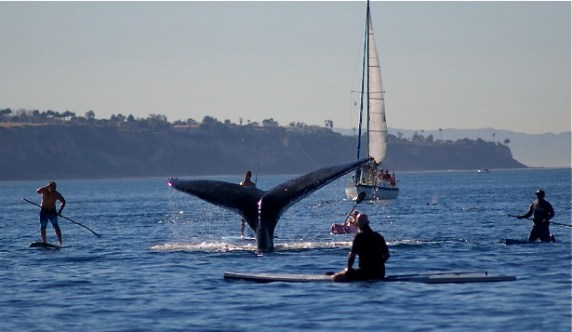
redondo-gray-whales
Yes, Redondo Beach has quite a history. Before moving to Redondo Beach over a decade ago, I didn’t know its history or anything about Redondo. All I knew was that it is utterly beautiful, it has ideal weather and the clean air helped me decide this is where I wanted to live. For me, Redondo Beach will always be such a magical place to live.

Shine On

Our Furtive Foxy Friend

“A fox is a wolf who sends flowers.”
Ruth Brown


The Fox

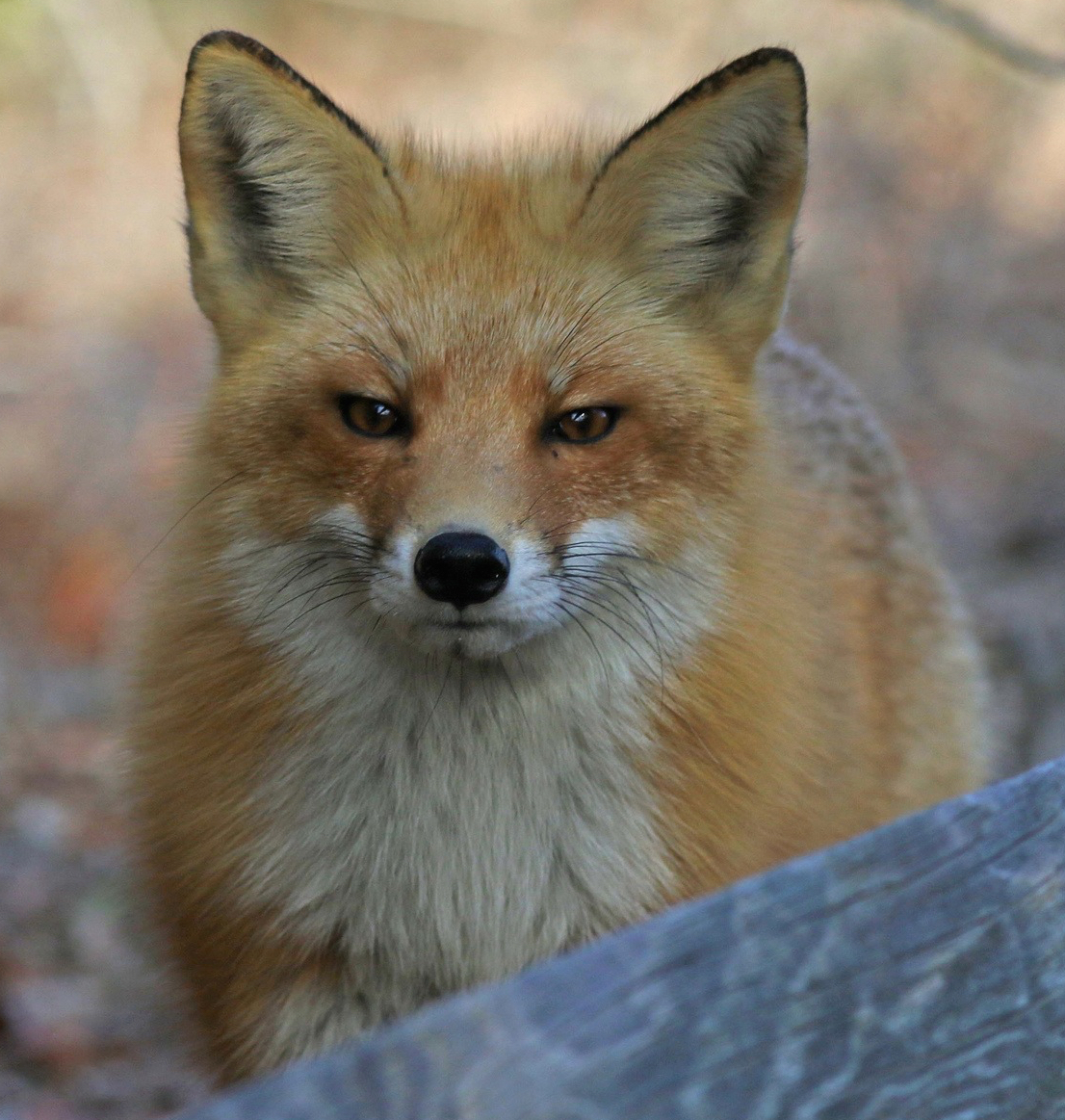
The North American Red Fox aka the Vulpes vulpes

Around dusk this past evening, I was on my walk and saw what appeared to be a fox. We have lots of coyotes roaming the city, but a fox? I must have been mistaken.

It piqued my curiosity, so I did a little research about the fox. I found out some interesting facts about foxes on a California website.

The fox, the smallest member of the dog family, is a highly adaptable species that inhabits mostly forest, chaparral, and desert regions, but can be found in nearly all habitats. There are three types of fox common to Southern California, including the Gray Fox, Red Fox, and Island Fox. The Southern California Kit Fox, a subspecies of Kit Fox, died out in Southern California in 1903.

Foxes are more solitary in their habits than are others in the dog family. They are territorial and can be aggressive, especially during the breeding season. Their once-a-year breeding season corresponds with the availability of food.

Despite the fact that urban foxes use human buildings for shelter and human refuse for food, their contact with humans is quite limited. Most people who live in an urban area have never seen a fox in the city. Foxes keep a nocturnal schedule, and in the nighttime are often mistaken for dogs when they are seen.

Red Foxes, the most commonly recognized fox, are known for their cleverness and have the largest range in North America. Although they are close relatives of the Gray Fox, they are considerably larger, normally ranging in size from ten to fifteen pounds. Their coats may be reddish or gray or even black, but their legs and feet are always black. The tail is tipped with white.

In California there are two populations of Red Fox- the native Sierra Nevada Red Fox, a threatened species found only in the Sierra Nevada and Cascade mountain ranges, and the more common, non-native Red Fox. Non-native Red Foxes were introduced decades ago for fox hunting and fur farming. Over time, these foxes escaped or were released. Their populations have grown and gradually spread. Currently, they have been spotted throughout the lowland areas of California including the Sacramento and San Joaquin Valleys, San Francisco Bay-Delta area, the Southern California Coast Range and Coastal Plain and in most major urban areas.

Socially, the fox communicates with body language and a variety of vocalizations. Its vocal range is quite large and its noises vary from a distinctive three-yip “lost call” to a shriek reminiscent of a human scream. It also communicates with scent, marking food and territorial boundary lines with urine and feces.

Now after reading about the fox, I’m positive it was a fox that I saw. I know it wasn’t a dog, because it had all the mannerisms of a fox.  Plus, when the fox saw me, it gave me that look that only can be given by our furtive foxy friend.

Shine On

Little Shop of Horrors

“I perhaps owe having become a painter to flowers.”
Claude Monet


Spring Has Sprung
I love flowers. All kinds of flowers. My favorites are the daffodil, peony, tulip, carnation, daisy, and of course the rose.

Last year for Mother’s Day, my son gifted me an orchid plant.

Not having any knowledge of orchids, I did some research, so that this beautiful flower would keep its bloom as long as possible. On the web site “Caring for your orchid dot com”, they suggested not to over water the plant, and to find a perfect spot where the plant would thrive.

I must be doing something right, because to my surprise, the blooms on the orchid lasted for several months. After the pedals all fell off, it lay dormant for about seven months. I continued to keep it watered while new leaf growth appeared. Suddenly two weeks ago I noticed a new bud on the orchid. The other morning when I got up, I was excited to see that a beautiful flower had unfolded over night.

The detail on this flowering orchid was so unusual that I took some photos. There’s a feature on the flower I never noticed before. It looks as though it has two bottom teeth. I’m assuming this is a common feature. If not, I might have to name the plant, Audrey III, from Little Shop of Horrors.

Shine On